Everyone is watching the robot’s brain and its body. The money is quietly moving to its eyes.
The same stack appears in Atlas’ factory validation path and in the hands-and-actuators bottleneck. A concrete camera baseline is Luxonis’ OAK4 platform specification, not a vendor-level market-share claim.
Two funding rounds nobody outside robotics noticed
Two funding stories, one pattern. Luxonis, the Denver-based company behind the DepthAI platform and OAK camera family, closed a $14 million Series A on July 2, 2026, led by Denali Growth Partners with Taiwania Capital participating — its first institutional round after seven years building the company, DepthAI’s SDK now at 6 million downloads and a customer list the company says includes 60-plus Fortune 500 names. And RealSense — which spun out of Intel in July 2025 with a $50 million Series A — announced a strategic collaboration with NVIDIA around Jetson Thor, Isaac Sim, and Holoscan on August 25, 2025.
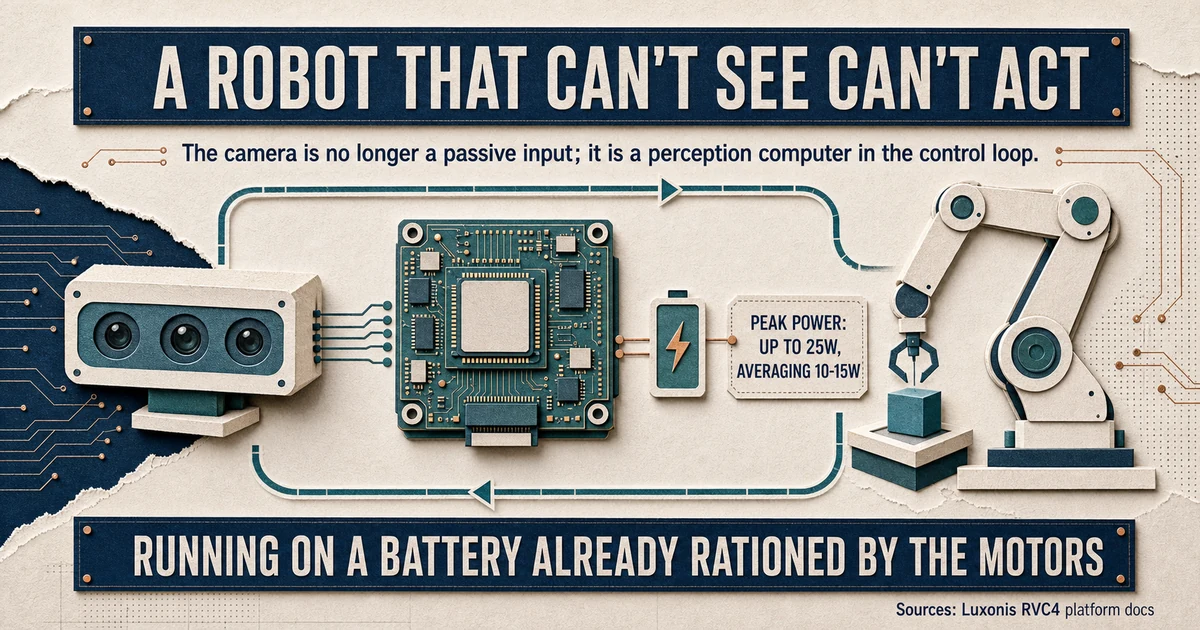
Neither company builds humanoids. Both sell the layer that lets robots understand the physical world — and the hardware says how serious that layer has become. Luxonis’s OAK4 line is a standalone AI vision system built around Qualcomm’s QCS8550, with PoE and, on most models, IP67 protection — the OAK-4-CS reaches that rating only with its lens hood fitted, IP65 without. Qualcomm’s own spec for the chip is 48 TOPS; Luxonis quotes 52, a module-level sum of the chip’s 48 INT8 neural-network TOPS and 4 more FP16 TOPS from a separate graphics block bolted on beside it — two different circuits doing two different kinds of math, added together for the marketing sheet. The camera is no longer an image input; it is a perception computer, and like any computer it has a power bill: Luxonis rates the platform at up to 25 watts at peak, averaging 10 to 15 watts, on a machine that may be running from a battery already rationed by its motors.
RealSense makes a bolder claim, though its own paper trail is less tidy than that claim suggests: its July 2025 release states its depth cameras are “embedded in 60% of the world’s AMRs and humanoid robots” — one figure covering both categories, not two. The 60/80 split first appears in an October 2025 Business Wire package and is repeated at CES 2026. No RealSense document names a denominator, an as-of date, or whether the count is shipped cameras, designed-in models, or robot SKUs. Treat those as company claims, not verified market share.
A robot that can’t see doesn’t get to use its brain
The useful frame is the stack. A robot is not a product; it is layers:
- Models & planners — VLA systems, foundation models, task reasoning
- Perception — cameras, depth, calibration, edge inference, middleware
- Body — motors, actuators, grippers, batteries
- Deployment — safety, field testing, workflow, maintenance
Two years of coverage have gone to layers one and three — better robot brains, better humanoid bodies, better motion demos. But the best model is limited if the robot cannot reliably see. A robot that misreads depth, loses calibration, or fails under hard lighting is not deployment-ready, however impressive its demo reel.
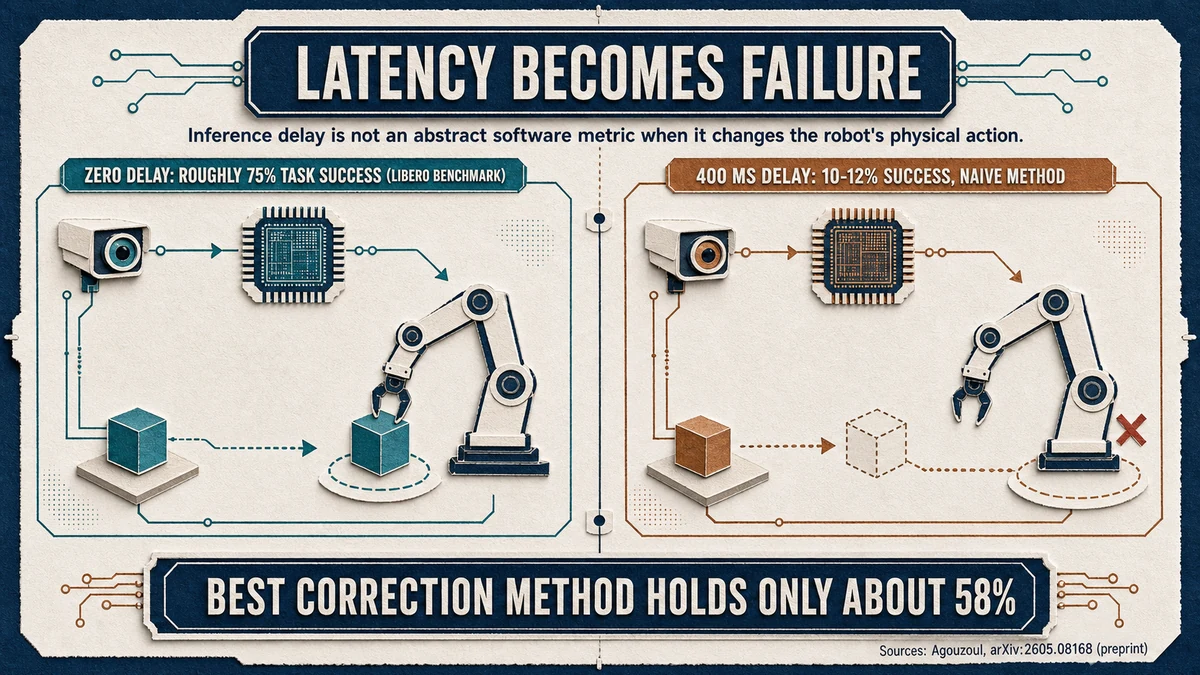
And vision in the field is a live physical problem. Lighting changes, objects overlap, humans cross the scene, floors reflect, robots vibrate. A useful perception system estimates depth, tracks objects, maps reachable space, and feeds a control loop at low enough latency to matter — and that latency has a measured cost. A 2026 preprint on vision-language-action robot policies, not yet peer reviewed, found that at zero delay a strong control method solves roughly 75% of a standard 40-task manipulation benchmark; introduce 400 milliseconds of inference lag, ordinary for a camera doing real work, and the naive version of that same method collapses to 10-12% success, with even the best correction method holding only around 58%. Four hundred milliseconds is not a dramatic failure. It is the gap between a functioning robot and a demo.
The failure is not exotic, either. A peer-reviewed dataset built specifically to document it — 57,715 RGB-D images across 130 scenes, captured on RealSense’s own D435 and L515 cameras — exists because ordinary depth sensors routinely misread a glass beaker: light reflects and refracts through it, and the camera reports the wrong shape or no shape at all. A learned correction layer recovers an 80% real-world grasp success rate on the objects that beat it. The fix is a smarter perception stack, not a better lens, which is exactly the business these two funding rounds are betting on.
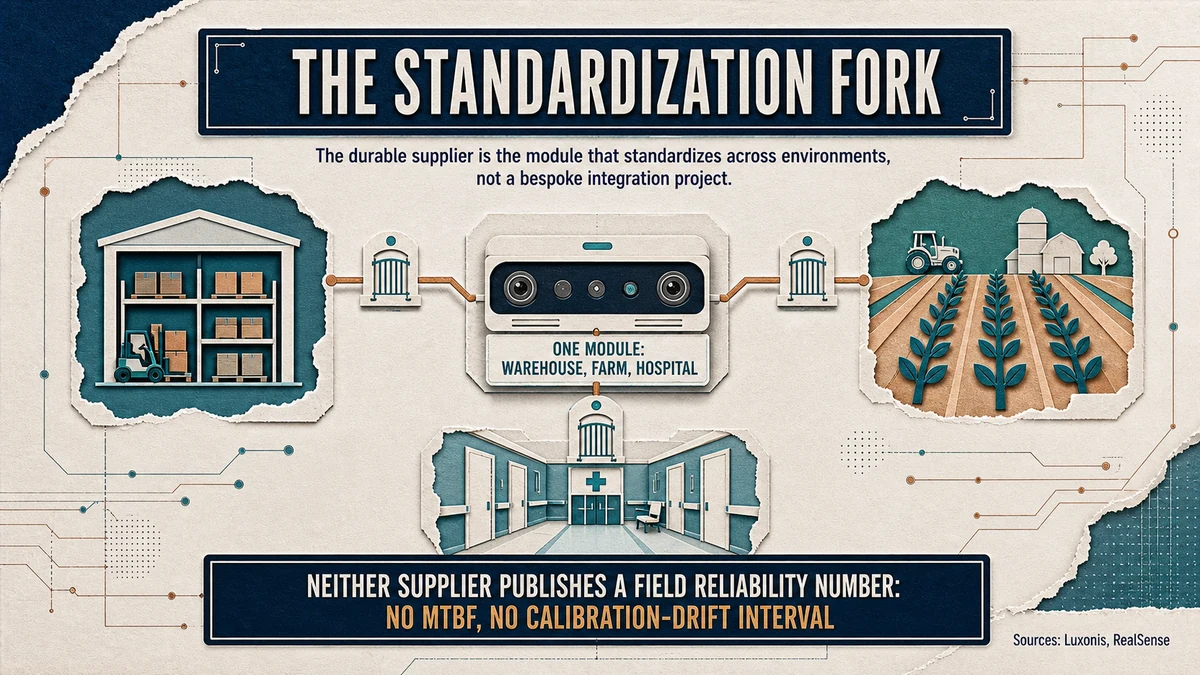
The honest uncertainty: this layer may not stay external. If large humanoid companies reach scale, they may pull cameras and sensors back in-house, turning today’s perception vendors into bridge technologies. Standardization is the fork — modules that work across warehouses, farms, and hospitals make a durable business; bespoke integration projects do not.
The layer is more crowded than two funding rounds suggest
A $14 million Series A reads differently once the rest of the layer is on the page. Basler, the German machine-vision maker, is put at roughly $370 million in industrial machine-vision revenue for 2025 by market-research estimate — about twenty-six times the entire Luxonis round, in a business it has run at an estimated 17% EBITDA margin. SICK AG sells vision sensors, smart cameras and 3D vision cameras onto the same factory and logistics floors through an automation business that predates the humanoid category entirely. Neither is a robotics startup, and both already sit where an integrator goes shopping.
The newer entrants matter more, because they are chasing the same design wins with the same story. Orbbec’s Gemini 330 stereo cameras are integrated with NVIDIA Isaac Perceptor, the reference workflow for autonomous mobile robots; the company is an NVIDIA Partner Network Preferred Partner, announced Jetson Thor compatibility at CES 2026, and co-developed a dev kit with NVIDIA built on AGX Orin and its own cameras. That is the same shape of platform relationship RealSense announced in August 2025 — which means the NVIDIA collaboration, on its own, does not separate one supplier from another. A platform that has blessed several camera vendors has not yet chosen a standard.
Consolidation has already started. Stereolabs, whose ZED stereo cameras are widely used in humanoid research, was acquired by the lidar maker Ouster in February 2026; the combined company shipped a wrist-mounted ZED X Nano for robotic manipulation in May. For one of the field’s best-known camera names, the question of whether the perception vendor stays independent is already answered.
And beneath all of them sits a far more concentrated layer. Sony Semiconductor Solutions held roughly 43% of the CMOS image-sensor market in 2025 by one market-research estimate, with Sony, Samsung and OmniVision together taking about three-quarters of revenue. Luxonis, RealSense, Orbbec, Stereolabs and Basler are not competing on the sensor; they buy from the same short list. What they add sits in the millimetres between that sensor and the robot’s control loop — depth, calibration, timing, on-device inference — which is exactly the ground NVIDIA’s platform is also reaching down into. A supplier squeezed between concentrated sensor supply below and a platform above that picks its own reference designs has a narrower path to becoming the standard than a funding announcement suggests.
What the camera makers won’t say
Behind the loud humanoid race, someone is standardizing the robot’s eyes — and in early hardware waves, the supplier layer tends to make money before the product category matures. What neither supplier publishes is more telling than what they do. Search both companies’ newsrooms and product documentation and there is no field reliability figure for either camera line: no mean time between failures, no calibration-drift interval, no recalibration schedule, no return rate. Luxonis rates its hardware for vibration up to a 2,000 Hz band and 30 G of shock and calls that IP67-qualified; those are bench tests, not a number for how a camera performs after a year on a moving robot. Neither company publishes the one figure that would actually settle deployment readiness: how much time elapses, camera glass to robot movement, in a working system. The vertical-integration risk is real, and it would show up first as silence — if large humanoid makers plan to build their own eyes in-house, the two suppliers now setting the standard have every reason not to publish the number that would let a customer compare.
That uncertainty stands regardless. But a robot cannot act in a world it cannot reliably see, which makes perception the quietest layer with the strongest claim on the stack, and right now the strongest claim on that layer is the only one with real evidence attached.
That is a claim about a layer nobody has priced yet, so it deserves a way to be wrong. Four things would do it.
- Tesla builds its own eyes. Tesla designs its own vehicle camera hardware, and on the hand it redesigned Gen 3 and relocated the actuators rather than buying a module. If a teardown or company statement confirms an in-house depth or tactile sensing module inside a production Optimus, the vertical-integration risk described above stops being a hypothesis, and the merchant camera layer’s ceiling is set at the customers who cannot afford to build their own.
- Figure names its camera. Figure runs the most-watched paid humanoid deployment and publishes almost nothing about its sensors. A disclosed Luxonis, RealSense, Orbbec or Stereolabs part in a production Figure robot would give the merchant-supplier case its first named production reference. A disclosed in-house stack would cut the other way just as cleanly.
- NVIDIA stops hedging. Isaac Perceptor currently ships reference workflows with more than one camera partner. If NVIDIA’s documentation, dev kits and default configurations converge on a single depth-camera family, that vendor becomes the de-facto standard whatever its funding round says; if the partner list keeps growing instead, nobody owns the layer and margin stays compressed.
- Logistics repeats a choice. Warehouse and third-party logistics operators replace fleets on multi-year cycles and disclose little. The test is repetition, not a single win: the same camera family appearing in new models from two or more distinct AMR makers, visible in spec sheets, filings or teardowns. One design win is a sale. The same part in three robots is a standard.
Each of those is falsifiable, dated and public. If none of them resolves by early 2027, the honest reading is that this layer is still too early to call a winner in — which would itself be the finding.
Sources
- Yahoo Finance (Luxonis release) — Series A of $14 million led by Denali Growth Partners; 6 million DepthAI SDK downloads; 60+ Fortune 500 customers (2026-07-02)
- RealSense — Intel spin-out, $50 million Series A; depth cameras ’embedded in 60% of the world’s AMRs and humanoid robots’ (one figure, not a 60/80 split) (2025-07-11)
- RealSense — NVIDIA collaboration around Jetson Thor, Isaac Sim and Holoscan Sensor Bridge, announced San Francisco (2025-08-25)
- Qualcomm — Dragonwing QCS8550 product specification: 48 TOPS (footnoted ’48 Dense TOPS’) (2026)
- Luxonis — RVC4 platform: NPU 48 INT8 / 12 FP16 TOPS, GPU 4 FP16 TOPS (the components of the ’52 TOPS’ figure); power envelope up to 25W peak, 10-15W average (2026)
- Fang et al., TransCG (arXiv:2202.08471) — Peer-reviewed (IEEE RA-L): 57,715 RGB-D images across 130 scenes on RealSense D435/L515 cameras document transparent-object depth failure; 80.4% grasp success with a learned correction layer (2022)
- Orbbec — NVIDIA Partner Network Preferred Partner; Gemini 330 stereo cameras integrated with Isaac Perceptor; Jetson Thor compatibility announced at CES 2026; Orbbec Perceptor Dev Kit co-developed with NVIDIA on AGX Orin (2026)
- Ouster — Acquisition of Stereolabs, fusing Ouster digital lidar with ZED stereo cameras for robotics and humanoid perception (2026-02-09)
View all sources
- Luxonis — OAK4 product line: PoE, IP67 (qualified per model), published depth-error and range specifications (2026)
- Luxonis — IP rating detail: OAK-4-CS reaches IP67 only with its lens hood fitted, IP65 without (2026)
- RealSense — CES 2026 release repeating the 60%/80% claim with no denominator or audit stated (2026-01-05)
- Agouzoul (arXiv:2605.08168) — Preprint, not peer reviewed: measured control-loop success under inference delay on the LIBERO benchmark (2026-05-04)
- Orbbec (PR Newswire) — Gemini 330 series integrated with NVIDIA Isaac Perceptor for AMR 3D reconstruction and obstacle cost maps
- Ouster — ZED X Nano wrist-mount stereo camera for robotic manipulation and imitation learning, announced April 2026, shipping May 2026 (2026-04-13)
- Mordor Intelligence — Market-research estimate, not audited disclosure: Sony ~43.4% of CMOS image sensors in 2025; Sony, Samsung and OmniVision together ~74% of revenue (2026)
- MarketsandMarkets — Market-research estimate, not company disclosure: Basler industrial machine-vision revenue ~$370 million for 2025 at an estimated 17% core-camera EBITDA margin; machine-vision camera market $6.73bn (2025) to $10.19bn (2030) (2026)
This article is for information and industry analysis only. It is not investment advice. Company-provided adoption figures should be read as source-specific claims, not independent facts.