Nemothia dwarf AI researcher standing between a coding agent dashboard and a security trust layer
The Claude Code controversy is a developer-trust story as much as a model-distillation story.

One-Minute Brief

  • Alibaba has reportedly told employees to stop using Anthropic’s Claude Code, with the internal ban set to take effect on July 10, 2026. The immediate trigger is a security controversy: reports and a widely discussed Reddit post alleged that Claude Code contained logic that could flag China-linked users through signals such as proxy configuration, timezone, and subtle changes in the system prompt.
  • That is why the story spread quickly across developer communities. It is not just another company blocking a foreign AI tool. It touches developer trust, enterprise security, China access restrictions, and the economic pressure around model distillation.
  • My view is straightforward: the surface story is “spyware.” The deeper story is that frontier AI companies are trying to defend models whose value can leak through ordinary usage. Anthropic can describe the code as anti-abuse and anti-distillation tooling. Alibaba can describe the same mechanism as a trust violation inside a coding agent. Both readings explain part of the dispute.
  • The caveat matters. Anthropic’s allegations about Alibaba-linked distillation activity are still allegations, not independently proven public facts. And the Reddit reverse-engineering claims should be treated as community evidence unless confirmed by a formal technical audit or official disclosure.

What Happened

The most concrete change is Alibaba’s reported internal policy. TechCrunch reported on July 4, 2026 that Alibaba would ban employee use of Claude Code starting July 10 and point staff toward its own coding tool, Qoder. Times of India, citing Chinese publication Yicai and other reporting, described Claude Code as being added to a restricted-software list after internal security concerns.
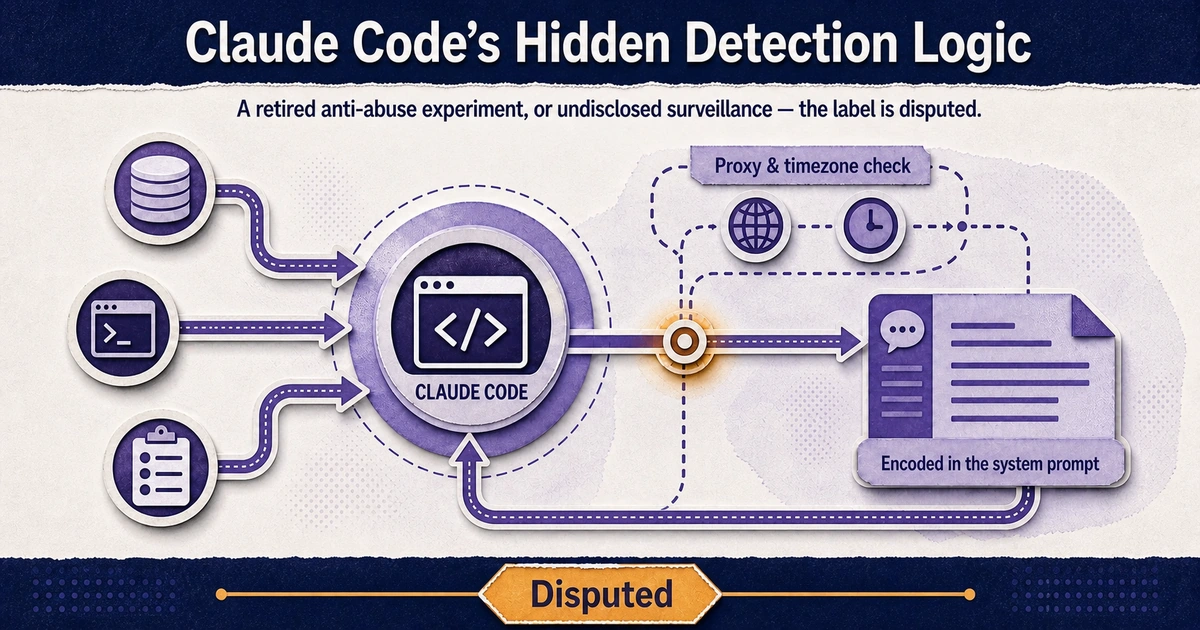
The second change is the public exposure of a detection mechanism inside Claude Code. The Decoder reported that Claude Code had included code that could flag users based in China or linked to a Chinese AI lab. A Reddit post in r/ClaudeAI made the sharper claim: since version 2.1.91, released on April 2, 2026, Claude Code checked proxy and timezone signals and encoded the result through small differences in the system prompt.

Anthropic’s Thariq Shihipar said on X, according to TechCrunch and The Decoder, that the mechanism was an experiment launched in March to prevent account abuse, unauthorized reselling, and distillation. He also said stronger mitigations had since been added and that the older mechanism had been scheduled to come down. Public reporting does not, by itself, prove every implementation detail of the removal.

Those details make this more than a privacy headline. The tool at issue is a coding agent. Developers often connect coding agents to local repositories, project context, terminals, issue trackers, and sometimes deployment workflows. That makes hidden detection logic feel more sensitive than ordinary web telemetry.

Why It Matters

Why this is drawing attention now

The timing is the first reason. TechCrunch reported the Alibaba restriction on July 4, 2026, and the reported effective date was July 10. That gave the story a near-term hook: a major Chinese technology company was reportedly changing its employee software policy within days.

The second reason is the path of the story. It started in a developer community, moved into technical reverse-engineering debate, and then reached mainstream technology outlets such as TechCrunch, The Decoder, Financial Times, Times of India, and Business Insider. That path matters because it joined two audiences that usually react for different reasons: developers worried about tool transparency, and policy/business readers watching the US-China AI split.

The third reason is that Claude Code is a symbolic product. It represents the shift from chatbots to agentic developer tools. If a normal chatbot checks geography, users may dislike it but understand the category. If a coding agent with local context and command-line access appears to contain hidden user-classification logic, the trust calculation changes.

Personally, I read the attention less as a simple China-versus-US story and more as a sign that developers now treat coding agents as infrastructure. The combination of Claude Code, Alibaba, distillation, the spyware narrative, and China gives the topic unusual search and media gravity.

That is why the debate is noisy. Some users see ordinary anti-abuse telemetry. Others see hidden surveillance inside a powerful developer tool. A more grounded reading is that the same mechanism can be operationally understandable and still damaging to trust if it was not disclosed clearly.

Abstract AI operations room showing a developer forum controversy spreading into global media and enterprise policy
The story moved from developer reverse-engineering debate into global AI policy coverage.

The surface reading: “Anthropic got caught spying”

The easiest version of this story is that Anthropic embedded spyware, Alibaba found out, and China pushed back. That version is clickable, but it is too flat.

There is a real trust issue here. If a developer tool quietly inspects proxy and environment signals and transmits a classification back through prompt-level markers, users are right to ask why that was not disclosed more plainly. Obfuscation, even when used for anti-abuse purposes, makes a security-sensitive audience more suspicious.

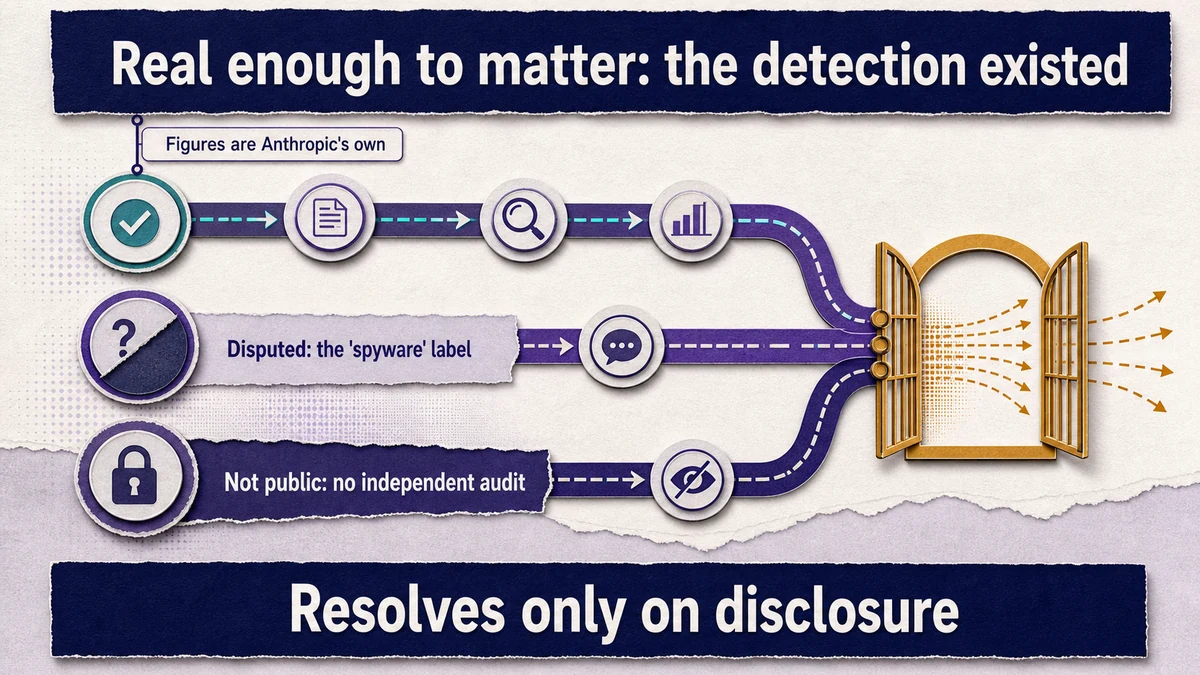
But “spyware” is also an overloaded word. The available reporting does not show public evidence that Claude Code exfiltrated source code, files, credentials, or business secrets through this mechanism. The controversy is about hidden classification of user context, especially China-related context. That is still serious for a coding agent, but it is not the same claim as broad data theft.

This is the line the article needs to keep visible: the spyware narrative explains why people are angry, but it does not fully explain why the code existed.

The real split: anti-abuse detection vs. developer trust

The useful way to read this story is to split it into two buckets.

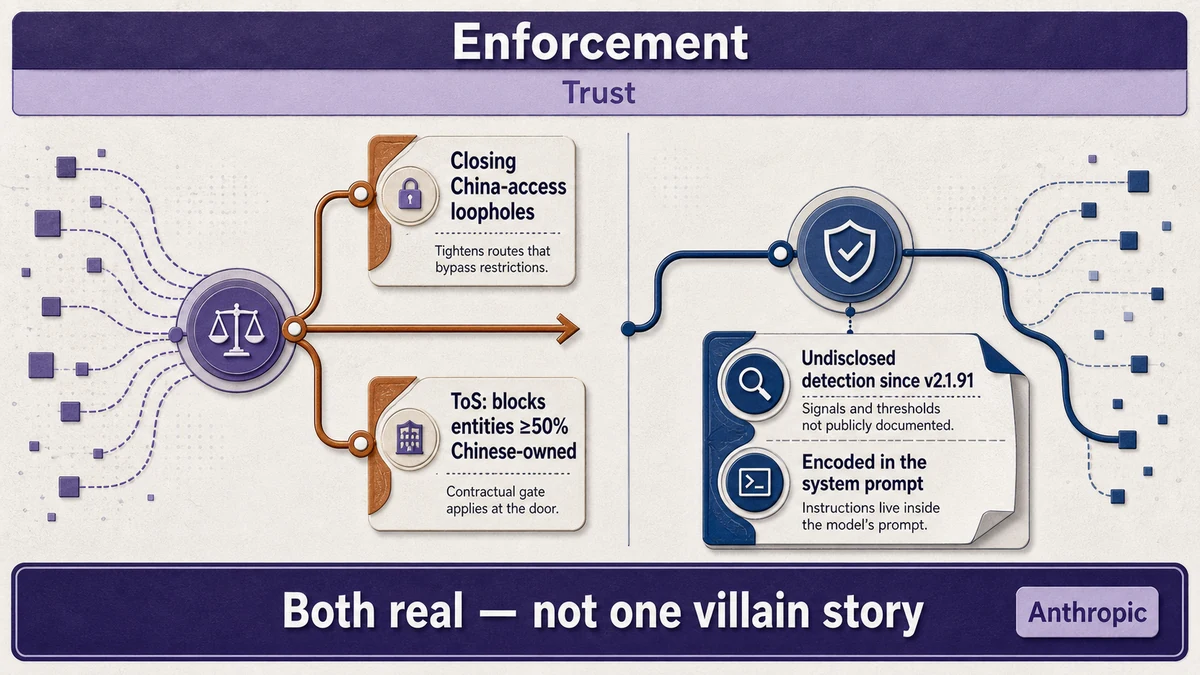
The first bucket is anti-abuse enforcement. Anthropic already restricts access to Claude in unsupported regions and, according to Financial Times reporting, has been trying to close loopholes that allow Chinese companies to access Claude through cloud providers, overseas subsidiaries, VPNs, and transfer-station services. From Anthropic’s perspective, detecting suspicious access routes is part of enforcing terms of service and protecting frontier-model capability.

The second bucket is developer trust. Claude Code is not a passive website. It is a tool developers invite into the workbench. A company adopting a coding agent is not only buying model quality. It is accepting the vendor’s update channel, telemetry posture, policy enforcement logic, and security judgment.

Those are different problems. Anti-abuse detection can be legitimate. Hidden detection inside a trusted developer tool can still damage trust.

This is the part I would treat most carefully as a reader. A security control can be technically reasonable and still be poorly introduced if the people depending on the tool feel they discovered it by accident.

That distinction explains why Alibaba’s response is useful politically and operationally. The company can say it is protecting internal development environments from foreign tooling risk. At the same time, it can redirect employees toward Qoder and strengthen the broader argument that domestic AI tools are safer for Chinese firms.

Abstract split-screen AI illustration comparing anti-abuse enforcement with developer trust
The same detection mechanism can be framed as abuse prevention or as a developer-trust risk.

Why model distillation changes the incentives

This controversy sits on top of a larger dispute over model distillation.

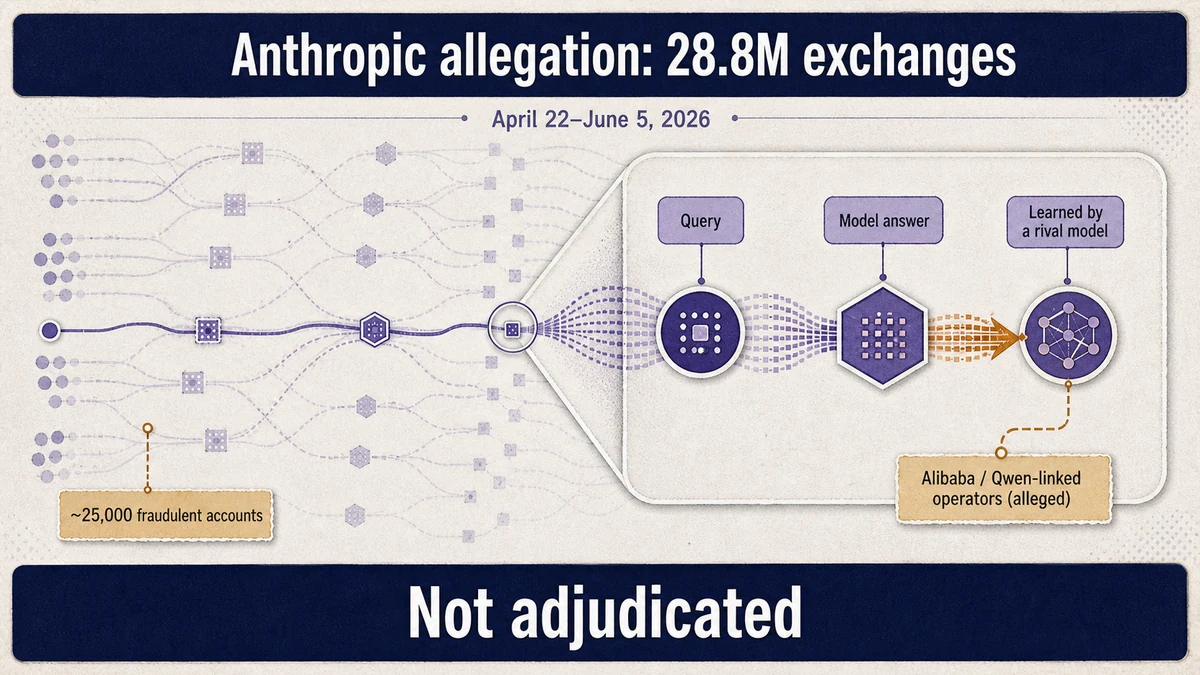
Business Insider reported that Anthropic’s head of policy, Sarah Heck, wrote to Senators Tim Scott and Elizabeth Warren on June 10, 2026, accusing Alibaba-affiliated operators of running the largest known distillation attack against Anthropic. According to that reporting, the letter alleged 28.8 million exchanges with Claude through almost 25,000 fraudulent accounts between April 22 and June 5, 2026.

Tom’s Hardware and other outlets reported the same broad allegation: operators connected to Alibaba and Qwen allegedly tried to extract Claude’s capabilities, especially around agentic reasoning and software engineering. Anthropic had previously made similar claims about other Chinese AI labs, including DeepSeek, Moonshot AI, and MiniMax.

The numbers should be handled carefully. They are Anthropic’s allegations, not independently verified public findings. Business Insider said Alibaba representatives did not respond to its request for comment, so readers should not treat the 25,000-account figure as a court-tested fact or as an admitted fact.

Still, the mechanism is important. Distillation does not require stealing model weights. It can happen by repeatedly querying a model and training another system on the answers. At small scale, that looks like normal use. At industrial scale, it begins to look like capability extraction.

That is the structural problem for frontier labs. A model must answer queries to be useful. But every answer reveals something about how the model behaves. The more valuable the model is for coding, reasoning, and long-horizon tasks, the more incentive there is to learn from its outputs.

The more I follow coding-agent adoption, the more I see distillation as an economic pressure rather than a side issue. If a tool can automate valuable engineering work, competitors will look for cheaper ways to approximate that capability.

Abstract model distillation loop showing prompts, model outputs, training data, and a smaller model
Model distillation can learn from model outputs without copying model weights directly.

Why Alibaba’s ban is more than a software policy

Alibaba’s reported ban matters because it turns a technical enforcement dispute into an AI-sovereignty story.

For Anthropic, the issue is unauthorized access and model copying. For Alibaba, the issue can be framed as foreign software risk inside a domestic development environment. Those two arguments feed each other. The more Anthropic tries to detect China-linked access, the easier it becomes for Chinese firms to argue that foreign AI tools cannot be trusted. The more Chinese firms route around access restrictions, the easier it becomes for Anthropic to justify stronger detection.

That feedback loop is the real story.

Coding agents are quickly becoming part of the software supply chain. They do not merely answer questions. They read code, propose changes, run commands, and increasingly participate in build and review workflows. Once tools operate at that layer, vendor trust becomes infrastructure trust.

My own bias is toward more explicit disclosure here. Enterprise users do not need every anti-abuse signal exposed in detail, but they do need a clear sense of what kind of enforcement logic can run inside a development tool.

So the question is not only whether Claude Code contained an objectionable detector. The larger question is whether companies will accept foreign AI agents inside sensitive engineering workflows when the vendor is also enforcing geopolitical access rules.

Risks & Counterpoints

Several points look well supported by current reporting, but they should not be read as court-tested findings.

First, Alibaba’s reported Claude Code restriction is widely covered, with July 10, 2026 named as the effective date. TechCrunch and Times of India both reported the policy direction and the Qoder alternative.

Second, multiple reports suggest that Claude Code included a China-related detection mechanism, and Anthropic-linked commentary described it as a March experiment aimed at account abuse, unauthorized resale, and distillation.

Third, Anthropic has formally escalated distillation concerns to US lawmakers. Business Insider reported details from a June 10 letter naming nearly 25,000 accounts and 28.8 million Claude exchanges as part of the alleged Alibaba-linked campaign.

But several points remain open.

The public record does not yet include an independent technical audit proving every detail of the Reddit reverse-engineering post. It also does not prove that the detector should legally or technically be classified as spyware. Most importantly, Anthropic’s distillation numbers remain company allegations, not independently adjudicated facts.

The cleanest reading is this: the detection mechanism appears real enough to matter, the “spyware” label remains contested, and the distillation claims are central to Anthropic’s incentive but should be attributed carefully.

Abstract AI watchlist board with four icon nodes for enforcement, transparency, adoption, and policy
The next signals are enforcement, transparency, adoption, and policy response.

What to Watch

  • Whether Alibaba’s July 10 ban is enforced broadly or treated as a narrow internal compliance measure.
  • Whether Anthropic publishes a clearer technical explanation of what the Claude Code detector collected, how it encoded signals, and when it was removed.
  • Whether other frontier labs disclose similar anti-abuse or anti-distillation detection layers in developer tools.
  • Whether Qoder usage rises inside Alibaba or whether developers continue to route around restrictions through personal accounts and VPNs.
  • Whether US lawmakers move from chip export controls toward penalties or restrictions around model-output access and distillation.
  • Whether future allegations name additional labs, cloud routes, or reseller networks, which would suggest this is becoming a standing enforcement program rather than a one-off dispute.

Bottom Line

The Claude Code controversy is real enough to matter, but not clean enough for a simple villain story.

Anthropic may have had a rational reason to detect unauthorized access and protect against distillation. Alibaba may also have a rational reason to block a foreign coding agent that quietly classified China-linked users. The uncomfortable part is that both positions can be true at the same time.

The broader lesson is that frontier AI moats are leaky by design. A useful model must expose behavior through answers. A valuable coding agent must sit close to developer workflows. That combination creates a permanent tension between access and protection.

So the central question is not “was Claude Code spyware?” The better question is whether frontier AI companies can protect their models without breaking developer trust. That is the test this controversy has exposed.

This article combines public reporting with my own interpretation of AI infrastructure and developer-tool trust.

My Take: My takeaway is that the most important issue is not whether the word “spyware” is technically perfect. The more important question is whether frontier AI companies can protect their models without making developer tools feel opaque or politically conditional.

Some conclusions are opinions rather than established facts.

Readers should distinguish between verified reporting, company allegations, community reverse-engineering claims, and analytical commentary.

Frequently Asked Questions

What happened with Alibaba and Claude Code?

Alibaba reportedly told employees to stop using Anthropic’s Claude Code starting July 10, 2026 and directed them toward its own coding tool, Qoder. The move followed reports suggesting that Claude Code included hidden China-related detection logic.

Why are people calling Claude Code spyware?

The term comes from a Reddit reverse-engineering post and subsequent reporting that described hidden checks for proxy, timezone, and China-linked signals. The label is disputed. The available reporting points to hidden classification logic, not proven broad data theft.

What did Anthropic say the mechanism was for?

According to TechCrunch and The Decoder, Anthropic’s Thariq Shihipar described it as a March experiment intended to prevent account abuse, unauthorized resale, and model distillation. Reporting says stronger mitigations had replaced the older mechanism.

What is model distillation?

Model distillation is a training method in which one model learns from the outputs of another model. It can be legitimate when a company distills its own model, but it becomes controversial when a competitor allegedly uses another company’s model outputs at scale to train a rival system.

Did Alibaba allegedly use 25,000 fake accounts?

That is Anthropic’s allegation as reported by Business Insider, Tom’s Hardware, and other outlets. It should be treated as an allegation unless confirmed by independent evidence, legal findings, or public documentation from the companies involved.

Why does this matter for developers?

Coding agents often operate close to source code, project files, terminals, and engineering workflows. Hidden detection logic inside that kind of tool can create a larger trust problem than ordinary website telemetry.

Is this only a China-US issue?

No. The China-US context is central here, but the broader issue applies to all frontier AI vendors: how to prevent abuse and model extraction without making enterprise users feel that trusted developer tools contain undisclosed enforcement logic.

Sources

Primary and near-primary sources

Secondary reporting

This article is for information and industry analysis only. It is not legal, cybersecurity, or investment advice. Claims about hidden code, user detection, account abuse, and model distillation should be read as source-specific claims unless independently confirmed.