
One-Minute Brief
- Anthropic released Claude Sonnet 5 on June 30, 2026, and made it the default model for Free and Pro users on the Claude apps the following day.
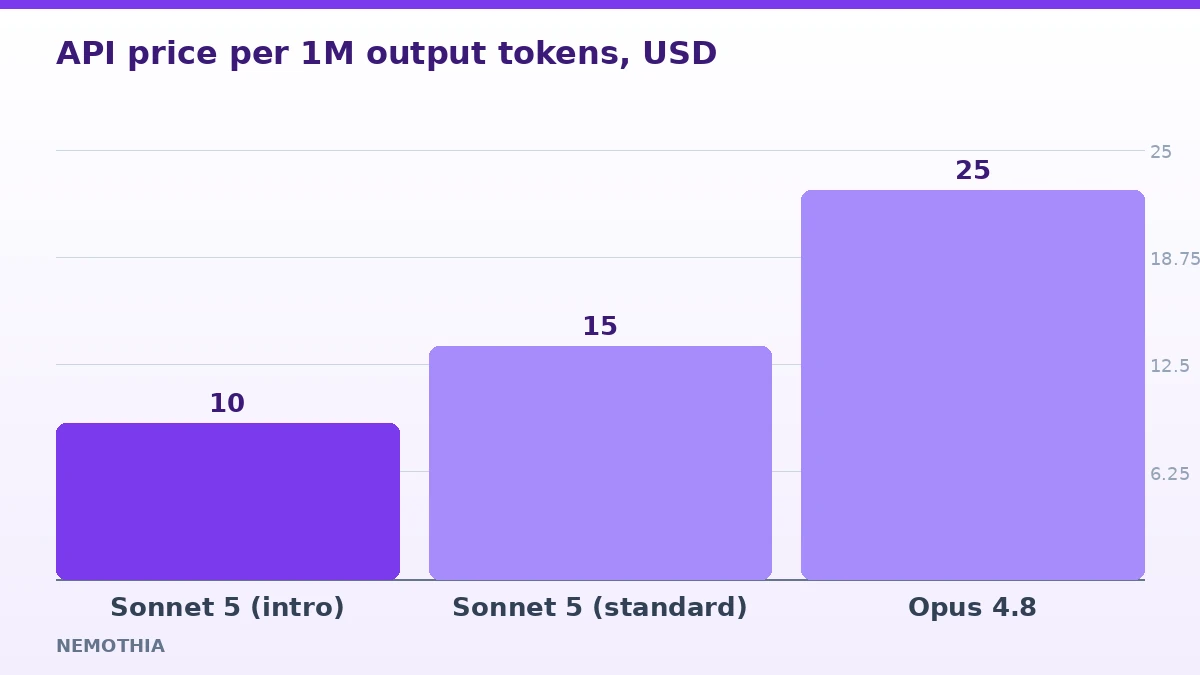
- Introductory API pricing is $2 per million input tokens and $10 per million output tokens through August 31, 2026, rising afterward to $3 and $15.
- Anthropic's flagship, Opus 4.8, is priced at $5 input and $25 output per million tokens, so Sonnet 5 sits well below it even after the promotion ends.
What Happened
Anthropic launched Claude Sonnet 5 on June 30, 2026, positioning it as a mid-tier model that runs agents – software that plans, browses, and executes multi-step tasks – at a fraction of the cost of a flagship system. The model became the default for Free and Pro plans on the consumer Claude apps starting July 1, and is available to Max, Team, and Enterprise users as well as through Claude Code and the Claude Platform API.
Pricing is central to the release. Through August 31, 2026, Sonnet 5 is offered at $2 per million input tokens and $10 per million output tokens; after that promotional window it moves to $3 and $15. For comparison, Anthropic's flagship Opus 4.8 is listed at $5 input and $25 output per million tokens, according to published pricing tables. That gap is the pitch: buyers can run a model that approaches flagship quality without paying flagship rates.
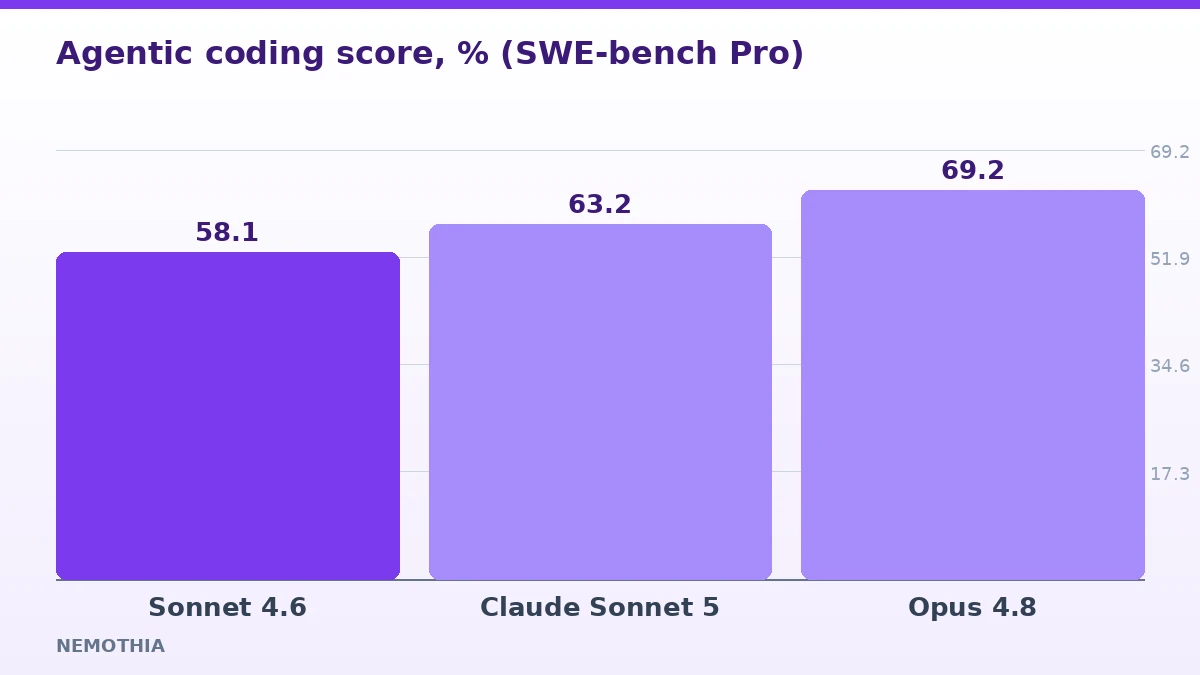
On measured performance, Sonnet 5 beats its predecessor across the board. Benchmark comparisons put it at 63.2% on SWE-bench Pro agentic coding, 81.2% on OSWorld-Verified, and 57.4% on Humanity's Last Exam. On the agentic-coding metric specifically, that 63.2% lands between Sonnet 4.6's 58.1% and Opus 4.8's 69.2%. Anthropic also reports that its safety assessments found Sonnet 5 exhibits an overall lower rate of undesirable behaviors than Sonnet 4.6, which the company frames as making it generally safer to operate in agentic contexts where a model acts with limited supervision.
Why This Matters for Claude Sonnet 5
The industry impact is a compression of the price-to-capability curve. For most of the past two years, running an agent that could reliably chain browser calls, terminal commands, and file edits meant paying flagship prices. Sonnet 5 is being marketed precisely as the model that dissolves that constraint, delivering behavior that "just a few months ago required larger and more expensive models," in Anthropic's framing. When the capable tier gets cheaper, the volume of tasks that are economically worth automating expands.
The technical meaning sits in the word "agentic." Benchmarks such as SWE-bench Pro and OSWorld-Verified measure whether a model can complete real, multi-step software and computer-use tasks rather than answer a single prompt. Sonnet 5's gains there matter more than a marginal bump on a knowledge quiz, because agent workloads consume tokens continuously – a single autonomous coding session can burn through far more output tokens than a chat exchange. That is why a lower output-token price compounds: the savings scale with how long the agent runs.
Corporate strategy is visible in the tiering. Anthropic is not replacing Opus 4.8; it is widening the menu so that Sonnet 5 captures the high-volume middle where cost sensitivity is greatest, while the flagship holds the frontier. This mirrors a broader pattern across the model market, where OpenAI's recently released GPT-5.6 family similarly spans a budget-to-premium spread. The competitive logic is that inference volume, not benchmark bragging rights, is where sustained revenue accrues.
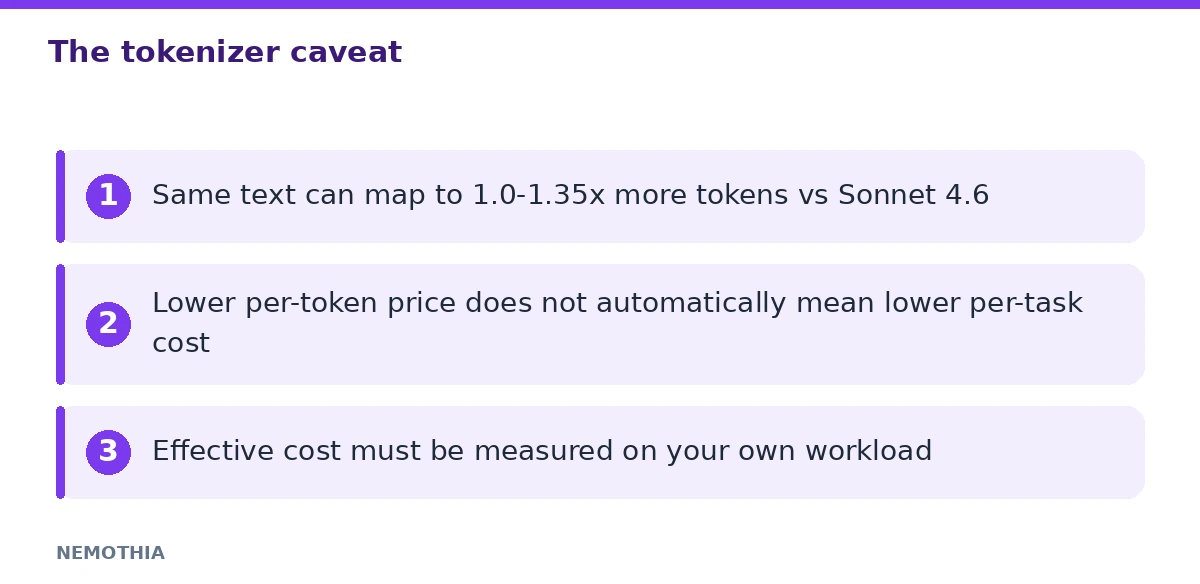
The market change is a shift in how buyers evaluate models. The headline price is no longer the whole story. Several analyses flag that Sonnet 5 ships with an updated tokenizer that can process the same input into 1.0 to 1.35 times as many tokens depending on content type. A lower per-token price paired with more tokens per task means the real per-task cost has to be measured, not assumed from the rate card. That nuance is reshaping procurement conversations from "what is the sticker price" to "what does my actual workload cost end to end."
The cross-industry ripple reaches well beyond AI labs. For software and SaaS vendors, cheaper mid-tier agents lower the marginal cost of embedding AI features, which can compress the per-seat economics of AI add-ons and pressure how those features are priced. For customer support and business-process outsourcing, models capable of running multi-step workflows at lower cost extend the range of tickets and back-office tasks that can be handled without a human in the loop, shifting the labor mix.
And for cloud and data-center operators, cheaper agents tend to increase total inference volume rather than reduce it – a classic efficiency-drives-demand dynamic – which sustains pressure on compute, memory, and power capacity even as the price per token falls.
Global market reaction has been framed less as a single blockbuster event and more as another step in a fast-cadence release cycle. Anthropic's launch landed within days of competing model updates from other major labs, and coverage across US and international outlets treated the pricing move – cheaper than the prior Sonnet at introductory rates – as the most consequential detail for the developers who actually deploy these systems.
Risks & Counterpoints
- The tokenizer change means the advertised price cut may be partly offset in practice; buyers whose content skews toward the high end of the 1.0-1.35x range could see smaller real savings than the rate card implies.
- Introductory pricing expires August 31, 2026, after which input and output rates rise to $3 and $15, so the most attractive economics are time-limited.
- Benchmark figures such as SWE-bench Pro and OSWorld-Verified are useful but imperfect proxies; performance on a specific production workload can diverge from published scores.
- A 63.2% agentic-coding result still trails Opus 4.8's 69.2%, so teams with the hardest autonomous tasks may find the capability gap, not the price, is the binding constraint.
- Safety claims rest on Anthropic's own evaluations; independent, third-party red-teaming over time will be needed to confirm the lower rate of undesirable behaviors in the wild.
What’s Next for Claude Sonnet 5
- Whether real-world cost audits confirm net savings once the tokenizer effect is included – this determines if the price cut is genuine for a given workload.
- What happens to pricing after August 31, 2026, and whether competitors respond with matching cuts – the post-promotion rate sets the true baseline.
- How quickly enterprises move default agent workloads onto Sonnet 5 versus holding the hardest tasks on Opus 4.8 – the split will reveal where the capability line actually falls.
Bottom Line
My Take: Claude Sonnet 5 is best read as a cost-structure release rather than a capability leap: it narrows most of the distance to Anthropic's flagship on agentic tasks while pricing itself for high-volume, always-on use. The most important caveat is not on the benchmark chart but in the fine print – the new tokenizer means the honest way to evaluate the model is to measure end-to-end cost on your own tasks, not to read the rate card. The release is less about who tops a leaderboard and more about pushing capable agents into the price band where they get deployed by default. The zoom-out that outlasts this news cycle is the efficiency-demand loop: as capable AI gets cheaper per token, the industries that stand to be reshaped are the ones that run it continuously – SaaS, customer operations, and the cloud and memory suppliers underneath them – because falling unit prices tend to expand total usage rather than shrink the bill.
Frequently Asked Questions
What makes Claude Sonnet 5 cheaper to run than the flagship?
Sonnet 5 is priced at $2/$10 per million input/output tokens during its introductory window and $3/$15 afterward, versus $5/$25 for Opus 4.8. Because agent workloads consume large volumes of output tokens, the lower output rate is where most of the savings accumulate.
How does Claude Sonnet 5 compare on agentic coding benchmarks?
Published tables put Sonnet 5 at 63.2% on SWE-bench Pro agentic coding, above Sonnet 4.6's 58.1% and below Opus 4.8's 69.2%. It also scores 81.2% on OSWorld-Verified and 57.4% on Humanity's Last Exam.
Is Claude Sonnet 5 actually cheaper once the new tokenizer is factored in?
Not automatically. The updated tokenizer can turn the same text into 1.0 to 1.35 times as many tokens, so the effective per-task cost depends on your content. The reliable approach is to measure cost on your own workload rather than infer it from the headline rate.
Where can I use Claude Sonnet 5?
It is the default model for Free and Pro users on the Claude apps as of July 1, 2026, and is also available to Max, Team, and Enterprise users, through Claude Code, and via the Claude Platform API.
Sources
- anthropic.com — Release date, default-model rollout, pricing, and safety-evaluation claims (2026-06-30)
- techcrunch.com — Framing of Sonnet 5 as a cheaper way to run agents (2026-06-30)
- thenewstack.io — Closes gap with Opus 4.8; introductory pricing cheaper than prior Sonnet (2026-06-30)
- marktechpost.com — Agentic-coding scores and Opus 4.8 pricing comparison (2026-06-30)
- platform.claude.com — Benchmark figures and tokenizer 1.0-1.35x note (2026-06-30)
- cosmicjs.com — Benchmark and pricing summary for developers (2026-07-01)
- buildfastwithai.com — Default-model rollout on July 1 (2026-07-01)
- datasciencedojo.com — Analysis of the tokenizer's hidden cost (2026-07-02)
This article is for informational and educational purposes only and does not constitute investment, financial, or legal advice.