The most concrete change is Alibaba’s reported internal policy.
Alibaba’s Ban and the Detection Code It Exposed
The most concrete change is Alibaba’s reported internal policy. TechCrunch reported on July 4 that Alibaba would ban employee use of Claude Code starting July 10 and point staff toward its own coding tool, Qoder; Times of India, citing Yicai, described Claude Code being added to a restricted-software list after internal security concerns.
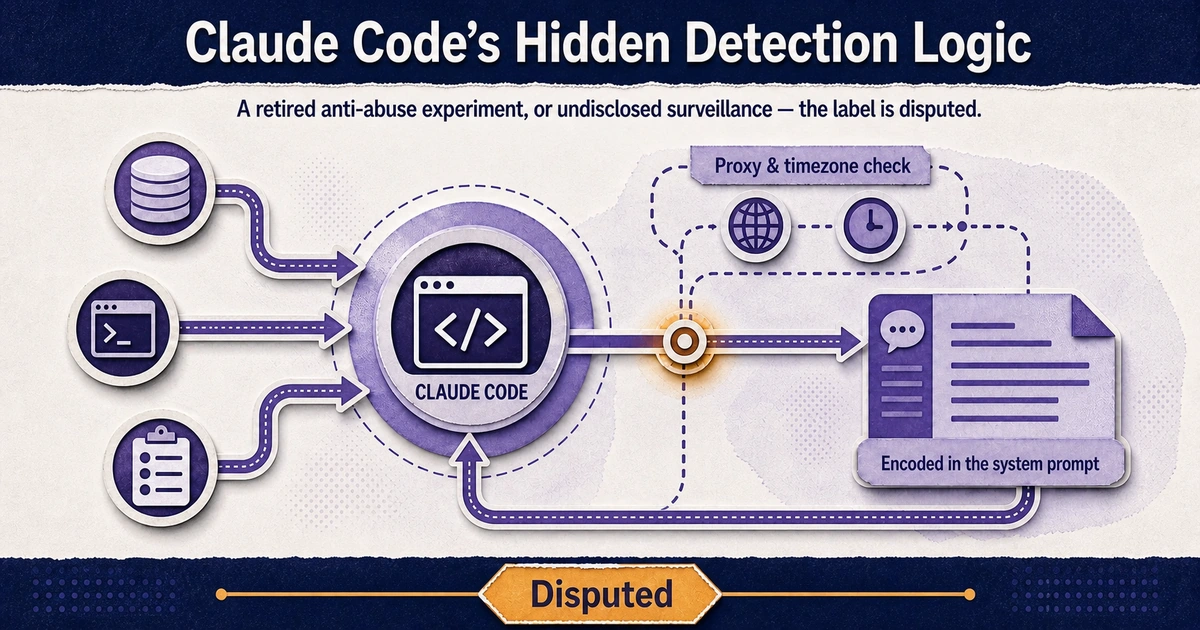
The second change is the public exposure of a detection mechanism. The Decoder reported that Claude Code had included code that could flag users based in China or linked to a Chinese AI lab. A Reddit post in r/ClaudeAI made the sharper claim: since version 2.1.91, the tool checked proxy and timezone signals and encoded the result through small differences in the system prompt. Anthropic‘s Thariq Shihipar said on X that the mechanism was a March experiment to prevent account abuse, unauthorized reselling, and distillation – and that stronger mitigations had since replaced it.
Public reporting does not, by itself, prove every implementation detail.
The dates tell the escalation:
Why this stings more than ordinary telemetry: the tool at issue is a coding agent. Developers connect coding agents to local repositories, terminals, issue trackers, and sometimes deployment workflows. Hidden detection logic at that layer feels categorically different from website analytics.
Enforcement, Trust, and the Economics Behind the Dispute
The easiest version – spyware embedded, Alibaba found out, China pushed back – is clickable but too flat. There is a real trust issue: if a developer tool quietly inspects environment signals and transmits a classification through prompt-level markers, users are right to ask why that was not disclosed plainly. Obfuscation, even for anti-abuse purposes, makes a security-sensitive audience more suspicious.
But “spyware” is an overloaded word. Available reporting shows no public evidence that Claude Code exfiltrated source code, files, or credentials through this mechanism. The controversy is hidden classification of user context – serious for a coding agent, but not the same claim as data theft. That line has to stay visible.
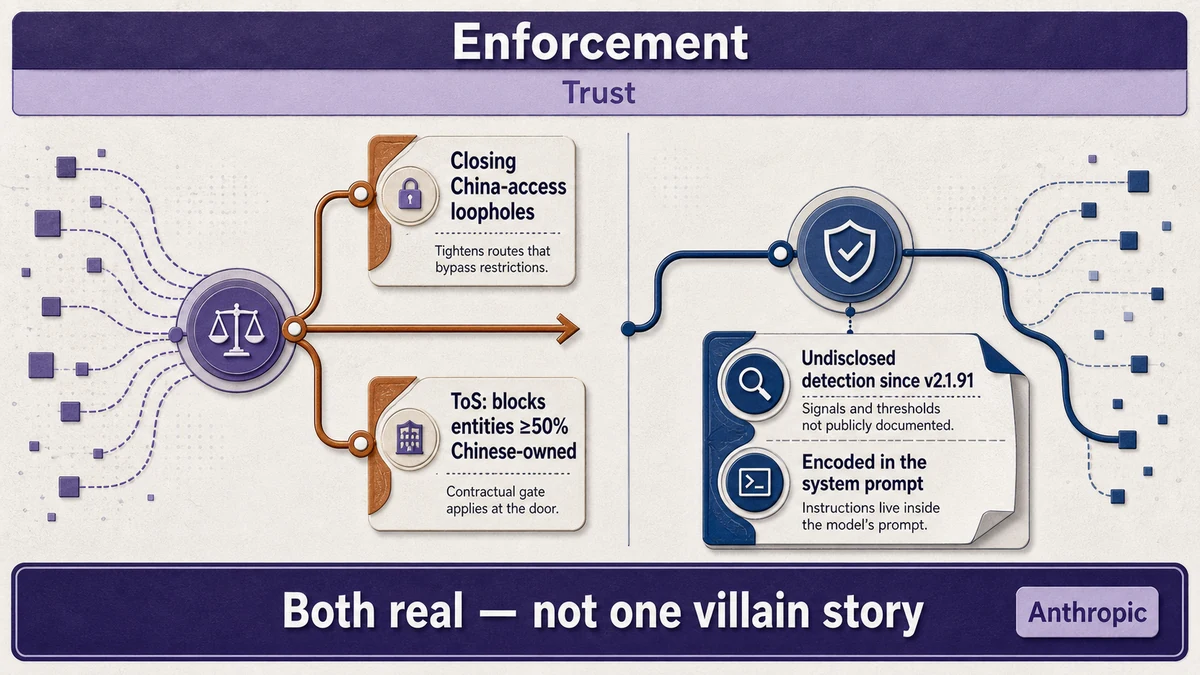
Split the story into two buckets and it gets clearer. Bucket one is enforcement: Anthropic restricts access in unsupported regions and, per Financial Times reporting, has been closing loopholes that let Chinese companies reach Claude through cloud providers, subsidiaries, VPNs, and transfer services. Detecting suspicious access routes is, from that side, terms-of-service enforcement.
Bucket two is trust. Claude Code is not a passive website – it is a tool developers invite into the workbench. Adopting a coding agent means accepting the vendor’s update channel, telemetry posture, and enforcement logic. A security control can be technically reasonable and still be poorly introduced if the people depending on the tool feel they discovered it by accident. Both buckets are real; that is why the dispute will not resolve into a clean villain story.
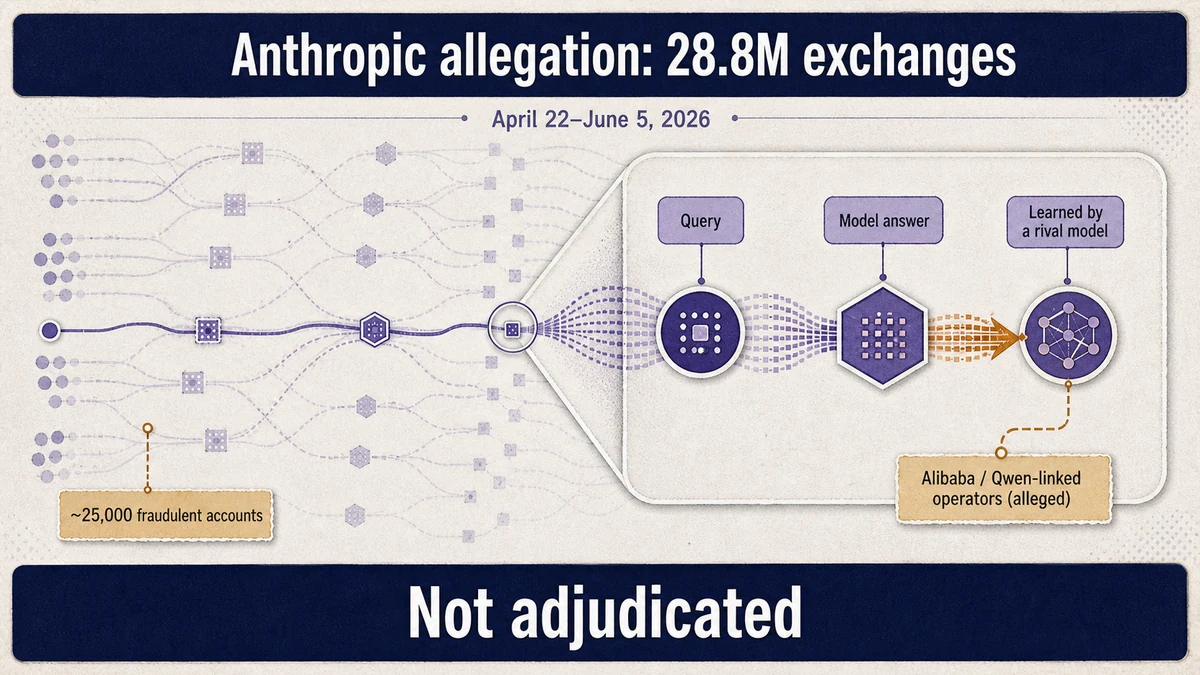
Underneath sits the economics. Business Insider reported that Anthropic’s June 10 letter alleges 28.8 million Claude exchanges through almost 25,000 fraudulent accounts between April 22 and June 5 – operators connected to Alibaba and Qwen allegedly extracting capabilities around agentic reasoning and software engineering. Anthropic has previously made similar claims about DeepSeek, Moonshot AI, and MiniMax. These are company allegations, not adjudicated facts; Alibaba did not respond to Business Insider’s request for comment.
The mechanism, though, is structural:
At small scale this looks like normal use; at industrial scale it looks like capability extraction. A model must answer queries to be useful, and every answer reveals something about how it behaves. The more valuable the model, the stronger the incentive to learn from its outputs – distillation is an economic pressure, not a side issue.
Alibaba’s ban turns a technical enforcement dispute into an AI-sovereignty story, and the two arguments feed each other. The more Anthropic tries to detect China-linked access, the easier it becomes for Chinese firms to argue foreign AI tools cannot be trusted; the more firms route around restrictions, the easier it becomes to justify stronger detection. Coding agents are becoming part of the software supply chain – they read code, run commands, and join build workflows – so vendor trust is turning into infrastructure trust, with geopolitics attached.
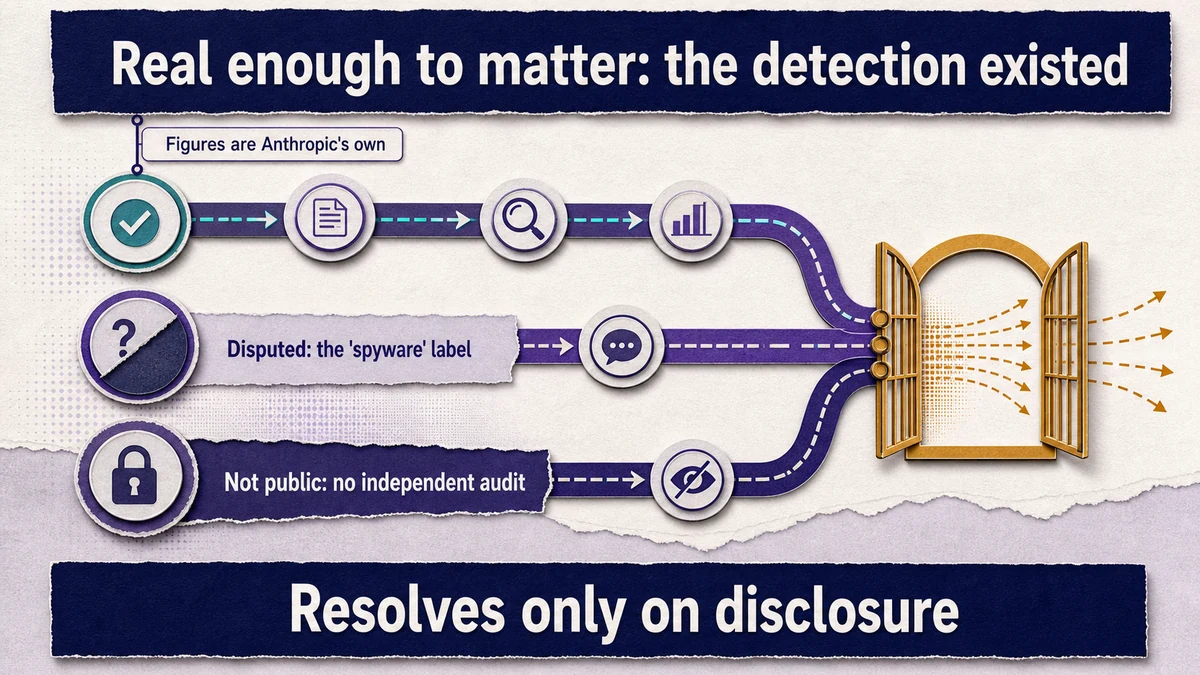
What remains unproven: no independent technical audit has confirmed every detail of the Reddit analysis, the “spyware” classification is contested, and the distillation figures are Anthropic’s own. The cleanest reading: the detection mechanism appears real enough to matter, the label remains disputed, and the allegations explain the incentive without settling the facts.
The dispute stays an allegation until one of two things becomes public:
Why Disclosure Beats a Spyware Verdict
Both positions can be true at once – that is the uncomfortable center of this story. Frontier AI moats are leaky by design: a useful model must expose behavior through answers, and a valuable coding agent must sit close to developer workflows. So the real question is not “was it spyware?” but whether frontier labs can protect their models without making developer tools feel opaque or politically conditional. The case for explicit disclosure is the stronger one: enterprises don’t need every signal exposed, but they do need to know what kind of enforcement logic can run inside a development tool.
The Spyware Label and What Distillation Actually Means
The term comes from a Reddit reverse-engineering post and follow-on reporting describing hidden checks for proxy, timezone, and China-linked signals. The label is disputed: available reporting points to hidden classification of user context, not proven exfiltration of code or credentials.
A training method where one model learns from another model’s outputs. It is legitimate when a company distills its own models, and contested when a competitor allegedly queries a rival at industrial scale to train against the answers – which is what Anthropic alleges happened here.
Sources
- techcrunch.com — TechCrunch: Alibaba to ban employee use of Claude Code from July 10, pointing staff to its own tool, Qoder; notes Anthropic’s March anti-abuse/anti-distillation detection experiment. (2026-07-04)
- the-decoder.com — The Decoder: reporting that Claude Code contained code able to flag China-linked users, with Anthropic’s Thariq Shihipar describing it as a March anti-abuse/anti-distillation experiment since replaced. (2026-07-03)
- ft.com — Financial Times: Anthropic closing loopholes letting Chinese firms reach Claude via cloud providers, subsidiaries, VPNs, and “transfer station” services; new ToS blocks majority Chinese-owned entities. (2026-07-03)
- x.com — Thariq Shihipar (Anthropic, Claude Code team) on X: confirms the mechanism was “an experiment we launched in March … to prevent account abuse from unauthorized resellers and protect against distillation,” since replaced by stronger mitigations. (2026-06-30)
- www.anthropic.com
View all sources
- businessinsider.com — Business Insider: Anthropic policy head Sarah Heck’s June 10 letter to Senators Scott and Warren alleging 28.8M Claude exchanges via ~25,000 fraudulent accounts (Apr 22-Jun 5), tied to Alibaba/Qwen-linked operators. (2026-06-24)
- reddit.com — Reddit r/ClaudeAI (u/LegitMichel777): reverse-engineering post claiming Claude Code has checked proxy/timezone signals and steganographically encoded the result in the system prompt since v2.1.91 (community claim, not a formal audit). (2026-06-30)
- tomshardware.com — Tom’s Hardware: corroborates the same 25,000-fake-account / 28.8M-exchange distillation allegation against Alibaba, April-June 2026. (2026-06-25)
- timesofindia.indiatimes.com — Times of India, citing Yicai: Claude Code added to Alibaba’s restricted-software list after an internal security review, effective July 10 (direct fetch blocked; date corroborated via same-day multi-outlet coverage of the same Yicai-sourced story, TOI’s own byline timestamp not independently confirmed). (2026-07-06)
This article is for informational and educational purposes only and does not constitute investment, financial, or legal advice.