One-Minute Brief
- Boston Dynamics unveiled a fifth-generation Atlas humanoid in 2026 with an "almost order-of-magnitude" reduction in mechanical complexity, aimed at manufacturability and lower.
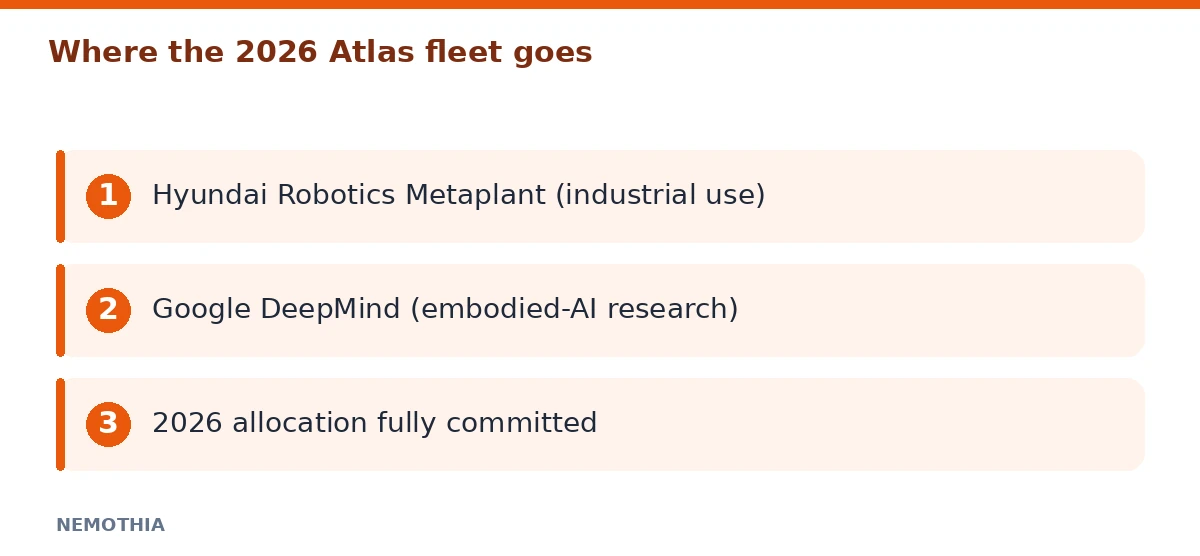
- All of the 2026 Atlas units are said to be spoken for, going to Hyundai's Robotics Metaplant facility and to Google DeepMind for embodied-AI work.
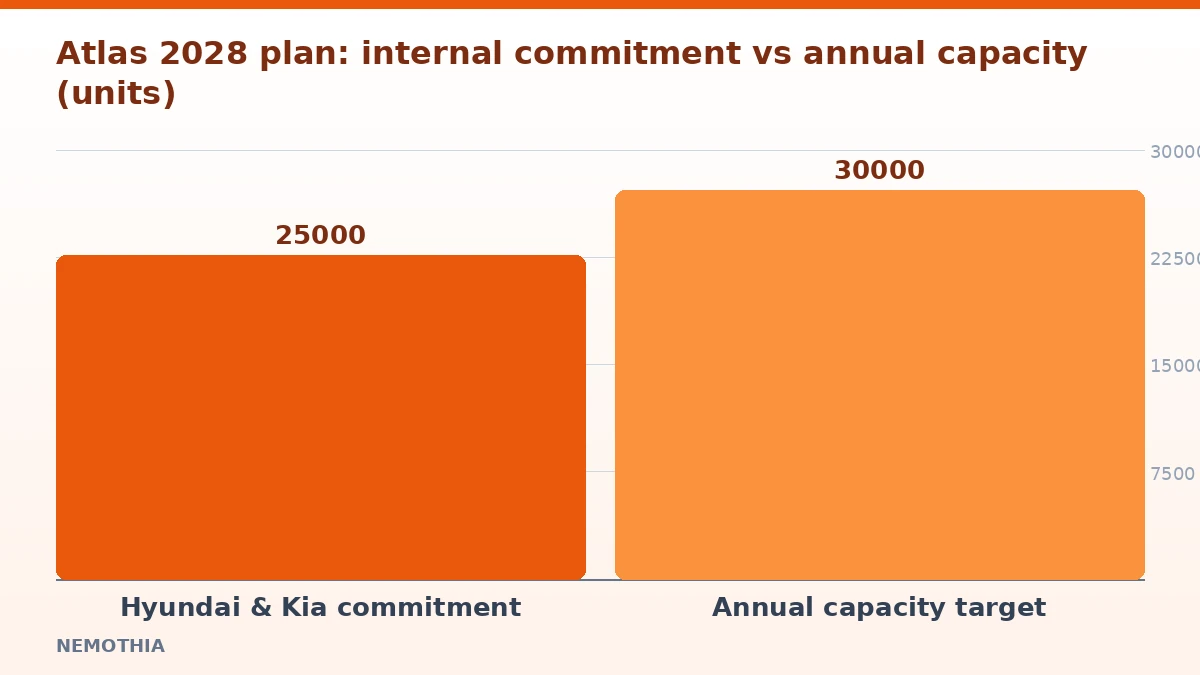
- Hyundai, Boston Dynamics' parent, plans a factory targeting about 30,000 Atlas units per year, with that capacity slated for 2028.
What Happened
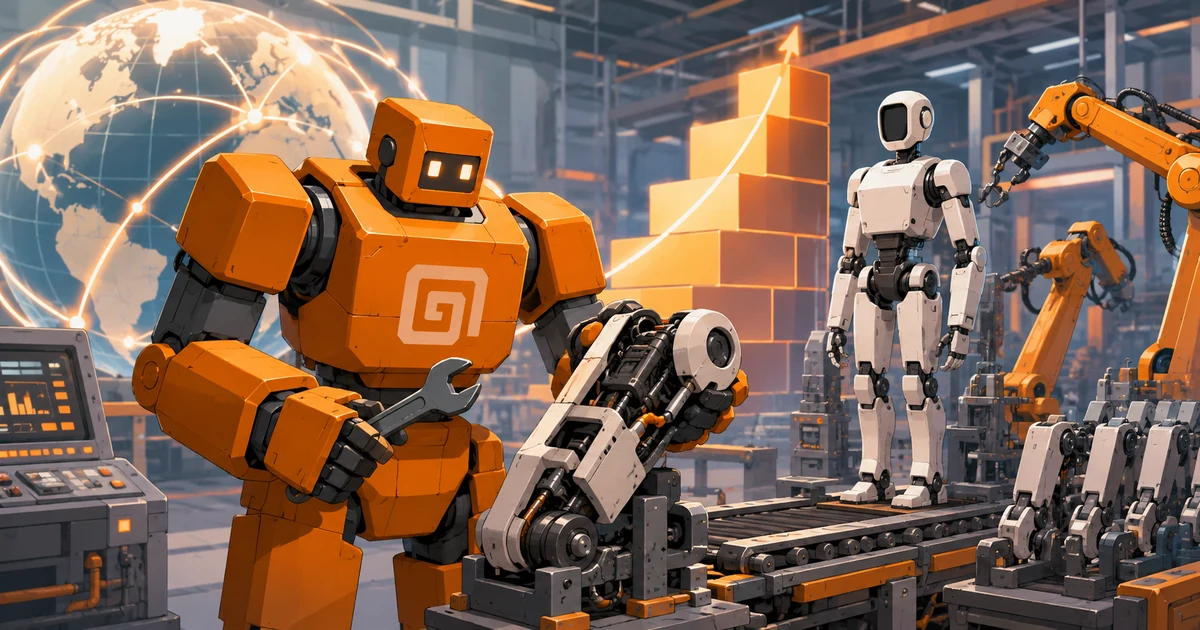
Boston Dynamics unveiled a redesigned, fifth-generation Atlas in 2026 that the company frames as built for the factory rather than the lab, citing an "almost order-of-magnitude" cut in complexity that translates into fewer parts, faster manufacturing, higher reliability, and lower cost. The redesign is the hinge of the story: a humanoid that is simpler to build is a humanoid that can actually be deployed at scale.
On deployment, all 2026 Atlas units are already spoken for, with fleets going to Hyundai's Robotics Metaplant Application Center and to Google DeepMind under an embodied-AI partnership. Hyundai, which owns Boston Dynamics, plans to apply its manufacturing expertise to a factory targeting roughly 30,000 Atlas units per year, with that plant slated for 2028. Production has already begun at Boston Dynamics' headquarters while the larger facility is stood up.
Hyundai has told investors it plans to deploy more than 25,000 of those robots across its own Hyundai and Kia plants – roughly 83% of the targeted annual capacity.
The context is a sector-wide shift from prototype to payroll. Coverage of the 2026 humanoid landscape describes multiple vendors moving from demonstrations into real plant work, with Atlas positioned around industrial reliability rather than viral agility clips.
Why This Matters for Atlas Humanoid
For the robotics industry, the redesign matters more than any single demo. A humanoid that removes an order of magnitude of parts changes the unit economics of the whole category, because cost, reliability, and serviceability – not peak acrobatics – are what decide whether a plant manager signs a purchase order. Being early to a manufacturable design gives Boston Dynamics a lead measured in production yield, not choreography. In a category where most rivals still optimize for demo-day agility, shipping a machine a plant can actually maintain is the harder and more valuable milestone.
The technical meaning is that simplicity is the feature. Fewer actuators and parts mean fewer failure points, easier maintenance, and a bill of materials that can fall with volume, which is exactly the curve a factory buyer needs before committing a line to robots. It reframes humanoids as industrial equipment with maintenance schedules, not research platforms.
Corporate strategy explains the customer list. Routing 2026 units to Hyundai's own facilities and to Google DeepMind lets Boston Dynamics prove the machine inside a parent that understands manufacturing while pairing the hardware with a frontier embodied-AI lab. That vertical integration – carmaker, robot maker, and AI lab aligned – is a moat rivals without a manufacturing parent will find hard to copy.
The market change shows up as committed demand ahead of capacity. With 2026 allocation already spoken for and a 30,000-unit annual plant targeted for 2028, the constraint is production, not interest. That mirrors how every hard-tech ramp begins: demand is proven in captive deployments before merchant supply opens up.
The ripple reaches well beyond robotics. For manufacturing labor, humanoids that handle repetitive line tasks shift where human workers add value toward oversight, exception-handling, and maintenance rather than a simple headcount swap. For logistics and warehousing, a reliable general-purpose body is a template for pick-and-place and loading work that fixed automation could never flex into. For the insurance and industrial-safety industry, fleets of humanoids raise new liability, certification, and workers'-safety questions that will shape adoption speed. And for commercial real estate, plants designed around humanoid workflows change floor layouts, power, and clearances the way conveyor automation once did.
The global reaction has treated 2026 as the year humanoids started earning their keep, with attention on whether committed pilots convert into repeat orders and on how fast Hyundai's volume plant comes online.
Risks & Counterpoints
- "Fully committed" and the 30,000-unit target are company-stated figures tied to captive customers, not open-market sales, and should be read as intent until merchant deliveries and repeat orders appear.
- First-year reliability on a newly redesigned platform is unproven at volume; a simpler machine still has to survive real shift work.
- Humanoids compete with cheaper fixed automation for many tasks, so the general-purpose premium must pay for itself to justify the form factor.
- Deployments concentrated inside the parent company make early results hard to read as neutral market demand.
What’s Next for Atlas Humanoid
- Whether Hyundai's 30,000-unit plant reaches volume on schedule, since that is the real test of the manufacturable redesign.
- Whether captive 2026 pilots convert into repeat and third-party orders, which would prove demand beyond the parent.
- Independent reliability and uptime data from live shifts, which would confirm or temper the "built for the factory" claim.
Bottom Line
My Take: The most useful way to read the 2026 Atlas is as an industrialization story, not a robotics-demo story. Cutting an order of magnitude of complexity is the unglamorous move that actually lets a humanoid ship, and routing early units through a carmaker parent and a frontier AI lab is a sober way to prove it. I would treat the 30,000-unit target as intent until the plant runs, and watch repeat orders as the real signal. Zooming out, the biggest second-order effect is on everyone who designs work around people: if a general-purpose body becomes reliable and affordable, manufacturing, logistics, insurance, and even building design have to rethink their assumptions – which is why this matters to industries that will never buy a robot directly.
Frequently Asked Questions
What is the Atlas humanoid?
Atlas is Boston Dynamics' humanoid robot. The 2026 fifth-generation redesign was rebuilt for manufacturing, with an "almost order-of-magnitude" reduction in complexity aimed at lower cost, easier assembly, and higher reliability for industrial tasks.
Who is getting Atlas humanoid robots in 2026?
Reporting says all 2026 units are committed to Hyundai's Robotics Metaplant facility and to Google DeepMind for embodied-AI work. Hyundai owns Boston Dynamics and plans a factory targeting about 30,000 units per year by 2028.
How many Atlas robots will be built?
Boston Dynamics has begun production at its headquarters, and Hyundai plans a dedicated plant targeting roughly 30,000 Atlas units per year, with that capacity slated for 2028. 2026 volumes are smaller and fully committed.
Why does the Atlas redesign matter?
Because manufacturability, not acrobatics, decides real deployment. Removing an order of magnitude of parts lowers cost and failure points, which is what factory buyers need before committing a production line to humanoids.
Sources
- forbes.com — 5th-gen Atlas, order-of-magnitude simpler, built for factory (2026-07-02)
- forbes.com — 2026 units fully committed; 30,000/year factory (2028) (2026-01-06)
- newatlas.com — Atlas fleets to Hyundai facilities and DeepMind (2026-01-08)
- automate.org — Production begins 2026; redesigned for industry (2026-01-07)
- grabarobot.com — 2026 humanoid workforce deployment context (2026-06-20)
- bostondynamics.com — Boston Dynamics unveils new factory-ready Atlas (2026-01-06)
- techtimes.com — Hyundai/Kia to deploy >25,000 Atlas, ~83% of 30k capacity (2026-05-22)
This article is for informational and educational purposes only and does not constitute investment, financial, or legal advice.