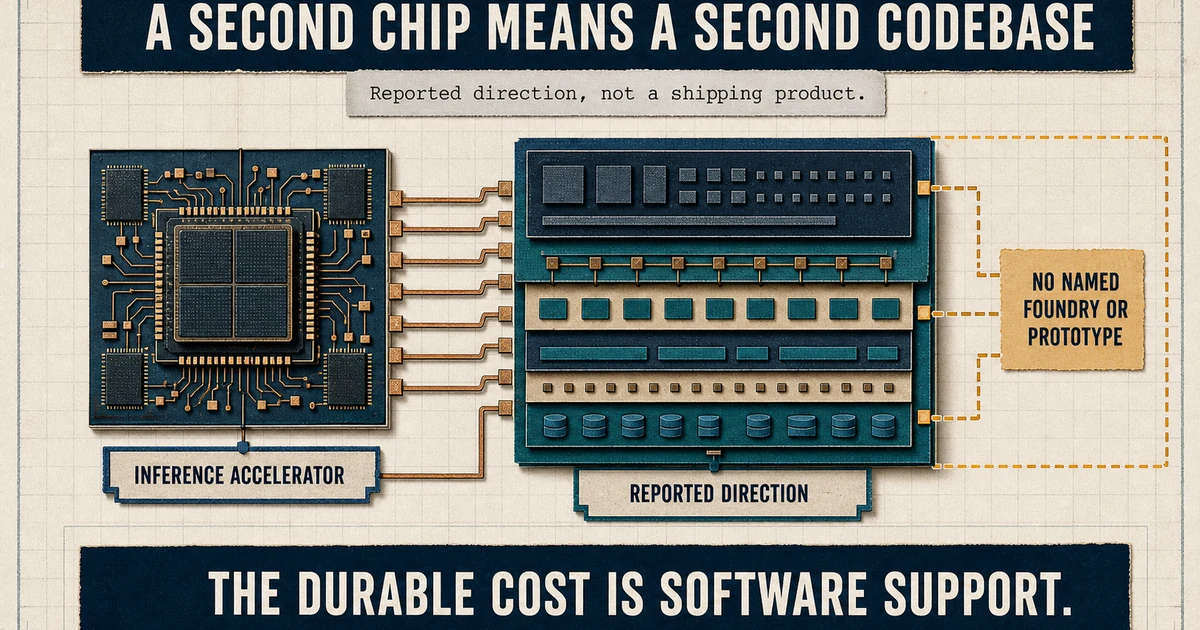
You design with the tools you are allowed to own. What that leaves out is who pays to make them usable. DeepSeek’s reported inference chip has no named manufacturer and no prototype, and the durable cost it implies is not silicon at all — it is a software target that has to be maintained for as long as the chip exists.
The Report Is Intent, Not Yet Silicon
DeepSeek, the Chinese AI lab known for cost-efficient models, is reported to have spent about a year designing an AI inference chip with outside design and foundry partners. The published reporting names no manufacturer and identifies no working prototype. This is therefore evidence of direction, not evidence of a product ready to ship.
That ceiling matters because a chip project has multiple execution gates. Choosing an architecture is not the same as securing a foundry. Securing a foundry is not a tape-out. First silicon is not acceptable yield, and acceptable yield is not a qualified production fleet. Packaging, memory, runtime support, and volume capacity can each become the constraint after the preceding problem is solved.
The useful question is not whether DeepSeek can announce an intention to design silicon. It is where the bottleneck moves if that intention becomes hardware.
Why Inference Fits the Available Manufacturing Base
The inference focus is the tell. DeepSeek did not reportedly choose inference because training no longer matters. It chose the part of the workload that better fits the manufacturing base and the economics available to a model lab.
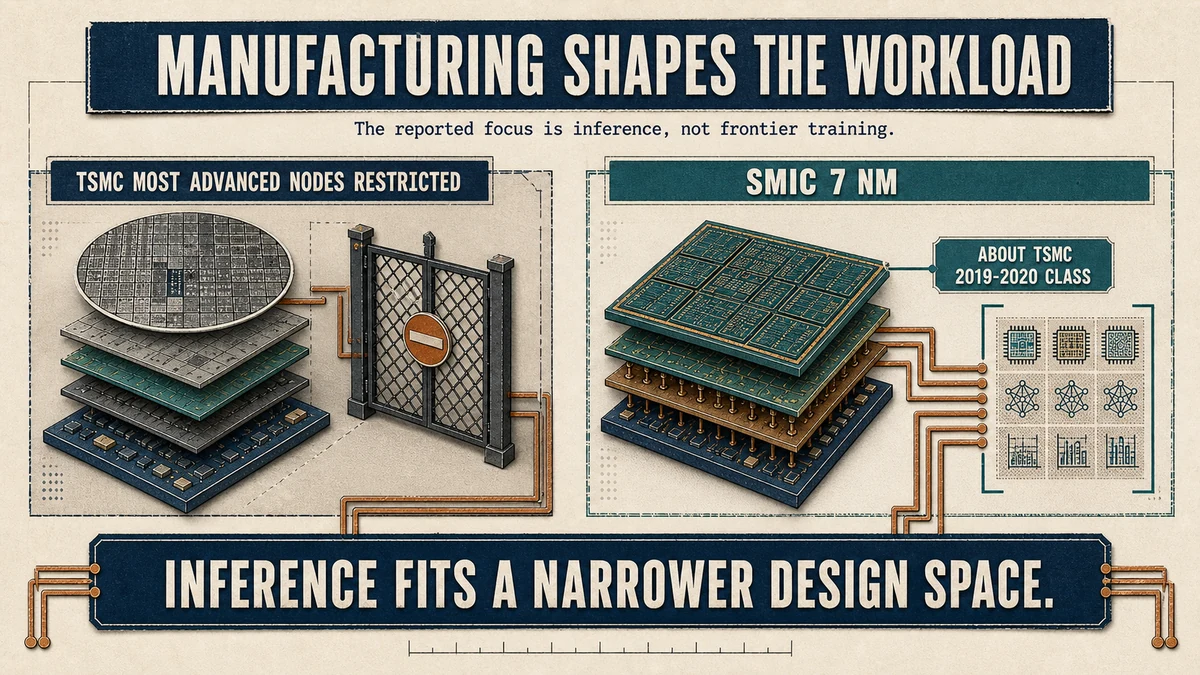
US export controls block Chinese firms from TSMC’s most advanced nodes, forcing greater reliance on domestic foundry SMIC. The published baseline places SMIC’s 7-nanometer process roughly at TSMC’s 2019-2020 state of the art. That gap is especially punishing when the objective is a frontier training accelerator, where leading-edge density, memory bandwidth, communication, and power efficiency all compound at scale.
Inference presents a narrower target. The trained model runs repeatedly, and the model operator pays for every request. The baseline reports an estimate that roughly 70% of AI compute demand is expected to come from inference. Even modest gains in latency, energy use, or hardware utilization can accumulate across a large serving fleet.
That is the problem a custom chip could remove: dependence on a general-purpose outside accelerator for a recurring workload whose cost DeepSeek directly bears. Hardware-model co-design could let the lab optimize around its own architectures instead of trying to match Nvidia across every workload. It could also provide more control over availability and serving economics. The policy mechanics remain part of that calculation, including which chips get let back through the gate and on what terms.
The pattern is familiar from hyperscaler custom silicon, but the constraint is sharper. When access to the best hardware narrows, large buyers design around the hardware they can obtain. Sanctions and Beijing’s push for domestic alternatives to Nvidia accelerate that vertical-integration logic. It also sits inside the broader contest over who captures the value once a capability is cheap to run.
The Bottleneck Moves Into Yield, Capacity, and Qualification
A domestic inference accelerator could reduce exposure to restricted imported chips. It would not eliminate the semiconductor bottleneck. It would move it into foundry capacity, usable yield, equipment, materials, packaging, memory, and production qualification.
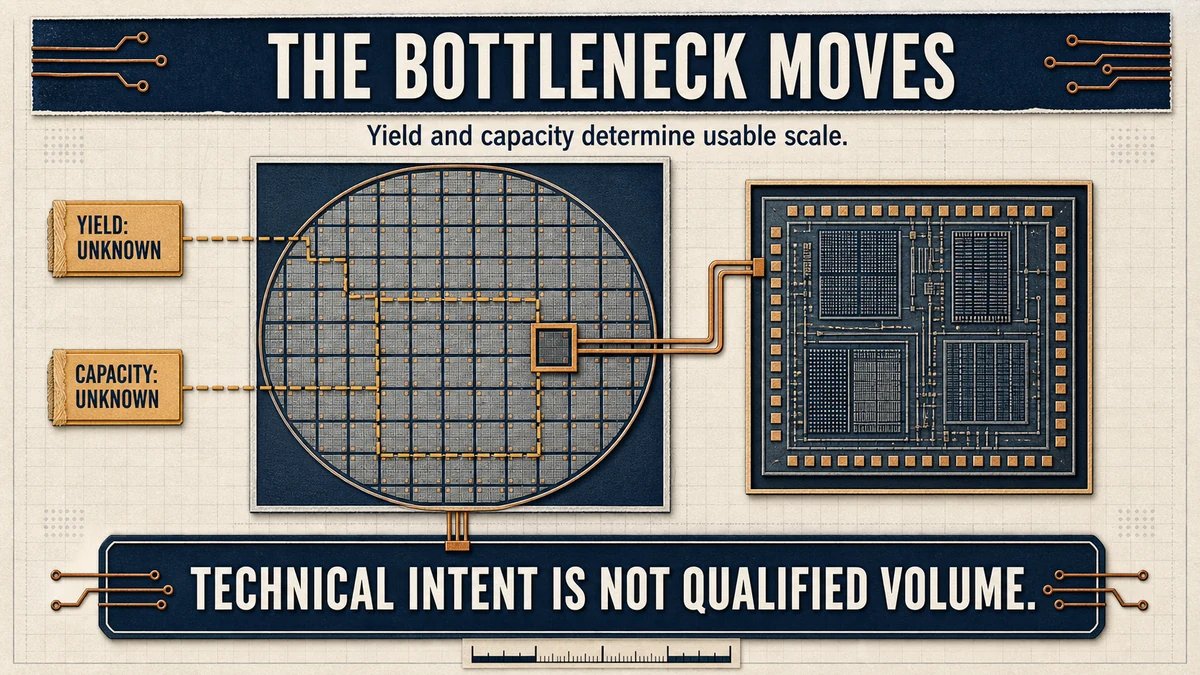
The baseline specifically identifies yield and capacity as constraints at SMIC. Yield determines how many usable dies emerge from a wafer. Low yield raises the effective cost of every working accelerator and can make a technically sound design uneconomic. Capacity determines whether the chip can move beyond limited internal deployment. A model lab gains little strategic independence if the foundry can supply only a fraction of its serving requirement.
Equipment and materials shape both outcomes. A trailing-node process may be established, but an unusually large AI die can still be difficult to fabricate economically. Packaging and memory can create additional constraints because an accelerator is valuable only as part of a complete system capable of feeding the compute units. The published evidence does not establish DeepSeek’s process node, package, memory configuration, or schedule, so none should be treated as settled.
Qualification then becomes the next gate. A prototype that executes a model is not automatically ready for continuous production serving. DeepSeek would need stable behavior across chips and production lots, repeatable performance, thermal and power validation, failure diagnosis, and a supply plan. Each removed problem exposes another one.
The equipment industry feels this shift as well. A larger captive Chinese hardware ecosystem redirects tool and materials demand toward mature and trailing-node capacity instead of simply recreating leading-edge demand. That changes the customer and product mix for fab suppliers, even when total domestic investment rises.
A Second Chip Creates a Standing Software Obligation
The serving-cost argument explains why a model lab might accept these risks. A custom accelerator lowers DeepSeek’s costs only if DeepSeek’s own stack runs on it efficiently. The lab pays for the port, but it also keeps the saving. That alignment is the strongest case for vertical integration.
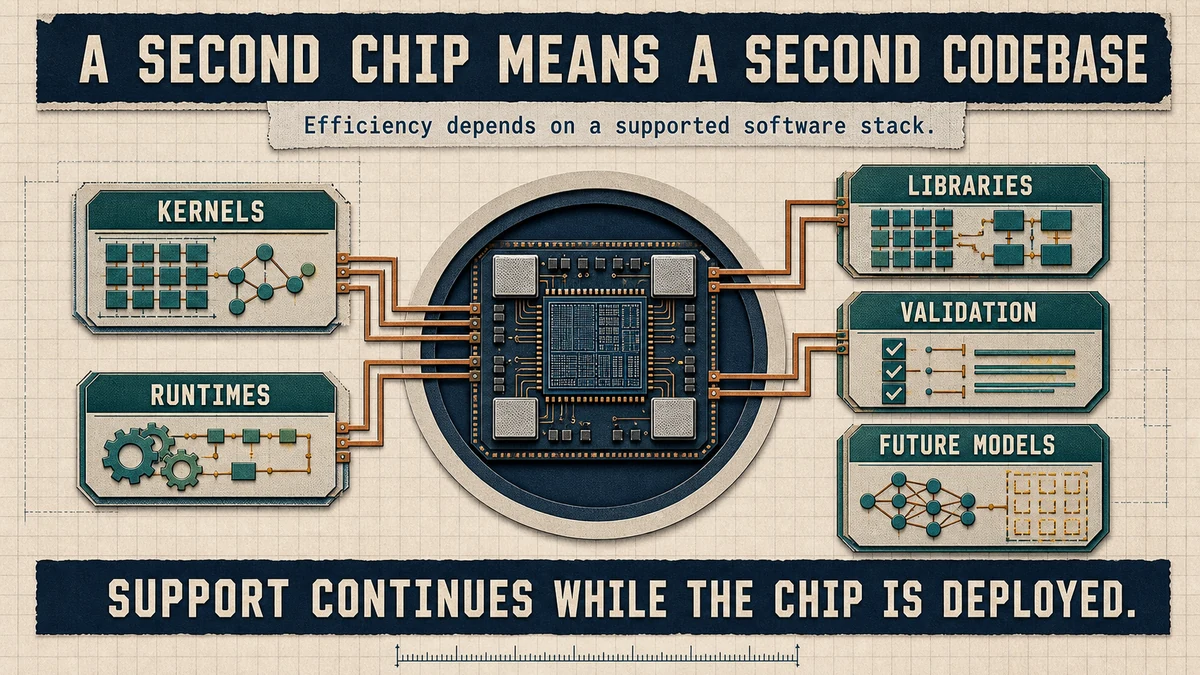
The bill arrives in kernels, libraries, compiler support, communication code, runtimes, deployment tools, monitoring, and validation. These are not accessories added after the chip is finished. They determine whether the chip can perform useful work at all.
A second hardware target is also not a one-time port. Every future model architecture has to be evaluated against it. New operators may require kernels. Numerical behavior must be checked. Performance changes need profiling rather than assumption. Runtime releases must be tested across old and new devices, while production teams need tools that can separate a software regression from hardware behavior.
A tape-out is a dated capital milestone. Software support is a recurring operating obligation. It lasts as long as the chip remains deployed, and it persists even if the next model generation changes the workload the original design was meant to accelerate.
For DeepSeek, that cost can still make sense because the same organization owns both the workload and any efficiency gain. For everyone else, the arithmetic can invert. A software company serving customers on both sides of the technology divide may have to support Nvidia-plus-CUDA outside China and one or more domestic targets inside it. High-level portability does not erase different kernels, libraries, memory behavior, communication paths, or performance characteristics.
This is where fragmentation becomes more important than the success of any single chip. If domestic accelerators share a stable software layer, developers may face one additional ecosystem. If each design requires separate tuning and release work, the second codebase becomes several codebases.
Value Accrues to the Owner of the Workload, While Risk Spreads
DeepSeek would capture the clearest upside. It could gain more control over inference supply, optimize silicon around its own models, and keep any reduction in serving cost. Unlike a merchant chip vendor, it does not need the first design to serve every customer or workload. Internal use can justify a narrower accelerator.
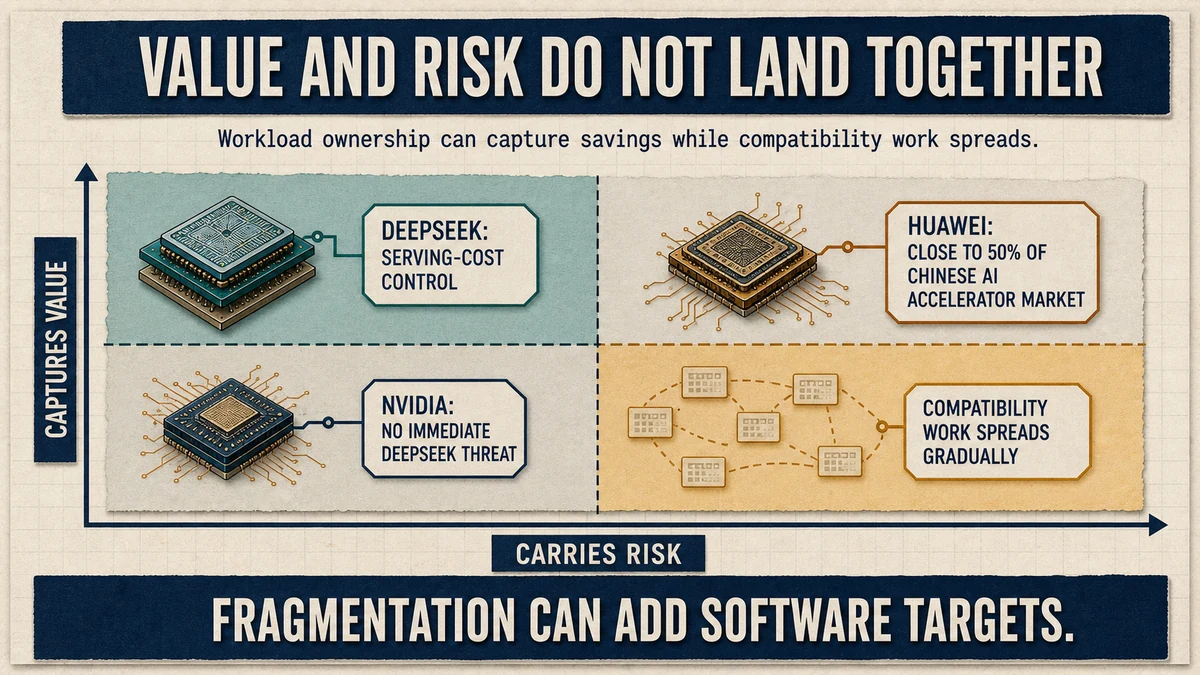
DeepSeek would also own the largest integrated risk. It would bear design expense, schedule delays, foundry limitations, low yield, inadequate volume, weak real-world performance, and the long-term cost of software maintenance. If the chip underperforms, the lab cannot treat the software investment as separate from the hardware decision.
SMIC and domestic equipment and materials suppliers could capture additional demand, but they would carry pressure to deliver usable yield and capacity. Model developers, inference-framework maintainers, and software vendors would carry portability and qualification costs when customers require multiple ecosystems. The value may concentrate with the company that owns the workload, while much of the compatibility burden spreads outward.
Nvidia carries the strategic risk of further China share erosion. The published baseline estimates Huawei could capture close to 50% of the Chinese market this year, with more domestic designs arriving. That points toward a walled Chinese AI-hardware ecosystem running a node or two behind the global leading edge.
It does not make DeepSeek’s reported chip an immediate Nvidia threat. With no named manufacturer or prototype, there is no basis for claiming near-term displacement. The more defensible conclusion is gradual fragmentation: Nvidia-plus-CUDA remains powerful, Huawei expands inside China, and new domestic accelerators add targets that software teams must support.
The Milestones That Would Change the Assessment
The first meaningful milestone is a named foundry or tape-out. That would move the project from reported intent toward execution. A working prototype would answer a different question, while measured performance, disclosed packaging and memory, acceptable yield, and production qualification would each remove another layer of uncertainty.
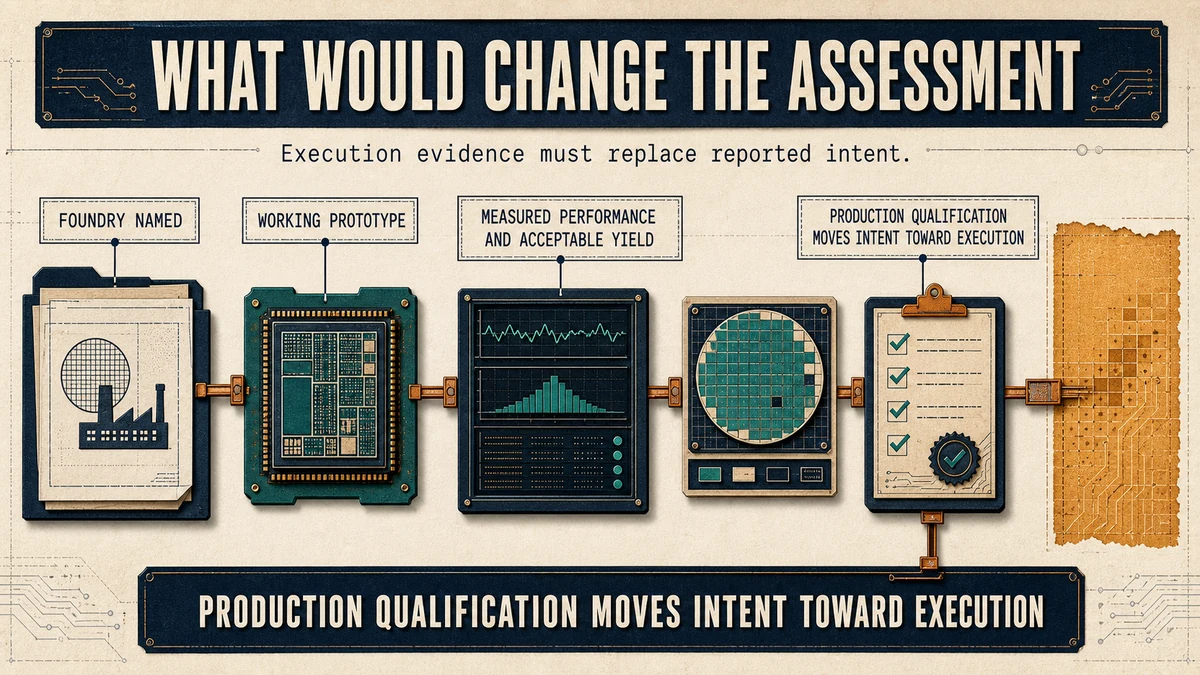
The software milestone is equally important. A supported compiler and runtime, working kernels, repeatable model performance, and an upgrade path for future architectures would show that DeepSeek is building a platform rather than a single piece of silicon. Evidence of a common domestic software layer across multiple designs would reduce the portability burden. Evidence of incompatible stacks would confirm that the new bottleneck is fragmentation.
Export controls are no longer only blocking Chinese AI hardware; they are helping specify its shape. The constraints favor inference-first designs that can use trailing-node domestic capacity and target recurring internal workloads. What they do not remove is cost. The cost moves into yield, capacity, equipment, materials, qualification, and the software surface required to keep the hardware useful.
Sanctions did not stop this reported chip; they narrowed its design space. DeepSeek still has to decide what to build inside that space and prove that the resulting system is worth operating. Until a partner and prototype appear, the project is a direction to watch rather than a shipping product. If it advances, the durable question will not be whether China can produce one more accelerator. It will be who pays to maintain the second codebase for as long as that accelerator exists.
This article is for informational and educational purposes only and does not constitute investment, financial, or legal advice.
Sources
- Semafor – roughly one year of design work, inference focus, no named partner or prototype (2026-07-07)
- The Next Web – SMIC foundry, sidestepping US curbs, 7nm (2026-07-07)
- Cryptopolitan – roughly 70% of AI compute demand is inference (2026-07-07)
- Xpert Digital – SMIC 7nm comparable to TSMC 2019-2020 class; manufacturing gap (2026-07-07)