The rocket is the easy part. Rocket Lab already builds spacecraft and launches them; the piece it cannot manufacture is a qualified communications network with regulated spectrum. It has agreed to pay an enterprise value of about $8 billion for Iridium, but ownership still depends on shareholder approval, regulatory clearance and permanent financing. The scarce asset is not a license alone: it is the license working with satellites, partners, 2.627 million billable subscribers and recurring service revenue.
Executive Summary: Why Spectrum & Subscribers Outvalue Rockets
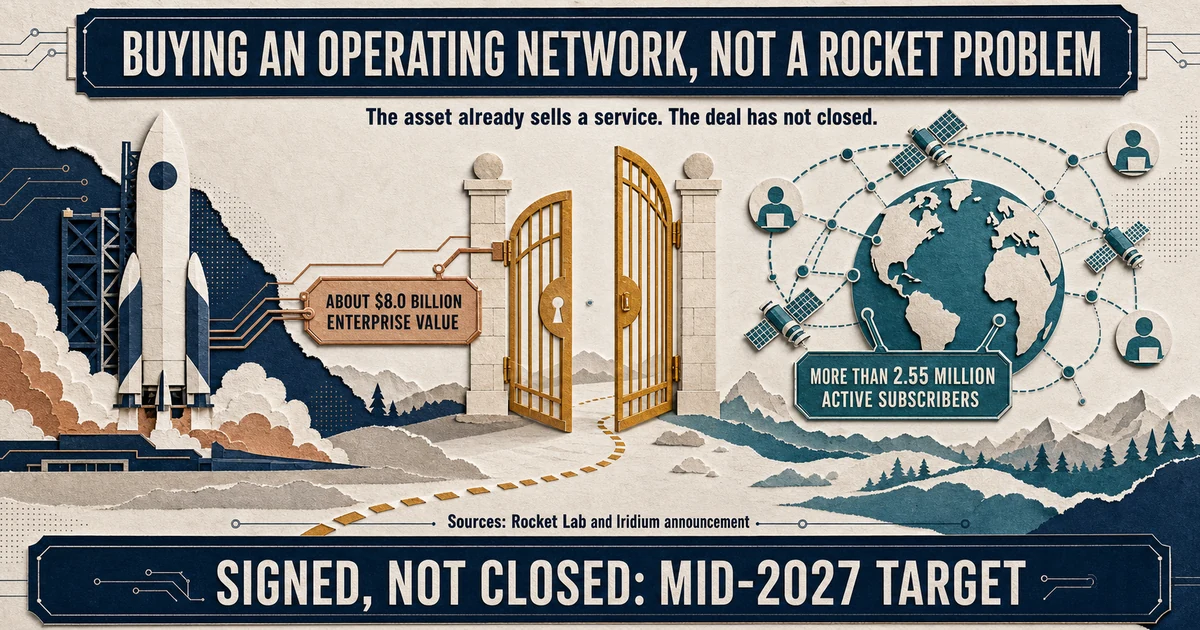
- Rocket Lab agreed on June 29, 2026 to acquire Iridium Communications at an enterprise value of about $8.0 billion — $54 per share in cash and stock — with closing expected in mid-2027.
- It is the second multibillion-dollar satellite-communications agreement announced in roughly ten weeks. Amazon–Globalstar is also pending, with a 2027 target close.
- Rocket Lab has commitments for a $3.6 billion, 364-day senior secured bridge facility. A permanent debt-and-equity mix remains a closing gate.
The $8 Billion Transaction: Rocket Lab Merges with Iridium
Rocket Lab and Iridium announced a definitive merger agreement on June 29. Iridium holders are to receive $27 in cash plus Rocket Lab shares, subject to an exchange-ratio collar, for a notional value of $54 per share and an enterprise value of about $8 billion. The deal is expected to close in mid-2027 only after Iridium shareholder approval, regulatory approvals and other conditions; until then, the businesses remain separate.
What Rocket Lab proposes to buy is an operating business rather than a project. Iridium runs a low-Earth-orbit constellation with global coverage including the poles, licensed L-band spectrum and more than 500 partners across maritime, aviation, government and industrial connectivity. In the second quarter of 2026 it reported $225.2 million of revenue, 72% from service, and 2.627 million billable subscribers. That is a functioning service base; claimed integration benefits remain forward-looking.
Regulated Spectrum & 2.6M Subscribers: Rocket Lab’s Unmatchable Moat
Related Analysis: On-Orbit Servicing Was Due in 2021. The Arms Arrive in 2027.
For a decade, winning in space meant launch cost — who could put a kilogram into orbit most cheaply. Rocket Lab won a version of that contest and then ran into its limit: cheap launch makes constellations easier to build for everyone, including competitors, which is a strange kind of moat.
Licensed, regulatory-grade spectrum behaves differently. It is slow and difficult for newcomers to replicate because it is coordinated and regulated rather than manufactured. Hardware can be copied; globally harmonized rights cannot. But public disclosure does not assign the announced $8 billion value to spectrum alone. The price covers the rights together with satellites, gateways, software, staff, partner and government relationships, customer contracts and current cash flow. The defensible claim is that spectrum is indispensable inside the system, not that it is the system’s disclosed appraisal.
The same capital logic is visible elsewhere in technology, where the race is to lock up scarce compute and foundry capacity before prices reset. What makes the orbital version sharper is that the scarce good has a regulator attached. New supply does not appear because demand rose.
Financial Transformation: Converting Volatile Launch Income into Subscription Cashflow
If the transaction closes, owning the network would add a subscription base to a launch-and-build company with lumpy project revenue. Iridium reported $871.7 million of 2025 revenue, with commercial and government service revenue representing 73% of the total. That is a different financial animal: contracted and repeating, but still accompanied by equipment and engineering work and not yet consolidated into Rocket Lab’s accounts.
It is also a different operating discipline. A launch provider fails by missing a window; a network operator fails by dropping service to maritime, aviation and industrial customers who built their own operations around continuous coverage. The 500-plus partner relationships are the asset and the obligation at the same time.
For the operators on the other side of those contracts, the deal cuts both ways. They inherit an owner with its own manufacturing and launch capacity, which should make constellation refresh faster and cheaper. They also inherit a new dependency risk if service priorities shift once the network sits inside a vertically integrated company with defense ambitions and a debt schedule.
Regulatory & Financing Timeline: The Road to 2027 Mid-Year Closing
Here is the clock. Amazon announced its agreement to acquire Globalstar on April 14, 2026. Rocket Lab announced the Iridium agreement on June 29, roughly ten weeks later. Both transactions target 2027 closings, so the interval measures announcement timing, not two completed integrations.
That year holds more than paperwork. Shareholder approval, spectrum and defense-asset review, an effective registration statement, permanent financing and integration planning all sit inside it, and any of them can move the date. The $3.6 billion bridge commitment is temporary by design; the final interest cost, dilution, maturity profile and capital left for Neutron and constellation renewal are not established by the commitment alone.
The consideration structure adds a third variable. Because Iridium holders are taking cash and stock, their final value is tied to Rocket Lab’s share performance through to closing — so the acquirer’s multiple is not just how the deal gets paid for, it is part of what the deal is worth to the seller.
Space Consolidation Wave: Small-Launch Providers Evolving into Prime Contractors
Two multibillion-dollar satellite-communications agreements announced in ten weeks suggest that established players place strategic value on spectrum, direct-to-device capability and operating constellations. They do not yet prove that the integrations work or that every remaining operator must sell. For the remaining independents, the choice among partnership, sale and heavy investment becomes more visible only if these proposed combinations close and preserve service quality.
The consequences reach past the sector. Telecom carriers face intensified competition to connect ordinary phones from space, which pushes them toward deeper satellite partnerships rather than away from them. Defense buyers gain a vertically integrated Western supplier holding sovereign launch, manufacturing and spectrum in one place — a combination that is difficult to assemble and, for procurement officers, difficult to ignore.
What to watch: the S-4/proxy and shareholder vote; regulatory conditions on spectrum and defense-sensitive operations; replacement of the 364-day bridge with permanent financing; Iridium partner retention, service revenue and network availability; and whether Rocket Lab can lower the cost and schedule of accepted replacement satellites without weakening continuity.
Measuring Synergies: Benchmarking Against Historical Space Mergers
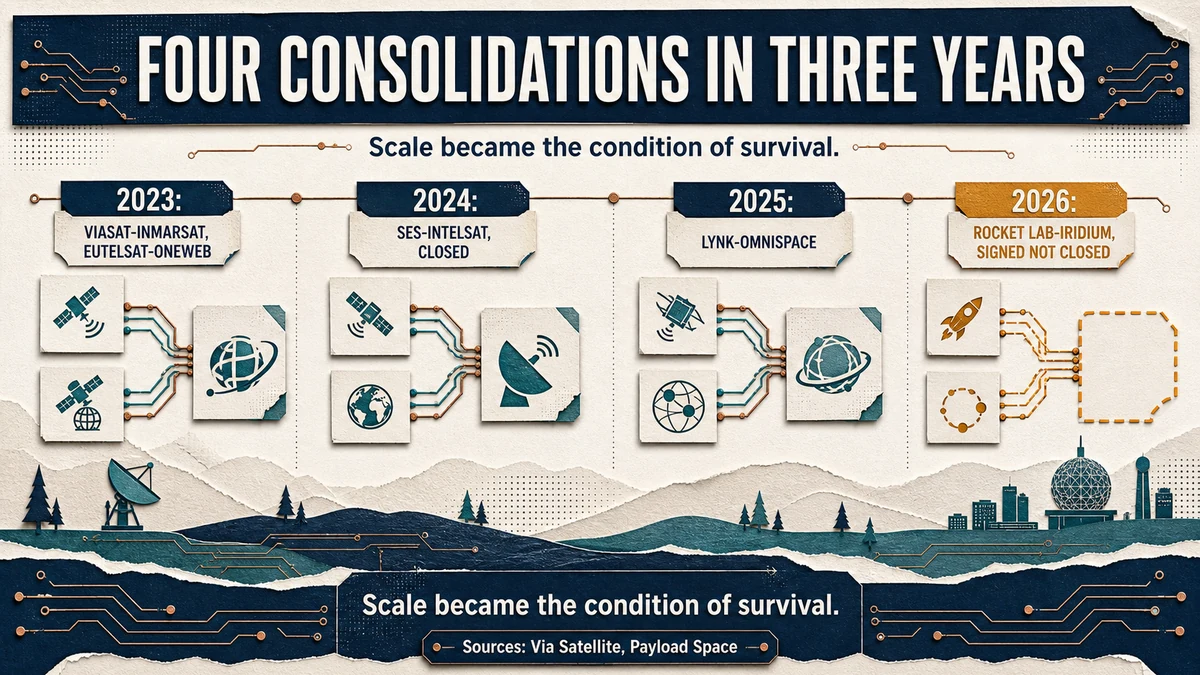
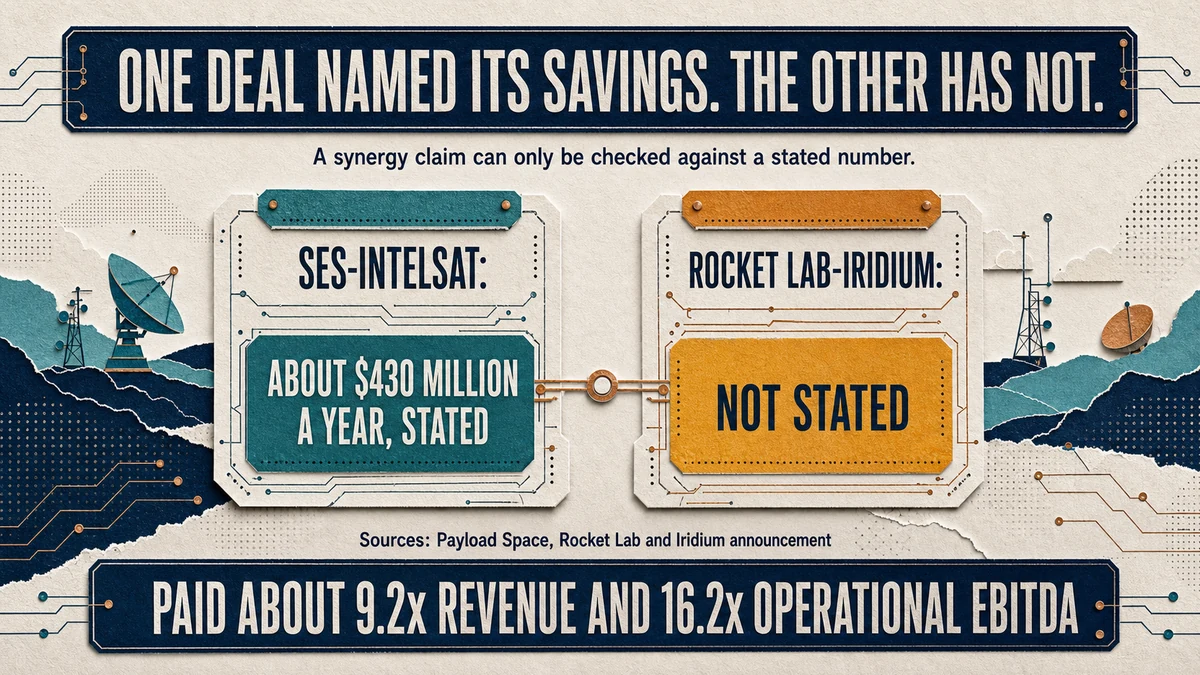
This is not the first operator bought for the promise of a cheaper combined network, which means the claim can be measured rather than debated. Viasat took Inmarsat and Eutelsat took OneWeb in 2023. SES took Intelsat in 2024 and closed it, producing a fleet of roughly 90 geostationary and 30 medium-orbit satellites with access to low orbit through an existing agreement — and, more usefully here, a stated target of about $430 million in annual cost savings. Lynk and Omnispace agreed to merge in 2025. Four consolidations in three years is not a coincidence; it is an industry concluding that scale is the condition of survival.
That SES figure is the number to hold this deal against. It is a public, dated, quantified synergy claim from a comparable transaction, which is exactly what the Rocket Lab announcement does not yet contain. A buyer paying roughly 9.2 times revenue and 16.2 times a company-defined EBITDA measure is asserting that vertical integration produces savings of some size; until that size is named, the assertion cannot be checked against the one precedent that named its own.
The difference in direction is worth stating precisely, though, because it cuts both ways. SES and Intelsat were two operators merging horizontally — same business, fewer overheads, an obvious cost line to remove. Rocket Lab is a manufacturer and launch provider buying an operator, which is the SpaceX shape rather than the SES shape: the savings would come from building and launching replacement satellites more cheaply than a merchant supplier would, not from deleting a duplicate sales force. That is a harder synergy to prove and a slower one to arrive, because it only shows up when the constellation actually needs replacing. It is also the only version that would justify owning a rocket company in the first place.
Strategic Implications
The ten weeks between the two announcements still matters, but it is not evidence that two networks have already changed hands. Rocket Lab proposes to buy a scarce operating system: spectrum rights joined to satellites, partners, subscribers and recurring service revenue. The industries that depend on satellite connectivity should watch who eventually owns the pipes above them — and whether the new owner can refinance the purchase, preserve service and improve the replacement cycle. Those results, not the announcement clock alone, will set the cost and availability of connectivity on the ground.
Frequently Asked Questions
Is the Rocket Lab–Iridium combination a direct competitor to SpaceX Starlink?
Not in the way headlines suggest. Iridium’s global narrowband network serves different use cases than Starlink’s broadband constellation; the clearest overlap is emerging direct-to-device connectivity for ordinary phones, not home internet service.
Sources
- Payload Space — SES completed its Intelsat acquisition, producing roughly 90 geostationary and 30 medium-orbit satellites with low-orbit access through an existing agreement, and targeting about $430 million in annual cost savings — the nearest quantified synergy benchmark for this transaction
- Via Satellite — The consolidation sequence: Viasat/Inmarsat and Eutelsat/OneWeb in 2023, SES/Intelsat in 2024, Lynk/Omnispace in 2025; scale framed as the survival condition for smaller operators (2026)
- Rocket Lab and Iridium — joint transaction announcement — consideration, bridge commitment, timing, operating footprint and stated rationale (2026-06-29)
- SEC Exhibit 99.2 — transaction investor presentation — Iridium operating assets, 2025 financial figures and buyer claims (2026-06-29)
- Iridium Form 8-K — merger agreement, approval process and outside dates (2026-06-29)
- Iridium Q2 2026 results — revenue, service mix, subscribers and current operating evidence (2026-07-22)
View all sources
- Iridium 2025 Form 10-K — audited revenue mix, network and government-customer context (2026-02-12)
- Rocket Lab Q1 2026 Form 10-Q — liquidity, backlog, revenue and continuing capital needs (2026-05-07)
- Amazon and Globalstar — official transaction announcement — pending status, 2027 target and closing conditions (2026-04-14)
- Globalstar Form 8-K — definitive agreement and transaction status (2026-04-14)
This article is for informational and educational purposes only and does not constitute investment, financial, or legal advice.