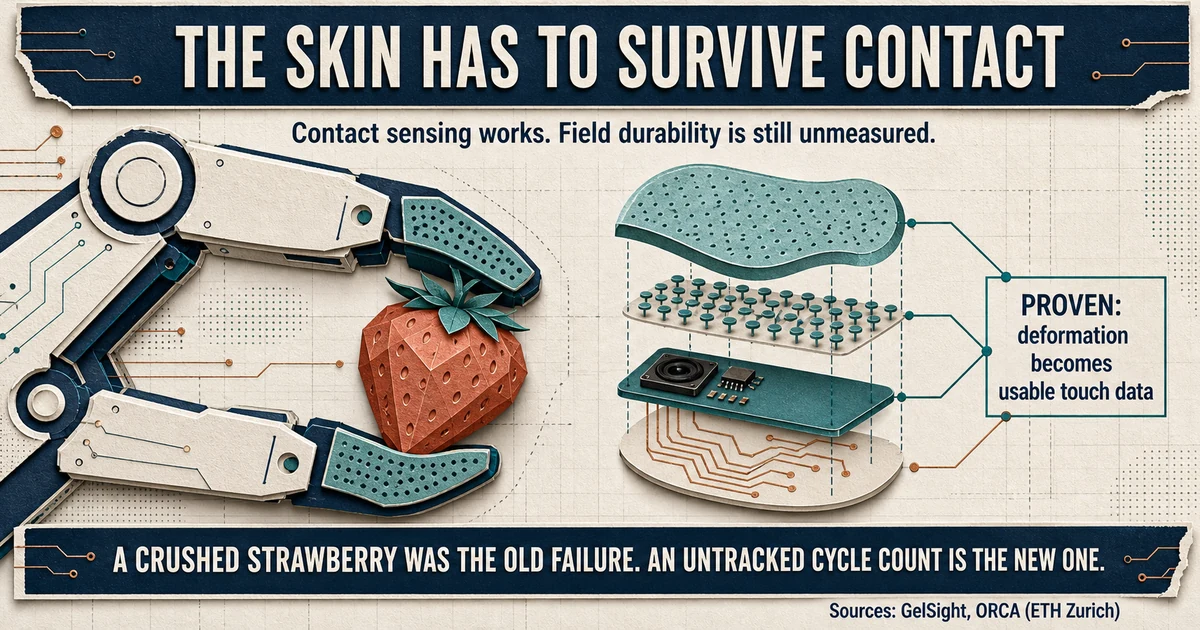
Put a robot hand on a real line and hand it something that bruises – a ripe strawberry, a full cup, a wiring loom that kinks if you pull it wrong. A modern system will identify the object and reach for it accurately. Then it closes its fingers and, often enough, crushes the object or lets it slip. The model knew what it was holding and where. What it could not do was feel how hard it was already squeezing. That gap – not the brain, not even the fingers – is where robots still fail at the last centimeter.
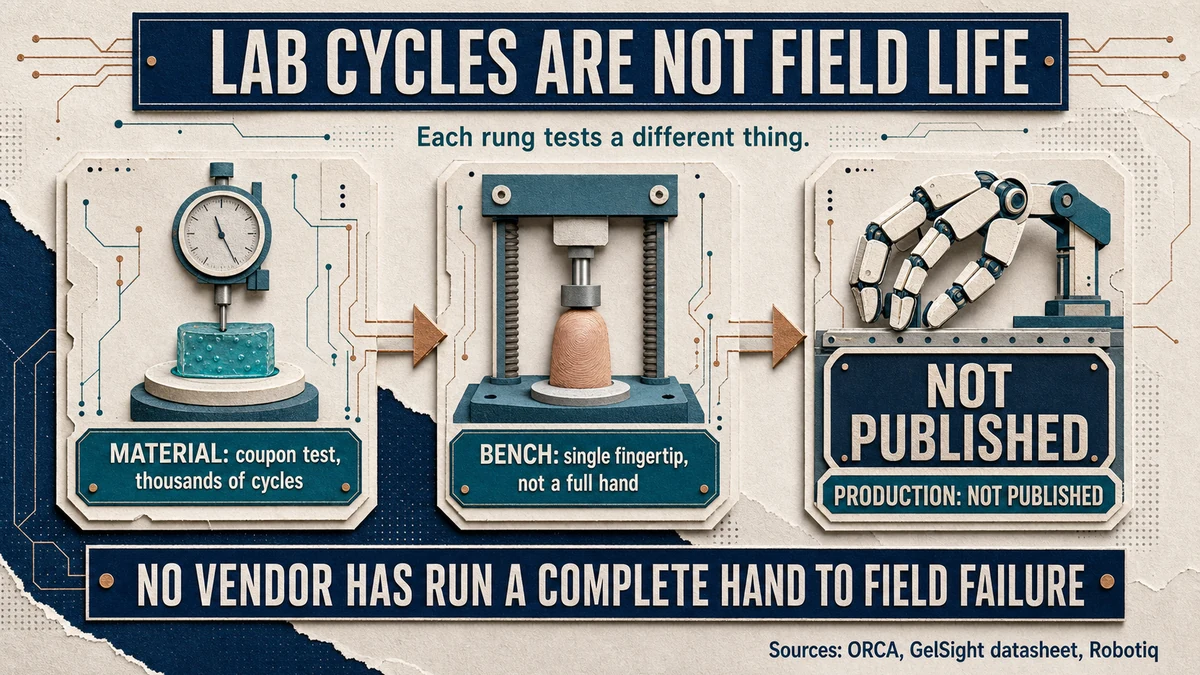
The field constraint links directly to the actuator and hand analysis and the perception layer. The closest thing to an endurance baseline is the ORCA tactile-hand study, which ran a complete tactile hand to skin and wiring failure on a named bench duty cycle — a laboratory result, not a production-line replacement interval.
The stack, rung by rung
It helps to put the whole robot stack on the same ladder any hardware component climbs – published paper, working prototype, customer validation, limited deployment, volume – because the layers are nowhere near the same rung.
The brain climbed fastest. In 2023, Google’s RT-2 showed a vision-language model could transfer web knowledge into robot control. Within two years Physical Intelligence shipped π₀, a generalist control model meant to run across different robot bodies; NVIDIA released GR00T N1 as an open foundation model for humanoids and gave it away; Google DeepMind folded the work into Gemini Robotics. General control is foundation-model territory now – high on the ladder, and being commoditized on purpose.
The fingers are the next layer up the body and the more visible constraint, where the hands and actuators remain the weak link. Below the fingers is the skin, which gets far less attention and sits far lower on the ladder.
The sensor is lower than the brain but genuinely moving. A decade ago GelSight-style sensors put a camera behind a soft gel and turned contact into an image, sharp enough to estimate how hard an object is from how the gel deforms – which means touch inherits the entire vision toolchain. In 2025 the design step itself became computational: a physically based rendering framework simulated a tactile sensor before it was built and produced a design that read embossed text about five times better than the prior human-expert version.
And vision-based tactile sensing has started to leave the paper stage: GelSight’s own Mini sensor ships today at a listed price, which puts one commercial part on the customer-validation rung a buyer can actually source. Meta’s Digit 360 fingertip — built with GelSight Inc as manufacturing partner — packs over 8 million taxels and registers forces down to 1 millinewton, but it is not a catalogue item: access runs through an application process rather than a store listing, which is a research rung, not a purchasing one.
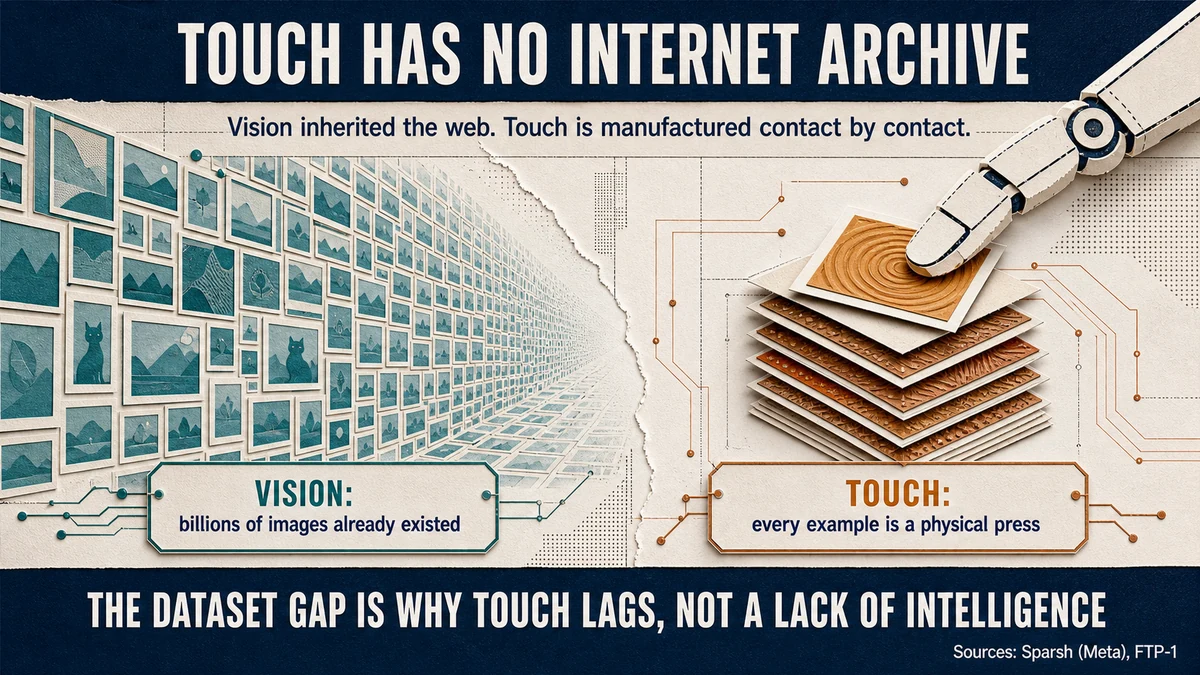
The dataset is the layer still stuck at research. Machine vision climbed its ladder on the back of the web: billions of images existed before anyone trained on them, and today’s robot vision and perception layer inherited that head start. Touch has no such archive. Tactile data exists only where a sensor has physically pressed on something, so the dataset that would make touch learnable has to be manufactured contact by contact.
Meta’s Sparsh is the first serious attempt to bootstrap it – self-supervised touch representations pretrained on more than 460,000 tactile images across different sensors, so downstream tasks stop needing task-specific labels. That is a paper with a roadmap, not a shipped standard.
Twenty months on, the attempt has scaled: FTP-1, a publicly released tactile corpus, spans roughly 3,000 hours of human and robot demonstrations across 21 tactile sensors from 26 sources. Set against the billions of images vision trained on, that is still a rounding error.
And the skin material – the part that actually has to survive contact – is the lowest rung of all.
Why the skin tears: fatigue is the wall
The electronic-skin field has promised robot skin for more than a decade, and its hardware reviews keep getting more sophisticated. The leading material family is hydrogels: soft like tissue, water-based, and able to carry signals by ionic conduction, the same way biological skin does. The lineage is decorated with real milestones – the double-network trick that first made hydrogels tough instead of brittle, a stretchable transparent ionic touch panel from Seoul National University, and the hydrogel-elastomer hybrids that solved how to bond a wet material to a dry machine.
What none of that solved is fatigue. A fingertip is pressed, sheared, and released millions of times; a gel that tears after a few hundred cycles is a demo, not a component. That is the exact wall the most interesting skin paper of 2025 goes after. A fatigue-resistant, mechanoresponsive color-changing hydrogel from Michigan State holds its optical readout — the color signal a camera reads as force — through up to 10,000 cycles of tensile loading at strain rates of 0.02 to 0.35 per second, with fracture toughness around 3,000 J/m² in a single load cycle and a fatigue threshold up to 400 J/m² under repeated loading.
Its cleverest feature doubles as a readout: the material changes color under stress, so a camera can read force straight off the skin – the materials route and the GelSight route converging into a single part.
Ten thousand cycles is a real result. It is also two to three orders of magnitude short of a fingertip’s service life. The useful way to read it is as a rung change, not a finish line: the field has moved from can a soft material sense? to can it sense for years? – and the second question is a manufacturing question, the kind industry knows how to grind down over time.
The number no vendor has published
Here is where an honest audit stops short of a verdict. Almost everything above is measured under a microscope: cycles to fracture, taxel counts, force resolution. None of it is the number that actually decides a deployment. That number is reliability in service – mean cycles between failure for a full tactile fingertip on a working hand, and how often a human has to step in to fix or replace it.
One bench run has gone after exactly that. ETH Zurich’s ORCA hand was driven through 2,250 grasps on a named duty cycle and reported where it came apart: skin wear pushed one fingertip sensor’s trigger threshold from a rated 0.29 N to an observed 6.38 N somewhere between 2,000 and 4,000 grasps, and wiring began failing between 4,500 and 7,000. That is a complete tactile hand run to failure and written down, which is more than the field usually gets. It is also a laboratory bench with a researcher beside it. The number that decides a purchase order is the same measurement taken on a working line – an intervention rate and a task-success curve across a shift, with the duty cycle named. For that, nobody has published it.
The published range for what does exist makes the point on its own. GelSight rates its own Mini sensor at 1,000 coin presses before the gel needs replacing — a bench number, one order of magnitude below the lab hydrogel above, on the exact commercial part the previous section names. Robotiq claims its tactile fingertip past 1.5 million accelerated grasp cycles on an uneven surface, without stating the load or frequency behind that figure. Between a vendor’s own 1,000 and another vendor’s unverified 1.5 million sits three orders of magnitude of published tactile durability claims — and the two are not even measuring the same thing, one counting coin presses and the other accelerated grasps. That spread is the tell that no shared test exists yet.
That absence is not a detail; it is the gate. A skin that survives 10,000 lab cycles at a controlled strain rate may last far fewer on a line that also brings abrasion, temperature swings, solvents, and off-axis impacts – or it may last longer if the loads stay gentle. Until someone runs a full tactile hand to failure on a real task and reports the mean-cycles-between-failure and the human-intervention rate, the skin layer cannot honestly be scored past prototype, however good the microscope numbers look.
So name the metric and the party who would have to publish it. The groups now assembling tactile hardware in public – Meta with Digit Plexus, GelSight building Digit 360, Wonik Robotics manufacturing the next-generation Allegro Hand with Plexus integrated – are the ones holding the parts to run that test. The first credible mean-cycles-between-failure and intervention-rate figure from a full tactile hand on a repetitive task is the datum that promotes robot touch off the prototype rung. Everything before it is promise.
What to Watch
- A mean-cycles-between-failure and intervention rate for a full tactile hand on a repetitive task – the number that promotes the skin layer off the prototype rung, and the group named above has the parts to publish it.
- A humanoid that ships with full-hand tactile arrays rather than sparse force sensors plus vision – the first bill of materials that genuinely needs durable skin.
- Touch pretraining spreading across sensor types, the way vision backbones did – the sign the dataset layer is leaving research.
- Skin cycle life climbing from thousands toward millions – the single number that turns a lab material into a component.
The sensor layer is commercializing anyway
The missing durability curve has not stopped the layer from becoming a market. XELA Robotics opened commercial orders in the first quarter of 2026 for its uSkin sensor integrated into Tesollo’s DG-5F hand, with resolution the company states down to 0.1 gram-force — a named sensor inside a named hand a buyer can order, which is a different stage from a paper. GelSight remains the vision-based leader through the Digit 360 work with Meta and Wonik Robotics. Contactile sells the opposite architecture: engineered squeeze, hold and slip signals delivered straight to a gripper without a learned model in the loop. Shadow Robot and Sanctuary AI work the same ground from the hand side. The whole flexible tactile-sensor category is put at roughly $266 million in 2025 rising toward $795 million by 2034 in one market-research estimate — small against the humanoid noise, growing at about 17% a year.
What that list shows is that the competition has already split by architecture rather than by brand. Camera-behind-gel sensing, magnetic and taxel arrays, and engineered-output sensors are three different bets on where the intelligence should live: in the image, in the array, or in the sensor itself. A buyer choosing between them is choosing a failure mode as much as a signal — a gel that clouds, an array that drifts, a transducer that saturates.
And none of the three publishes the number that would let the choice be made on evidence. Not one vendor in that list states a service life for its sensing surface under a named duty cycle. The market is maturing on price, resolution and integration while the durability question stays exactly where it was, which means a purchasing decision made today is made on specifications that describe a new sensor rather than a used one.
Bottom Line
Robot touch is not one problem but four layers at four different rungs, and the industry is scaling the ones that already have data because that is where scaling is cheap. The layer that actually gates daily use is the skin, and the skin is a lab prototype held back by a number no one has published for a working deployment. The next foundational moment in robotics comes from whoever first makes a tactile skin that survives a shift and proves it with a failure-rate curve — not a demo video, a curve. Until that curve exists, a robot that can name and locate a strawberry still cannot be trusted to pick it ten thousand times without crushing one. Feeling the grip, and feeling it on the ten-thousandth try, is the last unshipped sense.
The curve either appears or it does not, and there are four places it could appear first.
- A vendor states a service life. The narrow test: any tactile-sensor or hand maker publishing a replacement interval or cycles-to-degradation figure for its sensing surface under a named duty cycle. GelSight already rates its Mini gel at 1,000 coin presses, which shows the disclosure is possible; the question is whether it extends to a working hand rather than a bench part.
- Digit 360 becomes purchasable. It is currently reached by application to a Call for Proposals, not by purchase. If it moves to a listed price and stock, the customer-validation rung this article describes is genuinely occupied rather than approximated by other hardware. If it stays application-only through 2027, the rung is held by GelSight’s own catalogue parts and not by the flagship.
- One architecture wins a production line. Camera-behind-gel, taxel array and engineered-output sensing are three live bets. The test is a named sensor in a named robot doing paid production work, disclosed by either party. A single such disclosure would say more about which failure mode industry will tolerate than any resolution specification.
- The category’s growth shows up as shipments. A tactile-sensor market put near $266 million is small enough that a handful of fleet orders would move it. If the figure is revised upward on the back of named robot deployments rather than research purchases, touch has started shipping; if growth stays in laboratories and dev kits, the layer is still pre-deployment whatever the forecast says.
Sources
- Embedded Computing Design — CES 2026: XELA Robotics uSkin integrated into Tesollo’s DG-5F robotic hand, commercial orders opening in Q1 2026, sensing stated down to 0.1 gram-force (2026)
- Intel Market Research — Market-research estimate, not audited disclosure: flexible tactile sensors for robots at roughly $266 million in 2025 rising toward $795 million by 2034 (about 17% CAGR); Contactile, Sanctuary AI, Shadow Robot and XELA named among active suppliers (2026)
- proceedings.mlr.press — Zitkovich et al., RT-2: vision-language-action models transfer web knowledge to robotic control (CoRL 2023 / PMLR) (2023)
- arxiv.org — Gemini Robotics Team, Gemini Robotics: bringing AI into the physical world (arXiv) (2025-03)
- arxiv.org — Bjorck et al., GR00T N1: an open foundation model for generalist humanoid robots (NVIDIA, arXiv) (2025-03)
- arxiv.org — Black et al., π₀: a vision-language-action flow model for general robot control (Physical Intelligence, arXiv) (2024-10)
View all sources
- arxiv.org — Higuera et al., Sparsh: self-supervised touch representations for vision-based tactile sensing (Meta, CoRL 2024) (2024-10)
- science.org — Shih et al., Electronic skins and machine learning for intelligent soft robots (Science Robotics) (2020)
- doi.org — Yuan, Srinivasan, Adelson, Estimating object hardness with a GelSight touch sensor (IROS) (2016)
- nature.com — Agarwal et al., Vision-based tactile sensor design using physically based rendering – ~5x better than expert design (Communications Engineering) (2025-02)
- doi.org — Ying & Liu, Skin-like hydrogel devices for wearable sensing, soft robotics and beyond (iScience) (2021)
- pubs.rsc.org — Gong, Why are double network hydrogels so tough? (Soft Matter, DOI 10.1039/b924290b) (2010)
- science.org — Kim, Lee, Oh, Sun, Highly stretchable, transparent ionic touch panel (Science – Seoul National University) (2016)
- sciencedirect.com — Leogrande et al., Electronic skin technologies: from hardware building blocks and tactile sensing to control algorithms and applications (Sensors and Actuators Reports) (2025)
- nature.com — Yuk et al., Skin-inspired hydrogel-elastomer hybrids with robust interfaces and functional microstructures (Nature Communications, MIT) (2016)
- pubs.acs.org — López-Díaz, Vázquez, Vázquez, Hydrogels in soft robotics: past, present, and future (ACS Nano) (2024)
- advanced.onlinelibrary.wiley.com — Liu et al., Fatigue-resistant mechanoresponsive color-changing hydrogels for vision-based tactile robots – up to 10,000 cycles, ~3,000 J/m² toughness, fatigue threshold up to 400 J/m² (Advanced Materials, Michigan State) (2025)
- ai.meta.com — Meta AI blog: Sparsh (pretrained on 460,000+ tactile images) + Digit 360 fingertip (over 8 million taxels, forces down to 1 millinewton) + Digit Plexus platform; strategic partnerships – GelSight Inc manufactures/distributes Digit 360, Wonik Robotics manufactures/distributes next-gen Allegro Hand with Plexus integrated (2024)
- nvidianews.nvidia.com — NVIDIA newsroom: Isaac GR00T N1 announced at GTC as the world’s first open humanoid robot foundation model (2025-03-18)
- arxiv.org — Toshimitsu et al., ORCA: an open-source, reliable, cost-effective, anthropomorphic robotic hand — 2,250 grasps completed on a named bench duty cycle; fingertip sensor trigger threshold drifting from a rated 0.29 N to an observed 6.38 N between 2,000 and 4,000 grasps; wiring failures between 4,500 and 7,000 (ETH Zurich, arXiv) (2025-04)
- gelsight.com — GelSight Mini product page: listed commercial part, gel pad rated to approximately 1,000 coin presses before replacement (2026, accessed 2026-08-04)
- blog.robotiq.com — Robotiq: tactile fingertip claimed past 1.5 million accelerated grasp cycles on an uneven surface; the load and frequency behind the figure are not stated (vendor claim, not independently verified)
- arxiv.org — Yuan et al., FTP-1: a publicly released tactile corpus — roughly 3,000 hours of human and robot demonstrations across 21 tactile sensors from 26 sources (arXiv preprint, not peer reviewed) (2026-06)
This article is for informational and educational purposes only and does not constitute investment, financial, or legal advice.