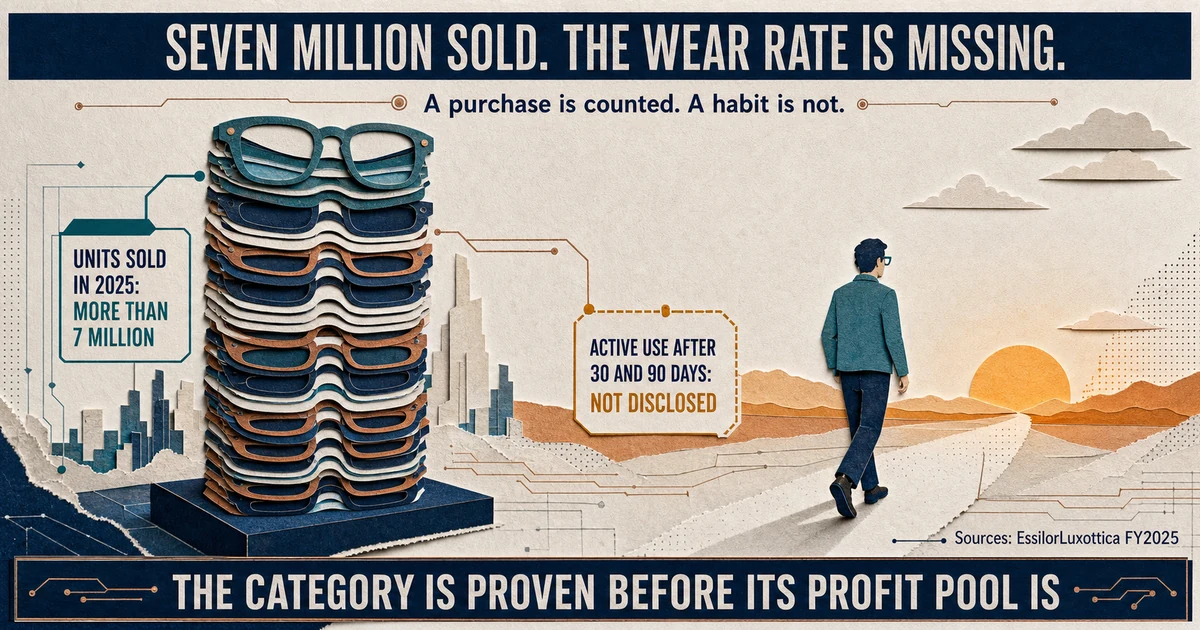
A decade of face computers gathers dust behind the pair that finally sold. EssilorLuxottica says Ray-Ban Meta and Oakley Meta sales exceeded seven million units in 2025. That is enough to retire the idea that every pair is a demo. It is not enough to identify the volume leader across incompatible market definitions, prove daily use or locate the category’s profit pool.
Key Takeaway: Volume Growth Belies Thin Device Margins
- EssilorLuxottica reported more than seven million Ray-Ban Meta and Oakley Meta units sold in 2025 — an actual company result, not a 2026 market forecast.
- Ordinary-looking, prescription-compatible frames and optical retail reduce purchase friction; Meta’s June 2026 lineup starts at $299.
- No reviewed filing discloses active-use retention, smart-glasses category margin, subscription attachment or paid-service revenue. Units prove a category; those measures would prove a durable business.
The 2026 Market Landscape: Chinese OEMs Shift 22.7M Units
After a decade of false starts, smart glasses crossed a real sales threshold. EssilorLuxottica reported more than seven million AI-glasses units sold in 2025 across Ray-Ban Meta and Oakley Meta. The combined total does not disclose model, region, returns or active use, but it is stronger evidence of purchase demand than a forecast for 2033.
What changed is the product and the route to market. The current wave leans on audio, camera and multimodal assistance in ordinary frames rather than requiring every buyer to accept bulky display optics. Prescription compatibility, fitting, returns and shelf space bring optical retailers into the technology stack. That makes distribution tangible; it still does not reveal how often owners use the assistant after purchase.
Comparing Form Factors: Why Lightweight AI Audio Glasses Scaled First
The failed wave was display-first: an AR screen on the face, with cost, weight and social acceptance tied to difficult optics. Several products failed to create a mass market. Public disclosure reviewed here does not provide comparable long-term wear-retention data for those devices, so the lesson is about product friction rather than a measured claim that every owner wore them rarely.
The current wave is assistant-first. Ordinary frames put design, battery, fitting, camera controls and assistant quality into one product. Meta’s June lineup begins at $299, supports prescription lenses and reaches buyers through Meta, LensCrafters, Sunglass Hut and other retailers. That lowers purchase friction. The unresolved test is whether owners return to the device often enough for the software and support costs to produce recurring economics.
Shipment Volume vs. Daily Retention: The Missing Metric
The figure that gets quoted is the market size. The figure that describes the competition is the unit count, and the two are not interchangeable claims about the same thing.
The useful comparison is now actual units versus disclosed economics. EssilorLuxottica reported more than seven million 2025 sales and a 16.0% group adjusted operating margin, with a 70-basis-point constant-currency decline attributed jointly to U.S. tariffs and AI-glasses investment. The company does not isolate the AI-glasses share of that pressure, revenue per pair or category margin. Meta does not isolate smart-glasses revenue or profit inside Reality Labs. The numbers therefore establish scale and an investment burden, not where durable margin sits.
Market Share Breakdown: Dominant Players & Emerging Chinese Brands
The original 22.67-million Chinese-brand estimate and 68-million global estimate came from different publishers using different category definitions and forecast windows. They cannot establish a shipped country share. The strongest current primary disclosure instead shows that an EssilorLuxottica–Meta portfolio sold more than seven million units in 2025.
Chinese manufacturers may still compete aggressively on price and iteration speed, but a strategy claim is not a shipment result. A defensible comparison needs the same product definition, period and sell-through basis across vendors. Until then, a forecast table is a lead for research, not a country scoreboard.
The market may split by price, fashion channel, display choice and assistant ecosystem. Public data does not yet reveal which side wins units, retains wearers or captures profit. Those are separate questions, and one cannot stand in for another.
Monetization Models: Shifting Profitability from Hardware to AI Assistants
Software improved over the air can create value, but the reviewed filings do not disclose paid assistant attachment, revenue per active wearer or renewal. The service layer therefore begins as a recurring cost for models, support and updates before it is demonstrated as recurring revenue.
The channel half is measurable. Frame makers and optical retailers provide shelf space, fitting, prescription lenses, adjustments and returns — capabilities a software company cannot create with an app update. EssilorLuxottica reported €3.764 billion of Direct to Consumer revenue and 7% comparable-store growth in Q1 2026, while saying AI-glasses demand supported stores and ecommerce. Those are group channel figures, not smart-glasses revenue, but they show why distribution is part of the product.
There is a genuine utility layer underneath the commercial one. Meta awarded nearly $2 million to 30 U.S. organizations selected from almost 500 applications for accessibility, workforce, education and safety pilots. That establishes funded experimentation and concrete use cases. It does not establish customer-funded renewal, task outcomes or recurring enterprise revenue after the grants end.
Key Bottlenecks: Battery Constraints, Display Yields & Privacy Regulations
The category has shipped results now, but retention remains missing. Battery life, comfort and social acceptance still cap adoption. The field measures that matter are active hours by feature mix, days worn per month, charge interruptions, return rate and the share of owners still using the glasses after six and twelve months. None is disclosed in the reviewed materials.
The sharper risk is consent around a face-mounted camera. Meta says a capture LED blinks for gallery recording and that blocking or physically tampering with the LED disables the camera on current generations. Those controls reduce covert-recording risk; they do not settle every workplace, school, healthcare or public-space rule, especially for live AI processing that may not create a saved gallery video.
What to watch: monthly active pairs net of returns and replacements; wear retention at six and twelve months; feature-weighted battery life; paid-service or enterprise-seat renewal; contribution after frames, lenses, fitting, warranty and support; and the number of locations or tasks restricted by privacy policy. Another shipment forecast cannot substitute for those measures.
Standardized Market Tracking & Categorization in 2026
The comparison this article asks for — same definition, same period, same basis across vendors — does exist, and it does not say what the country-share estimates said. IDC put Meta at 69.2% of global smart-glasses shipments in the first quarter of 2026, carried by the EssilorLuxottica partnership and the Ray-Ban line. RayNeo followed at 3.4%, Xiaomi at 3.1% on the strength of China shipments, Viture at 2.5% and XREAL at 2%, with a long tail of Chinese and global brands taking the remaining 19.8% between them. That is one tracker applying one definition to one quarter, which is exactly the property the forecast tables lacked.
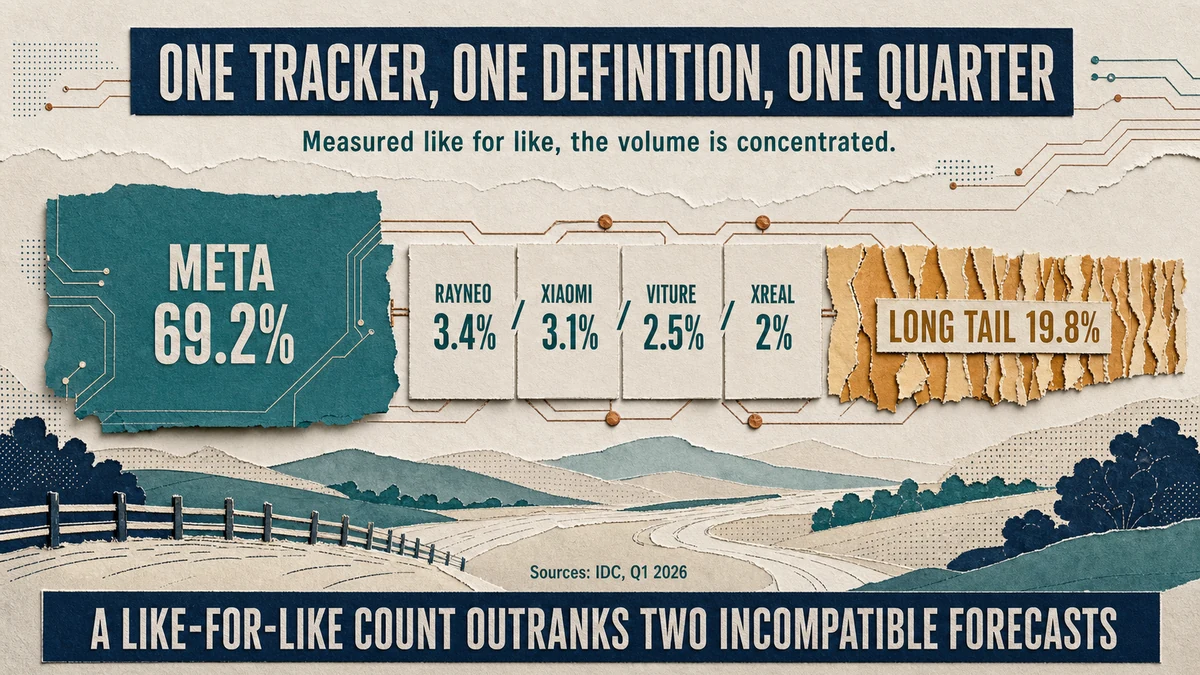
On those terms the volume is not Chinese. It is concentrated in a single Western brand partnership, with Chinese manufacturers occupying a fragmented remainder — the opposite of the shape the earlier estimates implied. A single quarter from a single tracker is not a permanent finding, and IDC’s category boundary is its own editorial choice rather than a law. But it is a like-for-like measurement, and a like-for-like measurement outranks two incompatible forecasts.
The growth underneath it is the part that makes the margin question urgent rather than academic. The category shipped roughly 2.25 million units in that quarter, up about 167% year over year, against an IDC full-year expectation near 13.6 million units for 2026 and 27.3 million by 2030. Display glasses — the optical see-through products where XREAL, Viture and RayNeo actually compete — are the faster-growing slice, projected from about 3 million units in 2026 to 12.2 million by 2030. So the fragmented end of the table is growing faster than the concentrated end, which is how a 69% share stops being a moat. The first-mover holds the units today. Nobody has yet shown that holding them produces profit, and the challengers are scaling in the segment where the hardware differentiates least.
Strategic Outlook
More than seven million disclosed 2025 sales prove that AI glasses are a real hardware category. They do not prove that Chinese brands lead comparable sell-through, that owners use the devices habitually or that margin has moved from frames to software. Ordinary design and optical distribution have cleared purchase friction; retention, paid outcomes and category profit remain the next tests. The industries inheriting a camera and assistant on millions of faces should treat those missing measures as the business case, not as footnotes to a forecast.
Related analysis: Meta Iris Chip: Not the Last Hyperscaler, the Loudest of Five examines Meta?s owned inference stack, the other side of the hardware-plus-assistant economics discussed here.
Sources
- IDC — Single-tracker, single-definition Q1 2026 share: Meta 69.2%, RayNeo 3.4%, Xiaomi 3.1%, Viture 2.5%, XREAL 2%, remaining 19.8% across a long tail; category shipments about 2.25 million units in the quarter, up roughly 167% year over year; full-year 2026 expectation near 13.6 million units rising to 27.3 million by 2030; optical see-through display glasses from about 3 million units in 2026 to 12.2 million by 2030 (2026)
- EssilorLuxottica — FY 2025 results — more than seven million AI-glasses sales, group revenue, adjusted margin and the combined margin headwind (2026-02-12)
- EssilorLuxottica — Q1 2026 results — store and ecommerce demand, Direct to Consumer revenue and comparable-store growth (2026-04-30)
- Meta and EssilorLuxottica — Meta Glasses launch — $299 starting price, prescription compatibility, styles and retail availability (2026-06-23)
- Meta — AI Glasses Impact Grants — nearly $2 million, 30 organizations, roughly 500 applications and pilot uses (2026-07-27)
View all sources
- Meta — AI-glasses privacy controls — capture LED, local gallery storage and camera-disable behavior (2026-07-07)
- Irish Data Protection Commission — Annual Report 2023 — regulator concerns and reported design changes around notice and tampering (2024)
- Meta Q1 2026 Form 10-Q — Reality Labs segment boundary; smart glasses are not isolated (2026-04-30)
This article is for informational and educational purposes only and does not constitute investment, financial, or legal advice.