The $500 Million Inside the $250 Billion Headline
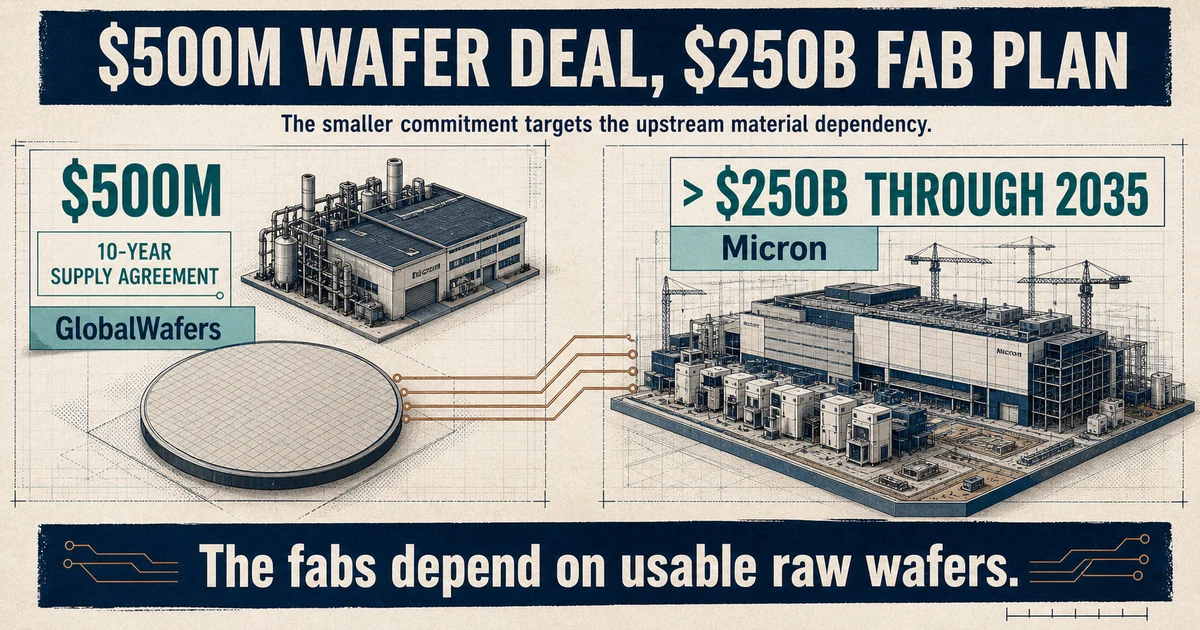
On July 9, Micron said it would raise its planned US investment to more than $250 billion through 2035 — up from the $200 billion it set in June — and poured first concrete at its New York DRAM megafab. Buried under that headline was a smaller number that may matter more: a $500 million position in the only US plant that makes advanced blank silicon wafers.
US investment through 2035
stake in GlobalWafers’ Texas plant
of Micron DRAM targeted for US soil
Micron described the $500 million as strategic financing for GlobalWafers, tied to a 10-year supply agreement. It goes to the company’s 300-millimeter raw-silicon-wafer facility in Sherman, Texas, and sits inside an up-to-$3 billion program Micron announced to reinforce the US semiconductor supply chain around its own fabs. Those figures describe company plans and commitments. They are not proof that the capacity is already operating or that every planned dollar will be spent on schedule.
The rest of the money is the reshoring story everyone can see. New fabs are rising in Boise, Idaho and Clay, New York, where Micron says the site will become the largest semiconductor manufacturing complex in the country. The published plan expects first wafers from Idaho in mid-2027 and a second fab in late 2028. New York is planned as as many as four fabs over more than two decades. CNBC reported that Micron shares rose almost 5% with the news. That reaction measures investor enthusiasm on the day, not execution across the next decade.
The Bottleneck Beneath the Fabs
Reshoring a fab is now a well-worn playbook: announce a multibillion-dollar campus, secure incentives, install equipment, and pour the concrete. The Sherman piece is a different kind of move. The published sources describe it as the only US facility making advanced 300-millimeter raw silicon wafers, the blank starting substrates consumed by leading-edge DRAM, NAND, and logic manufacturing.
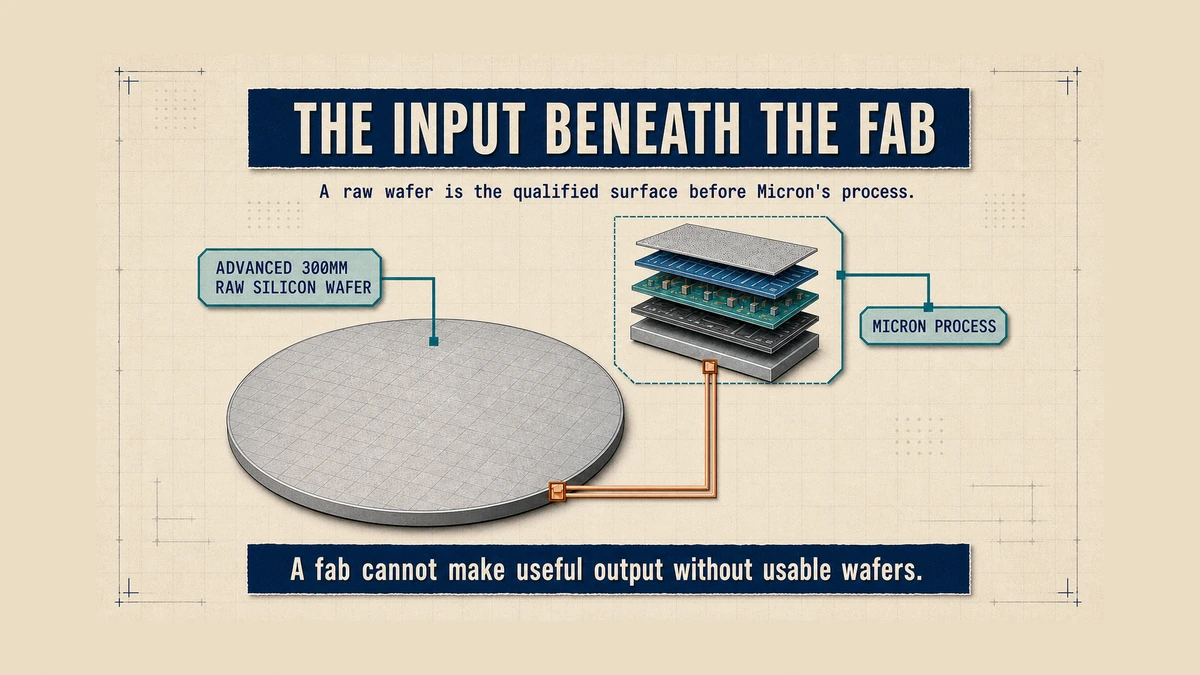
A raw silicon wafer is not a finished Micron wafer carrying DRAM structures. It is the qualified starting surface on which Micron must run its own process steps. That distinction keeps the claim in proportion. Localizing the substrate does not localize every tool, chemical, or production step, and it does not guarantee Micron’s yield. It addresses one upstream material dependency that becomes more consequential as domestic fab capacity expands.
The current bottleneck is therefore not just the absence of US factory buildings. It is the ability to feed new fabs with enough acceptable starting material at the volume and schedule their equipment requires. A cleanroom full of expensive tools does not generate useful output without wafers. If domestic manufacturing capacity grows faster than qualified domestic substrate supply, the supply chain is reshored in appearance but still exposed at its foundation.
- Build a multibillion-dollar domestic manufacturing campus
- Add equipment and target more US DRAM output
- Remain dependent on qualified upstream materials
- Finance domestic 300mm raw-wafer capacity
- Pair the investment with a 10-year supply agreement
- Reduce exposure to an overseas starting-material link
What the Wafer Agreement Removes
The immediate problem Micron is trying to remove is the mismatch between a large domestic fab buildout and reliance on raw wafers shipped from Asia. Fabs can have land, power, cleanrooms, and process equipment and still lack the material needed to start production. Financing the Sherman plant supports the upstream capacity. Pairing that financing with a decade of supply gives Micron a longer claim on the output during the period when its US fabs are supposed to ramp.
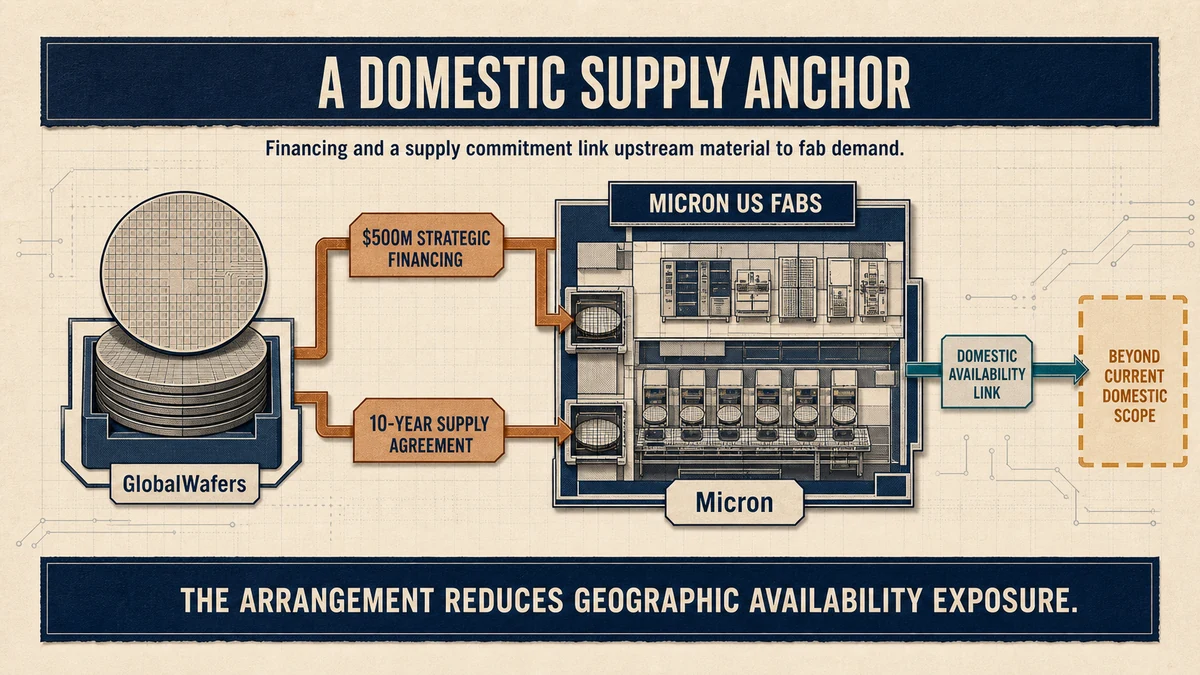
This is why the small number is the tell. The scarce asset in Micron’s plan is not only the factory. Capital and subsidies can build factories. It is also the blank wafer the factory is designed to consume, delivered in a form the process can use. A 10-year arrangement backed by strategic financing turns the $250 billion announcement into something closer to a supply-system plan. It is the same logic driving the race to lock up scarce foundry capacity one layer up the stack, pushed one layer further down.
The arrangement removes some geographic availability risk. It gives GlobalWafers financing and a long-term customer while giving Micron a domestic supply anchor. It can also reduce the chance that newly installed equipment waits for overseas starting material. What it does not remove is supplier execution, customer qualification, Micron’s process yield, or the volatility of the memory market.
The New Bottleneck: Qualification, Yield, and Ramp
Once geographic access improves, the bottleneck moves from finding a domestic source to making that source usable at scale. GlobalWafers must ramp material at the required volume and consistency. Micron must qualify the wafers for its process. Both ramps must line up with the Boise and New York schedules. Nominal wafer capacity is not the same as qualified supply available to a particular fab.
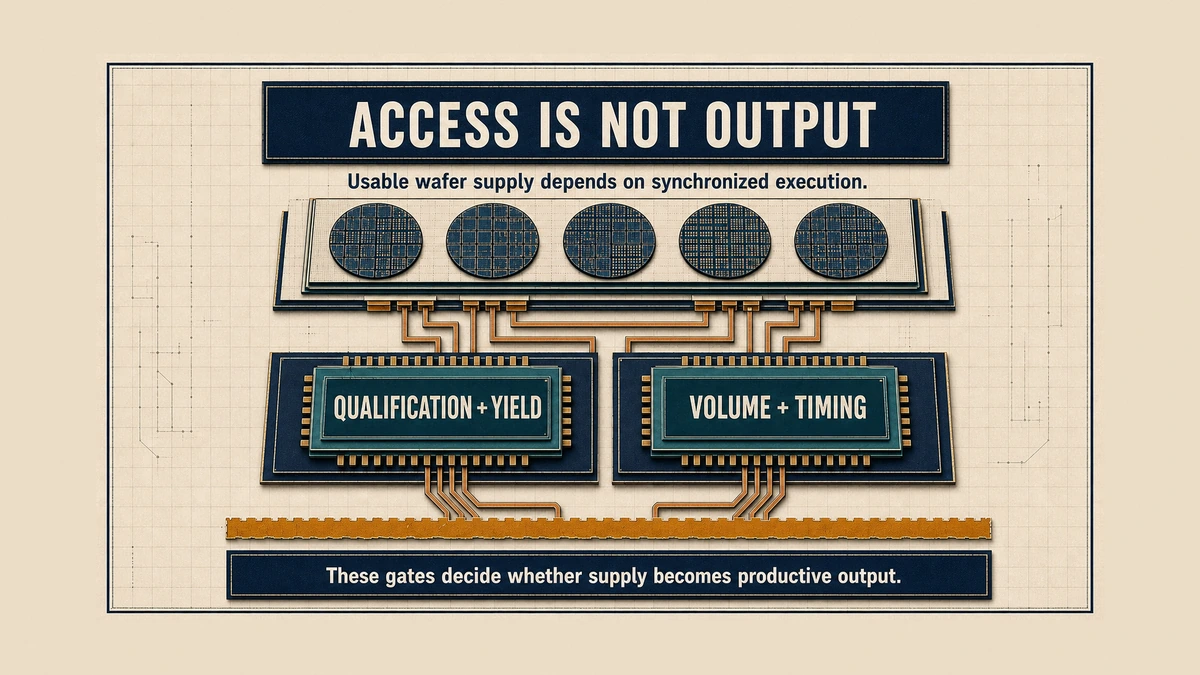
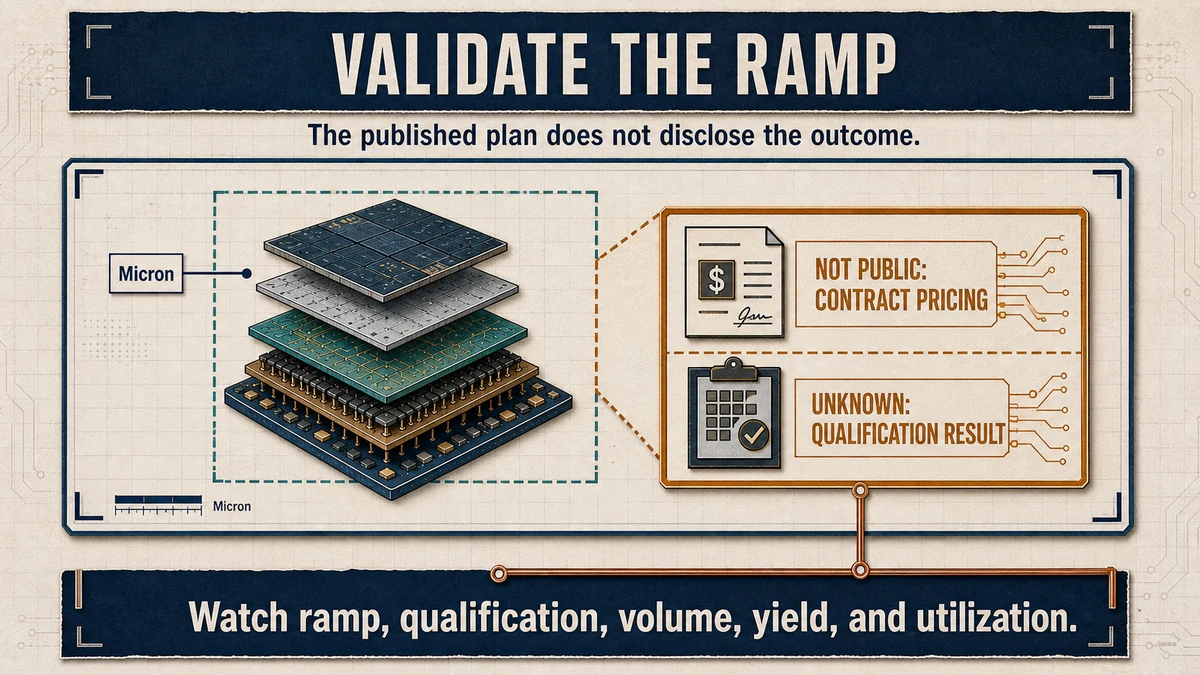
Qualification is where the strategic headline meets manufacturing reality. If a wafer falls outside the required specifications, it may not enter production. If variation appears after processing begins, it can contribute to rejected material or lower yield. If the wafers meet requirements but arrive too slowly, costly fab equipment can sit underused. The $500 million position addresses material access, but its economic value depends on material quality, qualification, output volume, delivery timing, and Micron’s ability to convert those wafers into good die.
The cost effect can move in either direction. Reliable domestic supply can protect fab utilization and reduce the disruption cost of a missing input. A poorly synchronized ramp can produce the opposite result: supplier capacity before customer demand, fab equipment before qualified material, or long supply commitments during a weak memory cycle. The supplied evidence does not disclose contract pricing or enough commercial detail to calculate which outcome will dominate.
The move also creates a more visible point of concentration. Sherman becomes strategically important precisely because it is the domestic answer to an upstream dependency. If the plant ramps well, Micron gains resilience. If it is late, short of volume, or slow to qualify, the constraint has not disappeared. It has moved from overseas sourcing toward domestic material execution.
Who Owns the Value and the Risk
Micron owns much of the strategic value. A reliable domestic starting-material channel can support its goal of producing 40% of its DRAM on US soil and help keep new equipment supplied. GlobalWafers gains financing, a decade-scale customer relationship, and demand visibility for the Sherman facility. The United States gains production located domestically, although GlobalWafers remains Taiwan-parented. This is US production, not US ownership.
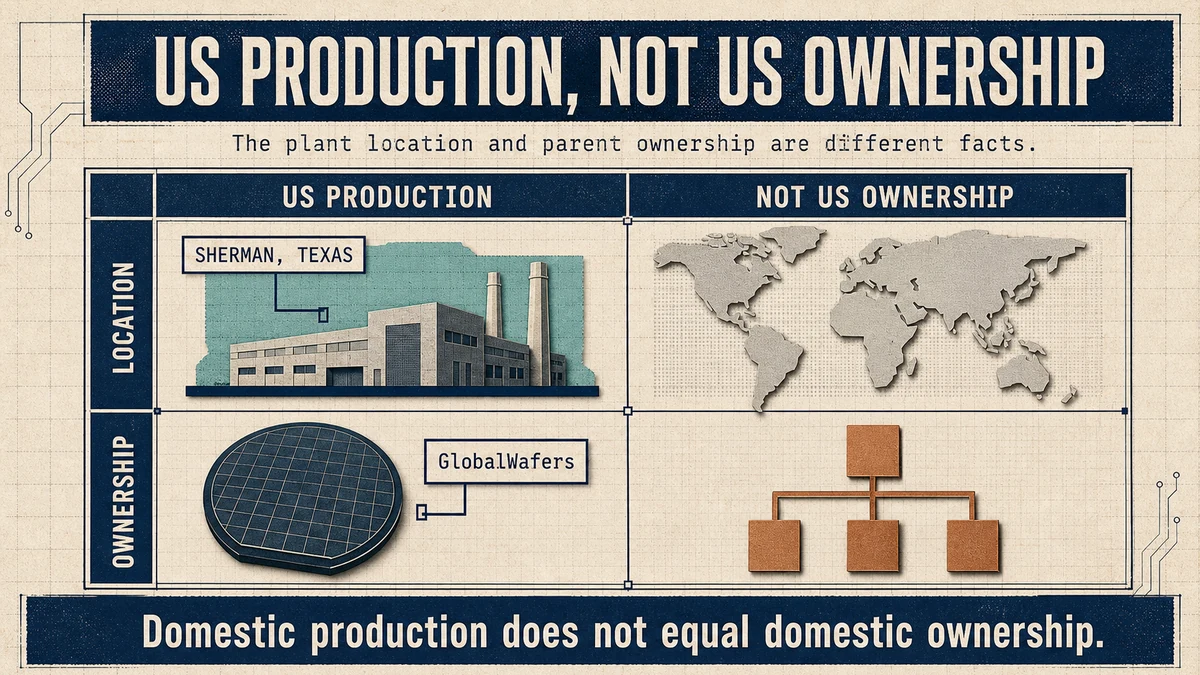
The execution risks divide differently. GlobalWafers owns the burden of bringing wafer capacity online and delivering consistent material. Micron owns qualification, fab utilization, process yield, and the return on its much larger manufacturing program. The more-than-$250 billion figure is a plan through 2035, not money already spent. The up-to-$3 billion supply-chain figure is also a ceiling announced by the company, not evidence that all supported projects have been completed.
Demand is the shared assumption beneath both investments. The buildout expects AI memory, including the HBM feeding AI accelerators, to keep pulling the way 2026 suggests it will. If that demand holds, secure wafer access can protect high-value tools and fab output from an upstream shortage. If demand softens, a decade of supply and a large installed fab base can become sources of utilization and fixed-cost pressure. That is an interpretation of the announced scale and duration, not a disclosed estimate of Micron’s contract economics.
What to Watch Next
The number to remember here is $500 million, not $250 billion. Reshoring headlines are about factories; supply-chain security is about the inputs beneath them, and Micron just bought insurance on the one input its entire US plan depends on.
Why would a $500 million wafer deal matter more than $250 billion in new fabs? Because the fabs depend on it. The financing supports a 10-year supply relationship for advanced 300-millimeter raw silicon wafers from the only US plant identified by the published sources as making them. Factories can be funded with capital and subsidies. A reliable domestic source of the qualified raw wafer is harder to replace.
But insurance only pays if the policy works. Watch whether Sherman actually ramps, whether its material qualifies on Micron’s schedule, and whether volume grows fast enough to feed the new fabs. Then watch Micron’s yield and equipment utilization. Those measures will show whether domestic wafer access has become productive output rather than nominal capacity.
Also watch whether rival memory makers move to secure their own raw-wafer supply. If they do, the quiet contest of the next few years will be fought a full layer below the fabs everyone is busy announcing. If they do not, Micron’s $500 million may look less like a footnote and more like the most strategically revealing part of the entire $250 billion plan.
This article is for informational and educational purposes only and does not constitute investment, financial, or legal advice.
Sources
- Micron (GlobeNewswire) – up to $3B strategic investment; $500M GlobalWafers financing; 10-year supply deal (2026-07-09)
- Tom’s Hardware – $500M position in America’s only advanced 300mm raw-wafer plant, Sherman TX (2026-07-09)
- Micron (GlobeNewswire) – $250B through 2035; 40% US DRAM goal; first concrete at New York fab (2026-07-09)
- CNBC – investment scale; shares up almost 5% (2026-07-09)
View all sources
- Data Center Dynamics – $250B total; $500M GlobalWafers partnership (2026-07-09)
- Yahoo Finance (Reuters) – 40% US DRAM target; AI-memory demand driver (2026-07-10)
- Tom’s Hardware – Idaho fab timelines; CHIPS Act reallocation (2026-07-09)