The Gate Opens Only Partway
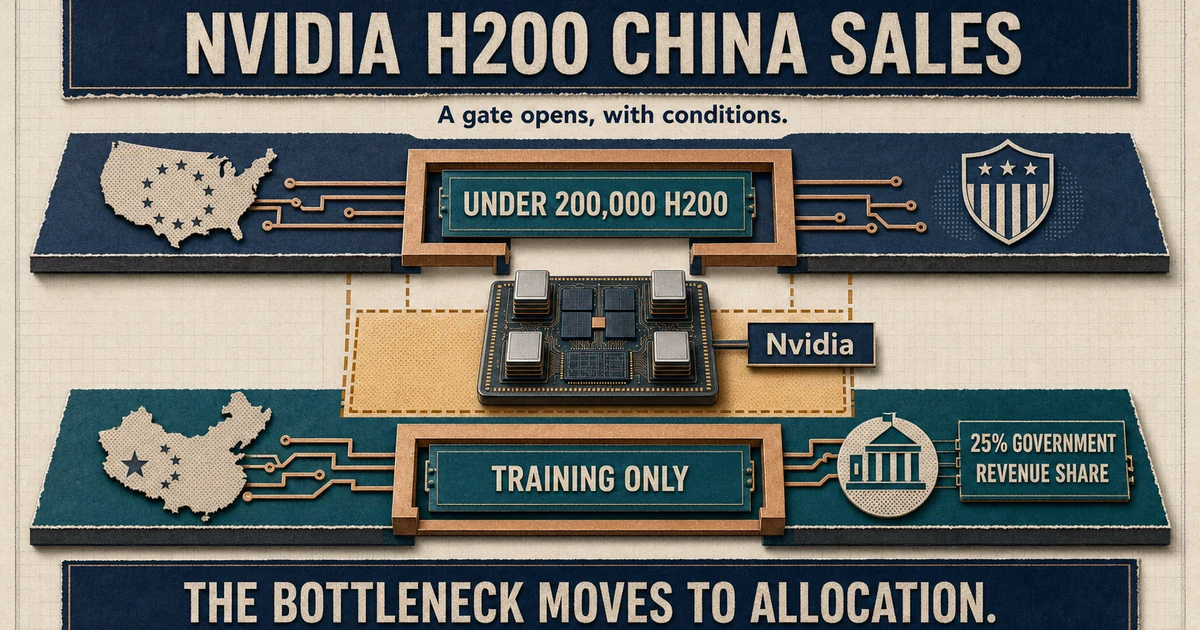
- Chinese officials have told Alibaba, ByteDance, and DeepSeek they may get permission to buy Nvidia H200 chips, The Information reported on July 8 — fewer than 200,000 units combined, less than half of what the firms requested.
- The chips would be restricted to AI training; Beijing wants inference to run on domestic processors such as Huawei’s Ascend line.
- For the first time since April 2025, Washington and Beijing appear aligned on letting some American AI silicon into China legally.
That is an opening, but not an open market. The reported plan covers selected buyers, a limited aggregate quantity, and a particular kind of workload. It was privately communicated rather than issued as a public Chinese policy document, and “fewer than 200,000” describes a ceiling under review, not a completed allocation or purchase order.
The moving bottleneck is therefore the story. US licensing had already removed one barrier, but Chinese purchase resistance prevented that permission from producing revenue. The reported shift could remove the second lock. In its place come narrower constraints: buyer qualification, per-company allocation, workload restrictions, the 25% US revenue share, and the risk that policy changes again before planned demand becomes repeatable shipments.
A Market With Two Locks
China is preparing to let its leading AI companies buy a limited quantity of Nvidia’s H200 accelerators, according to a report from The Information picked up by Bloomberg and Reuters on July 8. Each company must state how many chips it needs and why, and the combined allocation under review is fewer than 200,000 units.
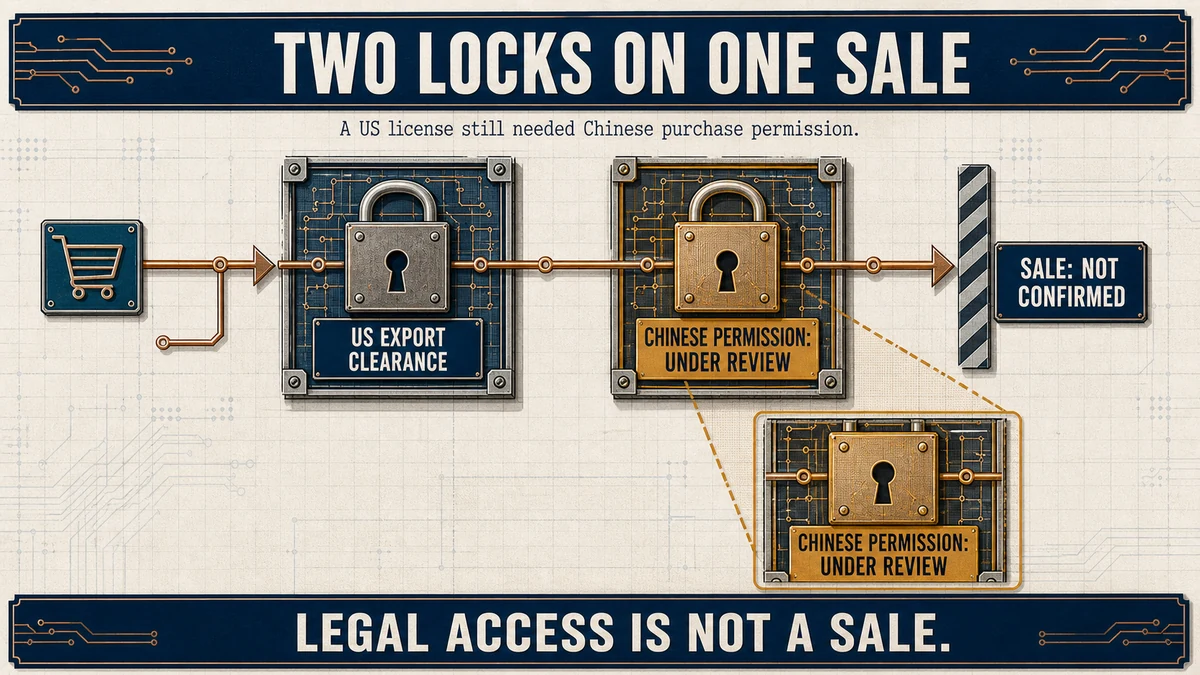
The US side was settled months ago, on unusual terms. Washington cleared H200-class exports in January 2026 with the government collecting 25% of revenue on each sale, and licenses followed in February. Yet a license authorizes a transaction; it does not create one. Beijing quietly discouraged its companies from completing purchases, so the legal channel on the American side ended at a closed gate on the Chinese side.
By Nvidia’s May earnings call, CEO Jensen Huang said he had “largely conceded” China’s data-center market to Huawei. Nvidia shares rose 3.65% to $204.12 on the July 8 report, lifting its market value to roughly $4.94 trillion. That reaction priced the possibility that a written-off revenue line could return. It did not establish the size, timing, or durability of actual orders.
A US license without Beijing’s blessing produced zero revenue — for six months, the gate had two locks.
The immediate problem removed is binary blockage: if both governments permit the same transaction, an H200 can legally reach an approved Chinese customer. The new bottleneck is administrative throughput. Which firms qualify? How many chips does each receive? Which proposed uses satisfy the conditions? How quickly can approvals become deliveries? A quota system answers whether some trade is possible while leaving all of those operating questions unresolved.
Training Relief, Inference Protection
The significant shift is not the hardware — the H200 is a 2024-generation product, two architectures behind Nvidia’s flagship line. It is that both governments now appear aligned on reopening a legal channel, which turns a written-off market back into a live revenue line. Export controls built the blockade; the 25% revenue share partially unwound it; Beijing’s purchase freeze was the final gate, and that gate is now reported to be opening.
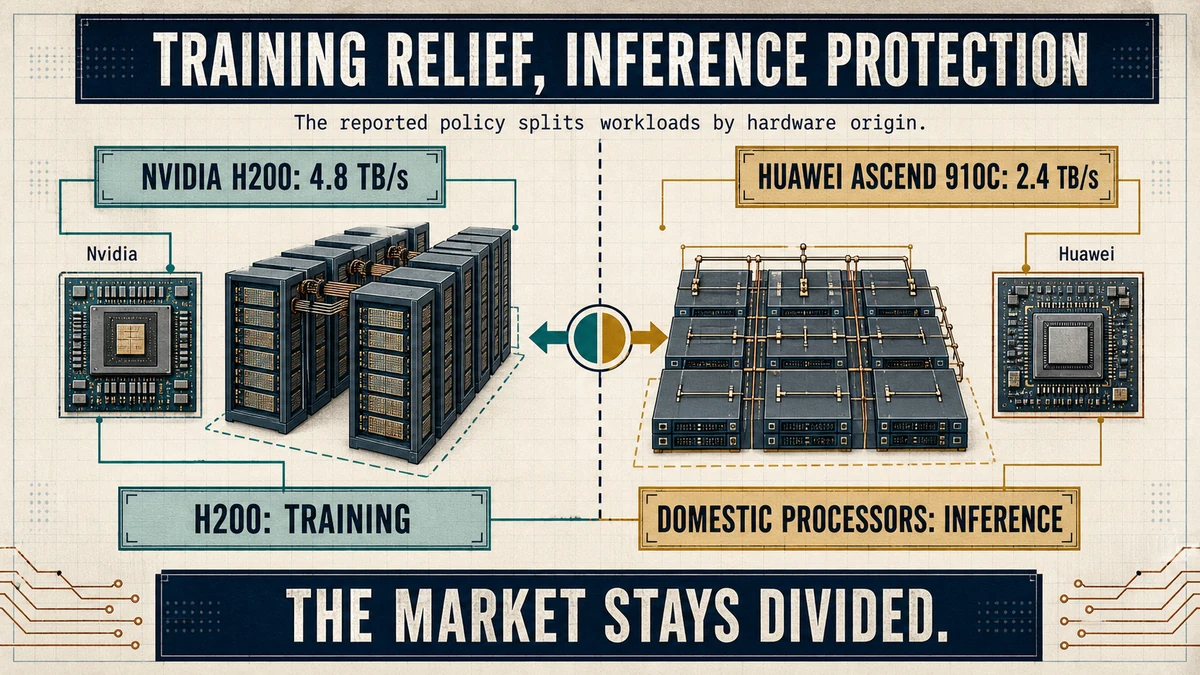
The training-only condition is widely read as industrial policy, not a technicality. Training frontier models is where the H200’s advantage over domestic chips is largest — industry comparisons put its memory bandwidth at 4.8 TB/s, roughly double the 2.4 TB/s of Huawei’s Ascend 910C. Inference is different: it tolerates weaker single chips because it scales out across many cheaper devices.
So Beijing eases its most acute bottleneck — frontier-model training — while preserving a protected market for Huawei and local designers, whose Ascend output is reportedly set to roughly double to around 600,000 units this year. Analysts at the South China Morning Post describe the move as a middle ground that buys time for the domestic industry, not a reversal of self-sufficiency goals.
The equipment effect is selective. Approved H200s could expand the training capacity available to Alibaba, ByteDance, and DeepSeek without displacing the policy preference for domestic inference processors. The material and infrastructure effects follow the same split: imported training clusters still require memory, networking, power, cooling, and software integration, while domestic inference deployments continue to require their own systems and qualification work.
This does not provide evidence of a semiconductor manufacturing yield change. Instead, the relevant “yield” is usable compute from a constrained allocation. A nominal quota only helps if chips arrive in sufficient quantities, can be integrated into clusters, and remain available long enough for model developers to schedule expensive training runs. The bottleneck moves from legal access to allocation quality and continuity.
The workload boundary can also create a new qualification burden. Model developers may have to maintain CUDA-based training infrastructure while adapting inference workloads to domestic accelerators. That protects local suppliers, but it can raise software, validation, and operating complexity for customers managing two hardware ecosystems.
Revenue Returns, but the Economics Stay Bounded
For Nvidia the money is real but bounded. Morgan Stanley has estimated a China reopening at $5–8 billion of revenue, against the $19.67 billion the region generated in Nvidia’s last full fiscal year — and the 25% levy plus a sub-200,000-unit cap keep the recovery partial. The estimate is a scenario, not company guidance, and the cap is not an order book.
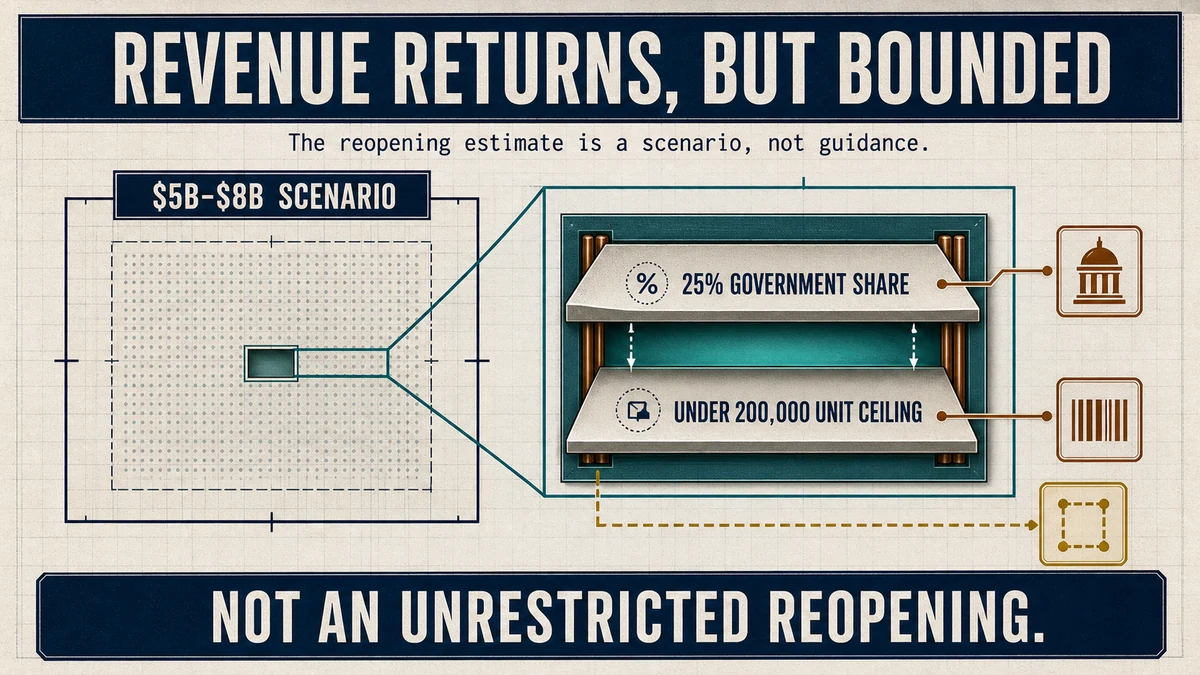
The cost structure matters as much as the headline permission. The 25% government share reduces the economics available somewhere in the transaction, whether absorbed through Nvidia’s realization, customer pricing, or a combination. Licensing and routing costs add friction. The quota prevents demand from translating freely into volume. Together, those conditions can make domestic alternatives more competitive for marginal workloads even when an imported chip has stronger specifications.
The strategic value may exceed the first sales contribution. Any shipment would re-establish CUDA-based infrastructure inside the same companies, DeepSeek included, that were being pushed to design around it. Once training workflows, engineering teams, and clusters remain tied to CUDA, Nvidia preserves a position that a fully blocked market would steadily erode.
That strategic gain is also bounded. If H200 access is restricted to training while inference expands on domestic hardware, Nvidia participates in the scarce, high-value portion of the workload but not necessarily the recurring deployment base Beijing wants local suppliers to own. The result is a divided market rather than a restored version of Nvidia’s former China business.
Who Captures the Value and Who Carries the Risk
Nvidia: The company owns the most direct revenue upside and the strategic benefit of keeping CUDA inside leading Chinese AI labs. It also bears quota, pricing, and policy-reversal risk. A possible allocation below 200,000 units sets an upper boundary, while the 25% share limits the economics of whatever volume is ultimately approved.
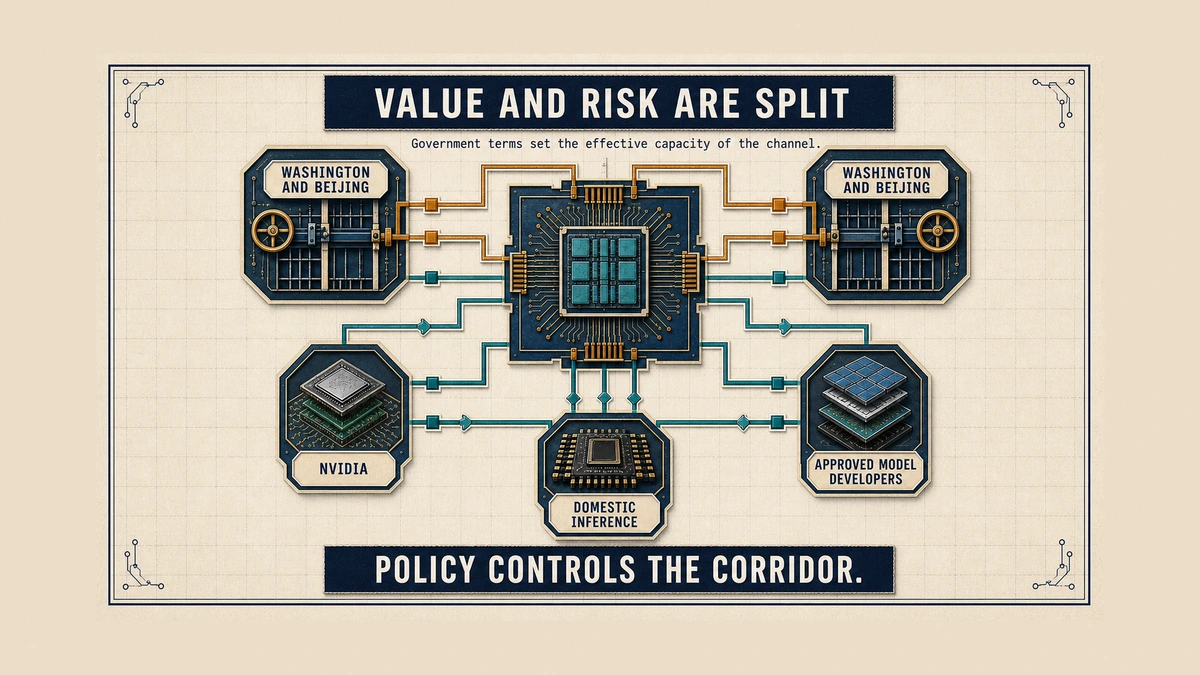
Chinese model developers: Alibaba, ByteDance, and DeepSeek gain a possible route around the frontier-training constraint. Their risk shifts from total unavailability to uncertain allocation. Training plans require enough accelerators, delivered on a reliable schedule, with confidence that later model iterations will have access to compatible capacity.
Huawei and other domestic designers: They may yield part of the most demanding training opportunity while retaining the protected inference market. Their value lies in offering supply that is more aligned with Beijing’s self-sufficiency objective. Their risk is that renewed H200 access preserves Nvidia’s technical and software influence at the model developers most able to shape future AI infrastructure.
Memory, equipment, and infrastructure suppliers: A permission headline creates no automatic order for the rest of the stack. Value appears when allocations become systems that require high-bandwidth memory, servers, networking, power, cooling, installation, and validation. These suppliers carry planning risk because the cluster mix depends on a political quota rather than demand alone.
Washington and Beijing: The governments retain control over the corridor. Washington permits selected sales while collecting 25% of revenue. Beijing can ease an urgent training bottleneck while continuing to direct inference toward domestic processors. The largest risk for every commercial participant is therefore held outside the normal supply chain: either government can change the effective capacity of the channel.
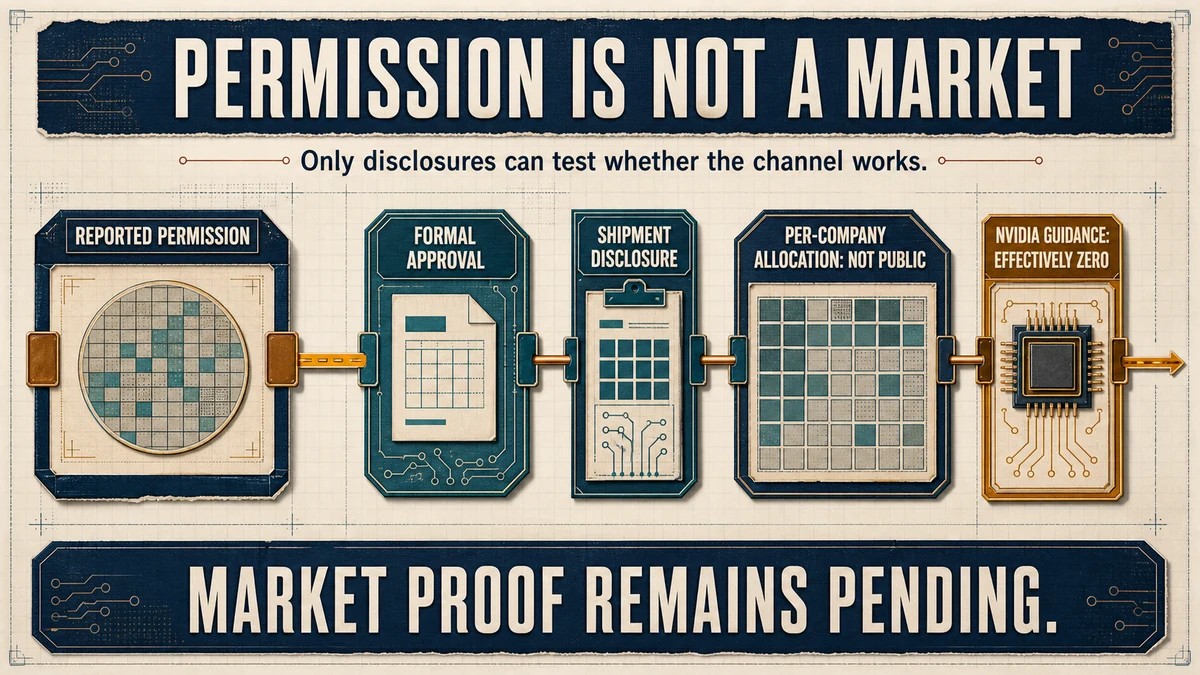
The Evidence That Would Turn Permission Into a Market
Worth weighing:
- This is a report of privately communicated plans, not a policy document — and Beijing has reversed course on H200 purchases once already this year.
- “Fewer than 200,000” is a ceiling under consideration, not an order book; the levy and routing costs may push marginal buyers toward domestic silicon sooner than raw specs suggest.
What to watch:
- Whether formal approvals and actual shipments follow — the gap between license and revenue has been the story all year.
- The final per-company allocation, and Nvidia’s next China data-center guidance, currently set at effectively zero.
Formal approvals would remove uncertainty about permission. Shipment disclosures would show that the administrative channel works. Per-company allocations would reveal whether the volume is large enough to change training schedules. Nvidia guidance would indicate whether the opportunity is financially material. None of those tests can be replaced by the reported aggregate ceiling alone.
Read this as Beijing repricing a bottleneck, not opening a market. The deeper signal is that AI compute has become a managed trade flow, negotiated shipment by shipment between two governments — and everyone in the supply chain, from memory makers to model labs, now has to plan around quotas rather than markets.
Why did Nvidia H200 China sales stall even after US approval?
Washington cleared exports in January 2026 with a 25% revenue share, but Beijing then discouraged its own companies from buying while it pushed domestic chip development. Without Chinese purchase approvals, a US license produced zero revenue — which is why this week’s reported shift on the Chinese side matters more than January’s on the American side.
Later in this series
This article is for informational and educational purposes only and does not constitute investment, financial, or legal advice.
Sources
- Bloomberg (The Information report) — Beijing to permit H200 purchases; three firms notified (2026-07-08)
- South China Morning Post — middle-ground reading; training bottleneck (2026-07-09)
- CNBC — US clearance with 25% revenue share (2026-01-14)
- Investing.com — sub-200,000 cap; per-company justification (2026-07-08)
View all sources
- Japan Times — training-only restriction detail (2026-07-09)
- Tom’s Hardware —~82,000 GPUs prepared for shipment (2026)
- Investing.com — share reaction, $4.94T market value (2026-07-08)