The AI industry keeps calling it a chip shortage. Anthropic just spent $19 billion pointing at the real one: the wall socket.
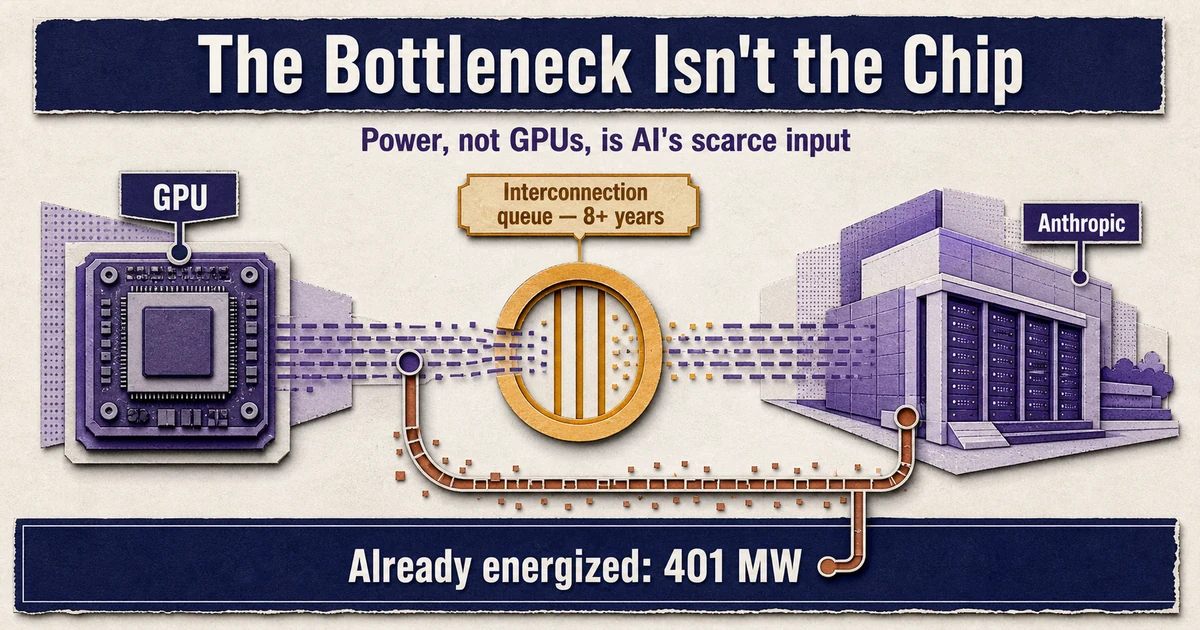
The $19 Billion Lease That Wasn’t About the Building
TeraWulf executed a 20-year lease with Anthropic at its Justified Data campus in Hawesville, Kentucky, expected to generate approximately $19 billion of contracted revenue over the initial term. The campus is engineered for about 401 MW of critical IT load, with initial capacity due in the second half of 2027 and the full build ramping by early 2028. In the same announcement, TeraWulf sold a majority stake in its Abernathy joint venture to Fluidstack.
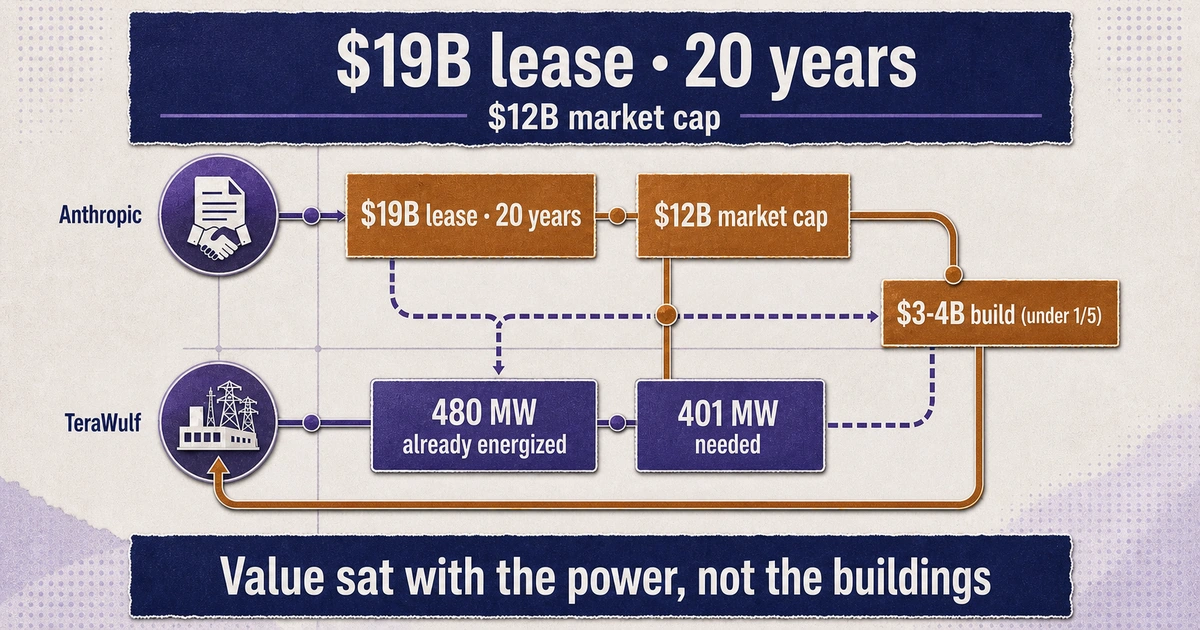
The market read it instantly. TeraWulf (ticker WULF) carried a market value near $12 billion – less than the future revenue this single lease represents – and its shares jumped on the news. The company plans to invest $3-4 billion in the build, under one-fifth of the contract’s value. The reason the math works: the site is a former Century Aluminum facility that already sits on roughly 480 MW of available power capacity.
That last detail is the whole story. Anthropic did not buy a building. It bought a place that was already plugged into the grid at industrial scale – and it is far from the only lab doing this. Across the US, bitcoin miners and old heavy-industry sites are being quietly repriced as the landlords of artificial intelligence.
Why Power, Not Chips, Is the Real AI Bottleneck
The dominant narrative of the AI buildout has been about silicon: who gets the most Nvidia GPUs, who designs the best custom accelerator. That framing is now half-wrong. You can tape out a new chip in a year. You cannot conjure a grid connection.
A GPU can be fabbed in months. A megawatt of interconnected, permitted power takes years – and that gap is the real AI bottleneck.
Here is how the mechanism actually works. A rack of AI accelerators is useless without megawatts behind it, and megawatts require a physical interconnection to the grid. That queue has seized up. By the end of 2025, more than 2,000 gigawatts of generation and storage were stuck waiting to connect in the US – and in the PJM region, the average time from interconnection application to commercial operation has stretched past eight years, up from under two years in 2008.
It is not just the queue. A high-voltage transformer that took 24-30 months to source before 2020 now runs closer to five years. So a greenfield data center that must wait four to eight years for a connection is nearly worthless to a lab racing on an 18-month model cadence. A brownfield smelter that is already energized is the scarce asset – and it prices like one.
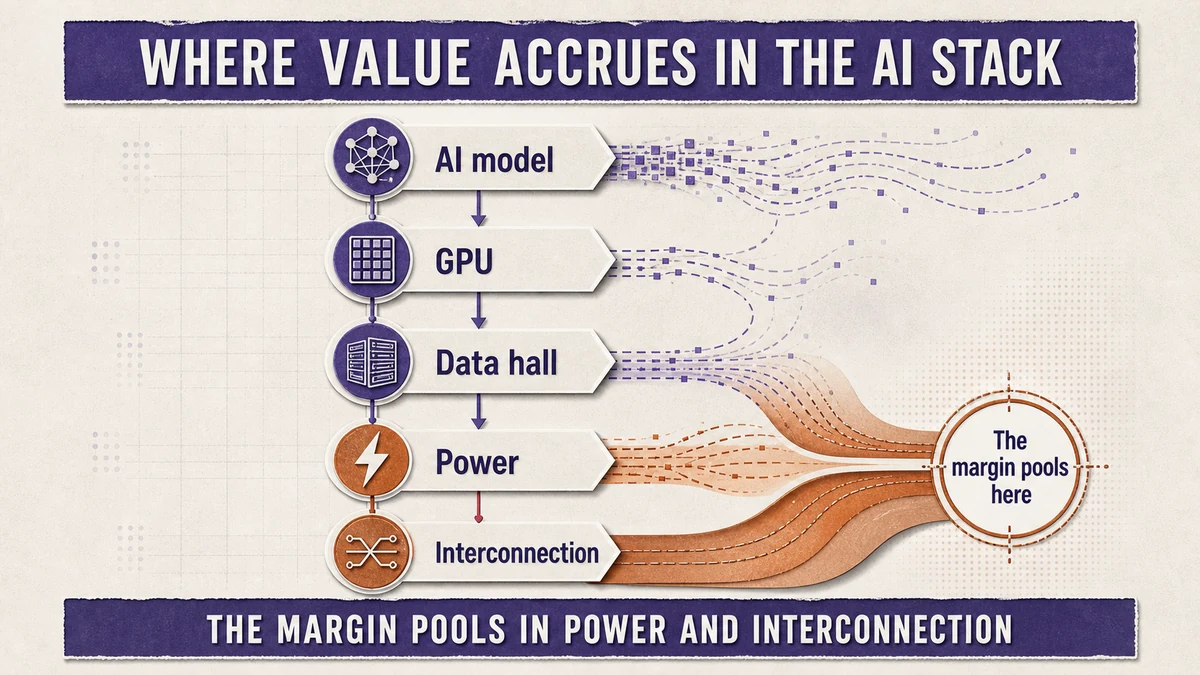
Descend one layer and the value map redraws itself. Under the AI model is the GPU; under the GPU is the data hall; under the data hall is power; under power is an interconnection to the grid; under that is generation and transmission. The margin is pooling at the layers almost nobody was watching: whoever holds permitted, energized land collects the rent. That is why a former bitcoin miner’s stock can be revalued by one contract.
The beneficiaries who win regardless of which lab “wins” are the unglamorous ones. Transformer and switchgear makers are sold out for years. Gas-turbine suppliers are booking orders as developers build on-site generation to skip the queue entirely. Independent power producers and utilities sitting on spare interconnection are, in effect, holding options on AI demand. The structurally exposed, by contrast, are the labs that did not lock power early and now must bid against everyone else for the same scarce megawatts.
- The $19 billion is contracted revenue spread over 20 years, not cash today; it depends on the campus actually getting built and on Anthropic honoring two decades of demand.
- TeraWulf takes on real single-tenant concentration and $3-4 billion of construction and financing risk against one counterparty.
- The power bottleneck is not permanent: behind-the-meter gas, small modular reactors, and grid reform could all loosen it over the next several years.
- If AI demand growth softens, the same energized sites that look scarce today could look overbuilt.
The first tranche of the 401 MW is scheduled to energize in the second half of 2027. If it does, the lease bought delivered power at a premium. If it slips, the premium bought a better position in the same queue everyone else is standing in – and the scoreboard for this buildout moves off GPU shipments and onto how many announced gigawatts actually get switched on.
The Interconnection Queue Is a Lottery, and Most Tickets Lose
On that reading, the next phase of this race will be decided less by who trains the best model than by who quietly optioned energized land two years ago. Power is the one input you cannot spin up in a quarter, and the labs seem to know it – that is what a 20-year lease with a former crypto miner really says. If you want a single number to track instead of the GPU headlines, track megawatts energized and interconnection approvals. That is where the ceiling on AI actually sits.
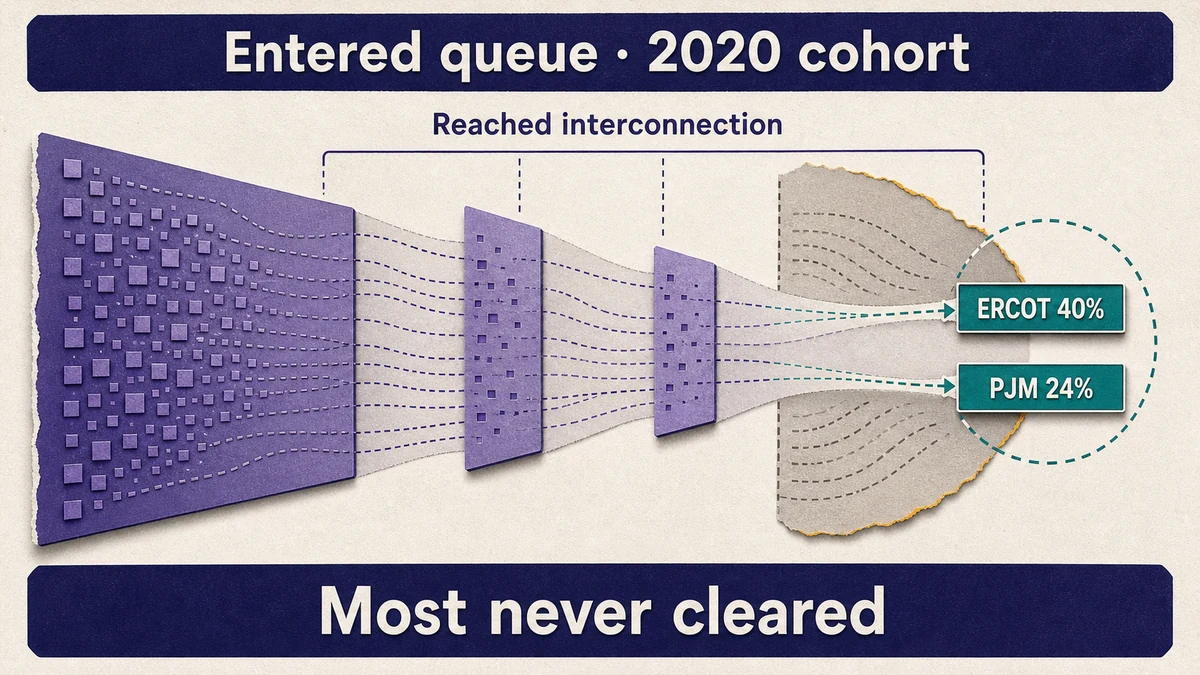
That number has since been measured, and it explains why a twenty-year lease on an existing site was worth $19 billion. Of the projects that entered ERCOT’s screening process by 2020, about 40% ever reached an interconnection agreement or began operating; in PJM the same cohort converted at 24%. A queue position is therefore a lottery ticket with roughly one-in-three odds and a multi-year wait, while an energized site is a settled fact. Anthropic did not buy cheap power. It bought a place in the minority that already cleared.
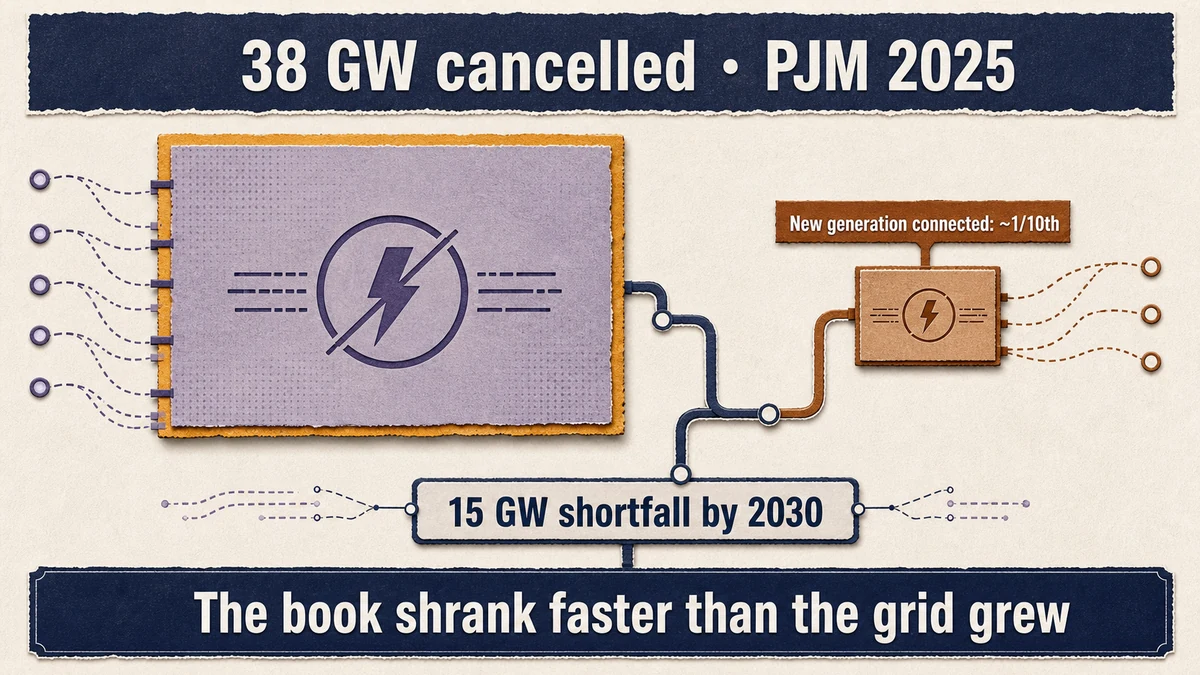
The scale of what did not clear is the other half of the picture. ERCOT’s large-load queue passed 238 gigawatts by March 2026, more than three-quarters of it data centres, with 198 gigawatts arriving in the first quarter alone. PJM cancelled 38 gigawatts during 2025 while connecting only a small fraction of that volume, even as its own outlook pointed to a 2030 capacity shortfall. The contrast shows why an existing energized site commands a premium.
Against that backdrop the crypto-miner conversion stops looking opportunistic and starts looking like the only fast path there is: the sites were built when power was cheap and interconnection was easy, and neither condition is coming back.
Which sets up the uncomfortable version of the same trade. Every hyperscaler now knows that energized capacity is the binding constraint, so the supply of convertible sites is being bid for by parties with far more cash than the miners who own them. The premium in a deal like this is not for electricity. It is for time already served in a queue nobody can skip.
Sources
- investors.terawulf.com — TeraWulf Investor Relations: primary press release confirming the 20-year Anthropic lease, ~$19B contracted revenue, ~401 MW critical IT load, H2 2027/early 2028 timeline, and the Abernathy JV sale to Fluidstack. (2026-07-06)
- ascendanalytics.com — Ascend Analytics: PJM capacity shortfall could reach 15 GW by 2030; general interconnection-queue reform coverage. Page as fetched does not contain the draft’s 40%/24% ERCOT-vs-PJM historical conversion-rate figures. (2026-05-05)
- latitudemedia.com — Latitude Media: ERCOT’s large-load queue at ~226 GW as of November 2025 (up from 63 GW end of 2024), ~77% from data centers targeting 2030 connection. Page as fetched predates and does not contain the draft’s “238 GW by March 2026 / 198 GW Q1 2026” figures. (2025-12-03)
- enkiai.com — EnkiAI: confirms 38 GW cancelled in PJM during 2025; page’s own shortfall figures are a 6 GW 2027 capacity-auction gap and a 60 GW decade-long deficit warning, not the draft’s “15 GW by 2030” (that figure is instead corroborated on C1’s page). (2026 (exact date not shown; page displays only a “© 2026 EnkiAI” copyright line))
View all sources
- cnbc.com — CNBC: TeraWulf shares rise after the Anthropic lease announcement; confirms ~$19B/~401MW and market reaction (direct fetch blocked by site; date and content corroborated via independent search results and cross-outlet coverage). (2026-07-06)
- datacenterdynamics.com — DataCenterDynamics: deal terms, 401 MW load, H2 2027 initial capacity to early-2028 full ramp, $3-4B TeraWulf build cost (direct fetch blocked by site; content corroborated via independent search results). (2026-07-06)
- datacenterknowledge.com — Data Center Knowledge: average transformer lead times rose from ~50 weeks (2021) to ~120 weeks (2024); projects spend 3+ years reaching an interconnection service agreement and another ~4 years waiting to energize after approval – supports the draft’s queue-delay and transformer-lead-time claims though with different specific figures than stated in the body. (2026-05-12)
- coindesk.com — CoinDesk: TeraWulf’s ~$12B market value versus the $19B lease, ~$3-4B build cost, and the bitcoin-miner-to-AI-landlord reframing. (2026-07-06)
- siliconangle.com — SiliconANGLE: confirms the site is a former aluminum smelting facility in Hawesville, Kentucky with 401 MW of computing power; page as fetched does not name “Century Aluminum” specifically or state 480 MW (those specifics are independently confirmed by TeraWulf’s own February 2026 Century Aluminum site-acquisition announcement, not itself in this source list). (2026-07-06)
- finance.yahoo.com — Yahoo Finance: the $19B lease exceeds TeraWulf’s ~$12B market capitalization at announcement. (2026-07-08)
- sec.gov — SEC Form 8-K (TeraWulf), Exhibit 99.1: the primary regulatory filing of the same press release confirming the Anthropic lease and Abernathy JV sale to Fluidstack (direct fetch blocked by SEC’s server; date and content corroborated via TeraWulf’s identical GlobeNewswire and investor-relations release of the same day). (2026-07-06)
- techinvestments.io — Tech Fund: argues power infrastructure, not GPU supply, is the binding constraint on AI data centers (“Electrical equipment is under 10% of total data center cost and 100% of the bottleneck”). (2026-05-09)
- enkiai.com — EnkiAI: reports roughly 2,600 GW of proposed generation/storage in US interconnection queues in early 2026 and a 6.6 GW PJM 2027-28 deficit – supports the draft’s general queue-backlog claim, though its specific figures (2,600 GW; no 2008-vs-eight-years PJM timeline stat) differ from those stated in the body. (2026 (exact date not shown; page displays only a “© 2026 EnkiAI” copyright line))
This article is for informational and educational purposes only and does not constitute investment, financial, or legal advice.