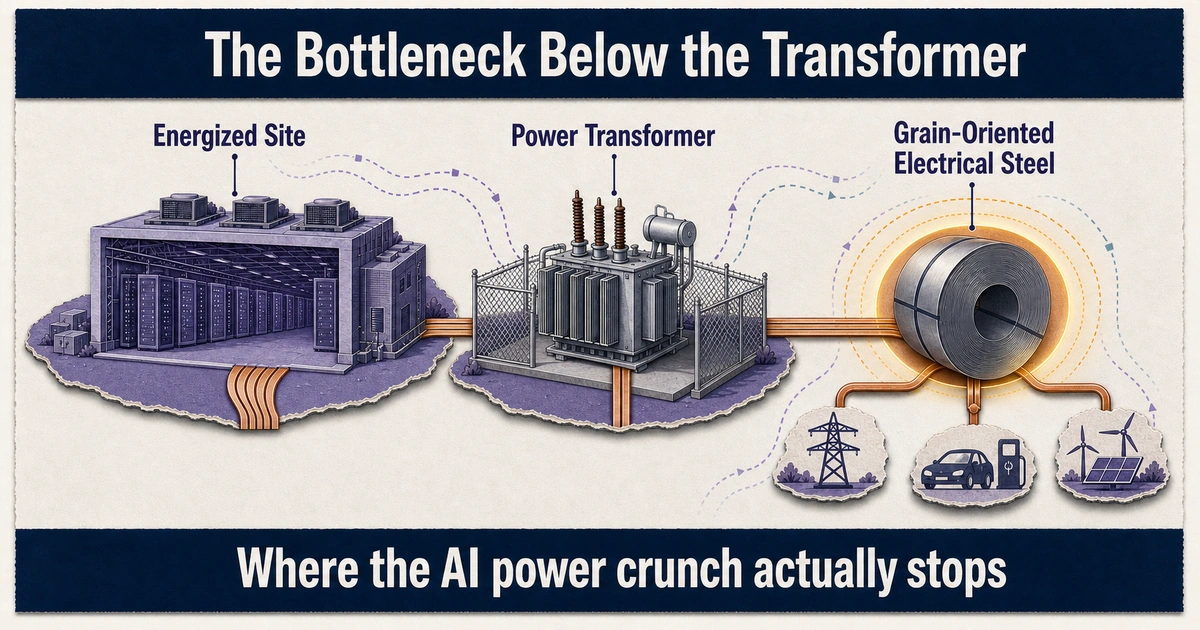
For most of the past year the story was that AI had stopped being a chip problem and become a power problem. A finished data center is worthless if it cannot draw current, and the industry spent 2026 learning that a permitted, energized site is scarcer than GPUs.
The grain in the steel
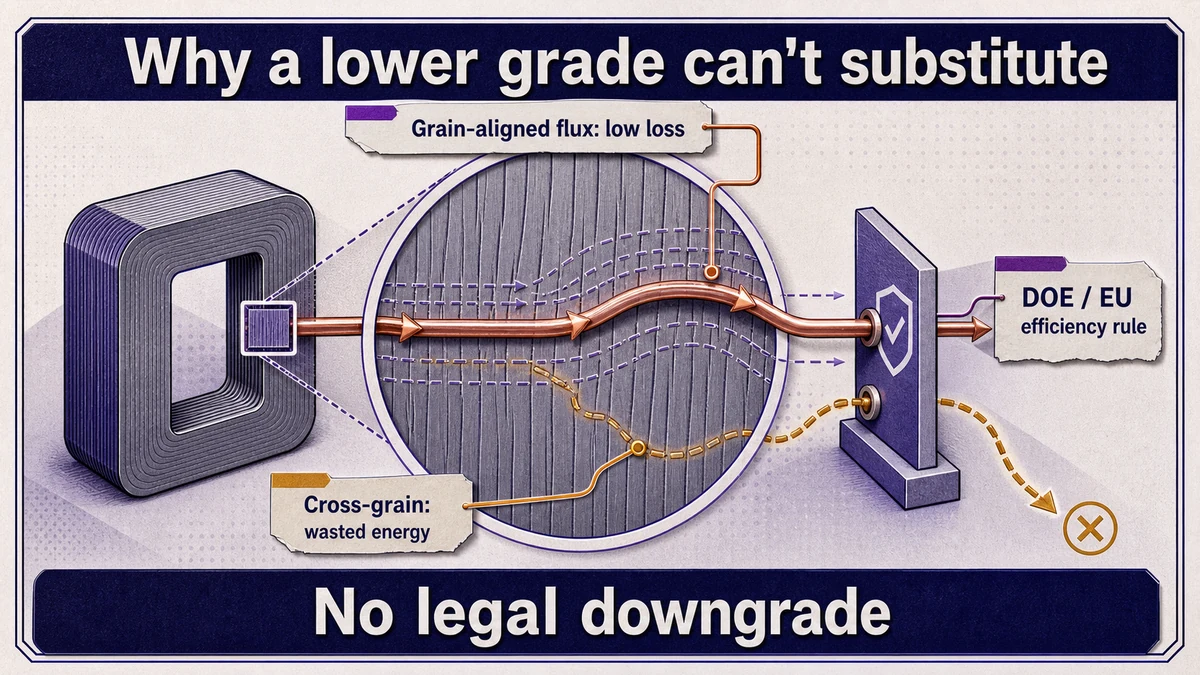
A power transformer is mostly a core, and that core is wound from grain-oriented electrical steel – GOES, a specialty silicon steel whose crystal grains are aligned in one direction so magnetic flux flows through it with minimal loss. The alignment is the whole point. Run flux the wrong way and the steel heats and wastes energy; run it along the grain and you get a transformer efficient enough to sit in the grid for forty years.
The chokepoint is that you cannot legally substitute a lower grade. US Department of Energy and EU efficiency rules for new transformers are written tightly enough that ordinary steel does not qualify. When copper spikes you can redesign windings; when GOES is short, there is no legal downgrade. The material is the spec.
And GOES is a small, slow world. Global output runs around 3.5-4 million tonnes a year – roughly 30 to 35 percent of all electrical steel – and prices have about doubled since 2020, with delivery stretched to 12-18 months. Data centers are not the only bidders: grid replacement, EV charging, and renewables all pull the same coils. A commodity most investors have never heard of is now sitting on the critical path of one of the largest capital buildouts in tech.
An oligopoly you can’t tariff your way around
GOES is made by a handful of mills worldwide – Nippon Steel and JFE in Japan, Baowu in China, ThyssenKrupp in Europe, ArcelorMittal, POSCO in Korea, and, in the United States, exactly one: Cleveland-Cliffs. Its DOE-funded expansion of grain-oriented capacity at Butler, Pennsylvania is on schedule – for 2028.
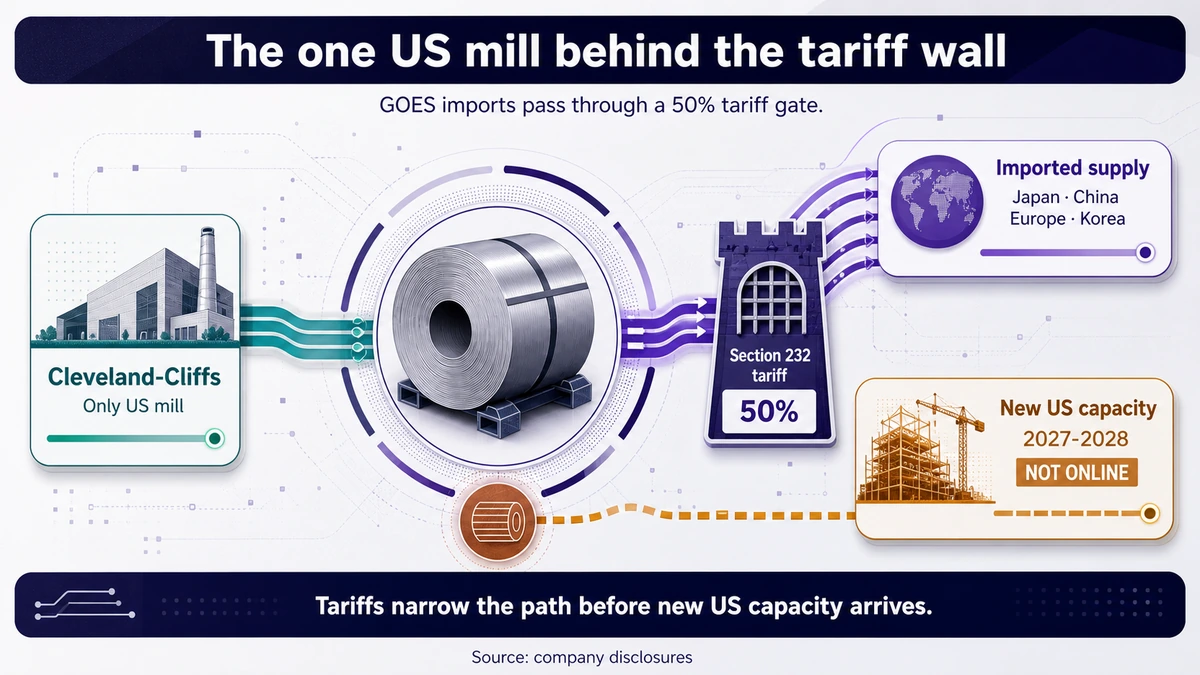
That single-producer fact collides with trade policy in an awkward way. According to Cleveland-Cliffs’ account of the expanded Section 232 coverage, the steel tariffs raised to 50 percent in 2025 were extended to electrical-steel laminations and cores, and in April 2026 to the full value of those goods. The intent is to protect domestic production. The effect, connecting the pieces, is to wall American transformer builders into one domestic GOES supplier while raising the cost of the imported alternative – tightening the very bottleneck the buildout is choking on.
New merchant supply exists on paper (ArcelorMittal is erecting a $1.2 billion electrical-steel mill in Alabama) but it is not slated to commission until around 2027, after the 2026-2027 crunch it is meant to relieve.
The tariff wall is protecting the one link in this chain the US genuinely cannot scale on demand – and paying for that protection in transformer lead time it can least afford right now. It is a defensible industrial-policy bet on the back half of the decade, made at the expense of the front half.
Where the money actually lands
Follow the scarcity and you find the value. When a material is un-substitutable, oligopolistic, and sold out, pricing power migrates to whoever makes it. GOES producers – Cliffs in a protected US market, Nippon Steel and JFE globally – capture rent that used to sit downstream. This is the same move investors watched play out in HBM memory two years ago: the boring input upstream of the exciting product turns out to be where the margin concentrates.
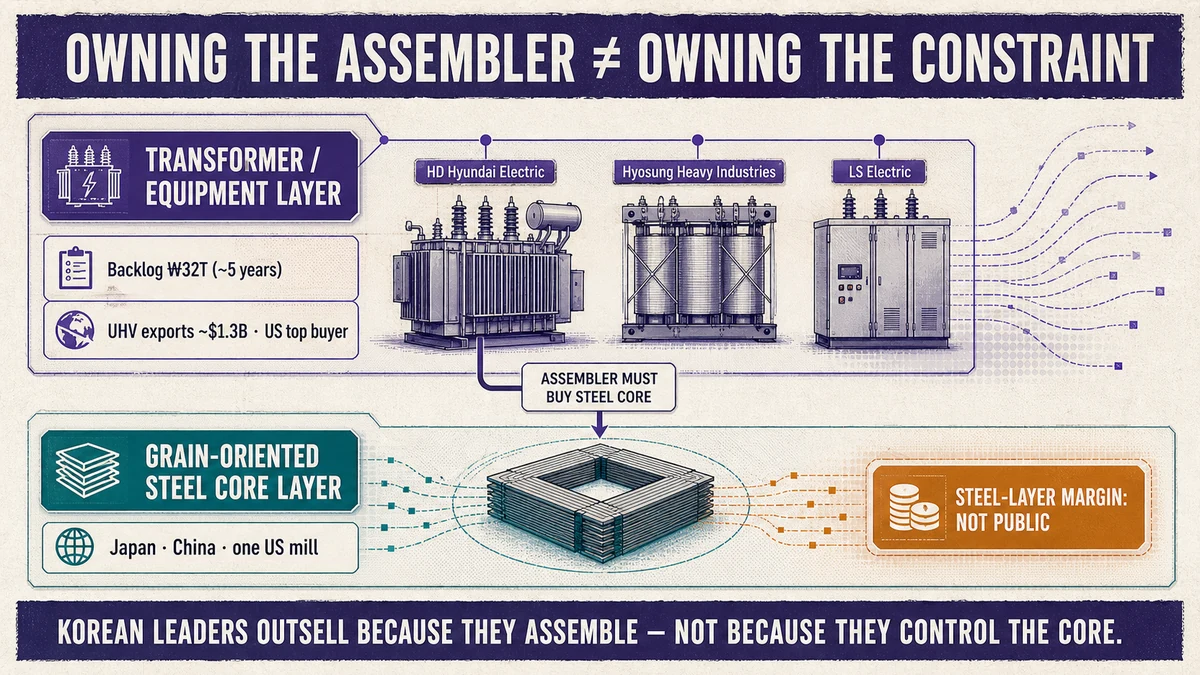
One layer up, the transformer builders are booking the boom directly. Korea’s three big power-equipment makers – HD Hyundai Electric, Hyosung Heavy Industries and LS Electric – are sitting on a record combined order backlog above 32 trillion won, roughly five years of work, and are pouring capacity into US plants in Alabama, Tennessee and Utah. Korean ultra-high-voltage transformer exports hit a record near $1.3 billion, with the US the biggest buyer by far. If you want the cleanest read on who is structurally positioned in the power-transformer squeeze, the order books of the equipment makers are it.
The subtlety – and the risk for anyone who owns only the transformer builders – is that the equipment maker still has to buy the core steel. A record backlog priced before GOES doubled again is a margin question, not just a revenue one. The durable rent in this chain sits at the steel layer, and the steel layer is a different, more concentrated set of names than the transformer layer. Owning the assembler is not the same as owning the constraint.
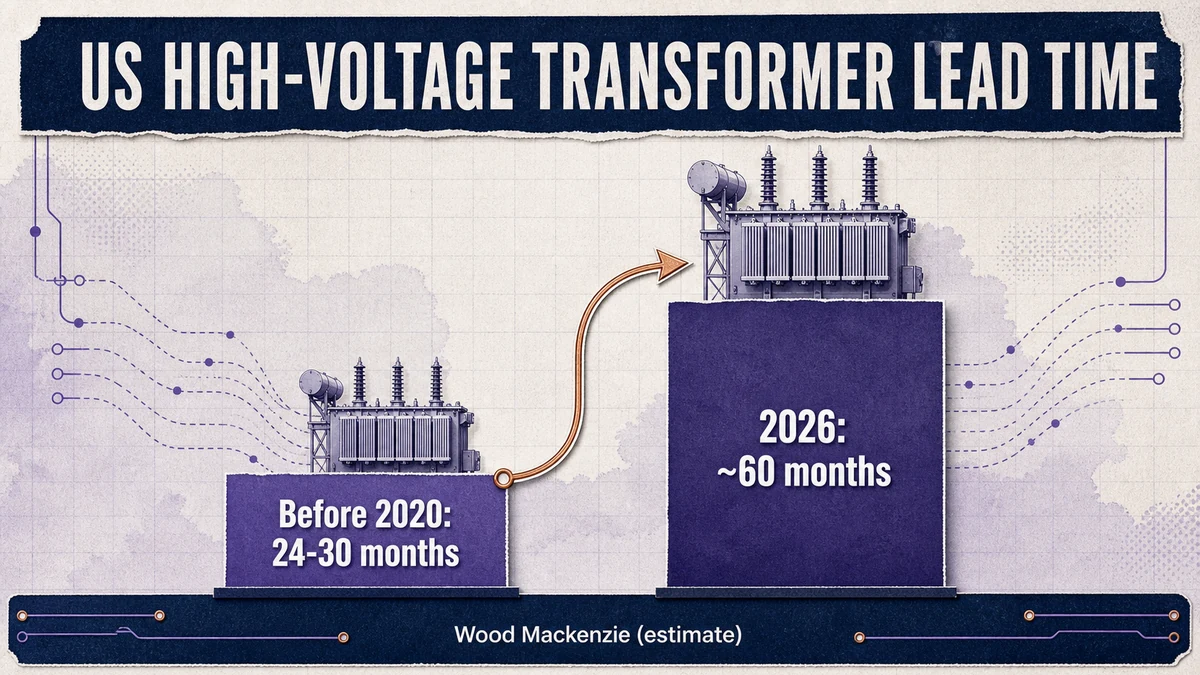
None of this is what the policy machine is aimed at. After its June 18, 2026 meeting, FERC moved to accelerate grid interconnection for large loads like data centers, fulfilling a DOE request. That is real and useful – but it speeds permission to connect, not the manufacture of the thing you connect through. Faster interconnection into a transformer you cannot take delivery of until 2030 does not close the gap. The layer that clears fastest this cycle is the one no lever in Washington reaches: a melting line for oriented silicon steel.
A shortage and a glut, in the same metal
The producer list is short enough to write out: Baowu, NLMK, Nippon Steel, Cleveland-Cliffs, Shougang, POSCO, JFE and Thyssenkrupp hold most of the world’s grain-oriented capacity, and by one industry count only ten to twelve plants anywhere can make the high-grade material transformers actually need. Roughly a fifth to a quarter of transformer manufacturers report supply problems, with premium grades quoted at six to nine months before a mill will commit. The whole market is put near $9.5 billion for 2026 — small enough that no producer can justify a speculative line, large enough that everything downstream waits on it.
Then there is the detail that makes this a story about grade rather than tonnage. In the middle of a shortage, Thyssenkrupp extended planned production shutdowns at its Isbergues works in northern France through September 2026, citing import pressure. A producer idling capacity while buyers queue looks like a contradiction until the two products are separated: commodity grades face cheap imports and thin margins, while the thin, low-loss grades that go into a grid transformer are made on a handful of lines that cannot be conjured by raising a price. Both conditions are real at once, in the same metal, at the same company.
That is also why the R&D goes where it does. Nippon Steel and POSCO are together spending well over $180 million on thinner, lower-loss variants rather than on volume — the constraint they are trying to relieve is efficiency per kilogram, not kilograms. A buyer waiting on a transformer is waiting on a metallurgy programme, and metallurgy programmes do not respond to demand signals within a procurement cycle. Cleveland-Cliffs remains the only major domestic US supplier, which is the sentence that turns a materials footnote into an industrial-policy problem.
Four things that would move the melting line
- GOES lead times and price. GOES delivery is still ~12-18 months and climbing; further rises signal the material constraint is binding, an easing signals capacity is catching up.
- 2027-2028 capacity coming online. ArcelorMittal’s Alabama mill and Cleveland-Cliffs’ Butler expansion are the two dates that decide whether the US eases or stays import-dependent.
- Transformer-maker margins, not just backlogs. A five-year backlog booked before the last steel move is where input inflation shows up first.
- Whether any policy lever finally targets the material. So far tariffs and interconnection reforms address everything except the melting line.
- Whether Isbergues restarts. Thyssenkrupp idling French capacity through September 2026 while premium grades run six to nine months out is the clearest test of whether this is one market or two. A restart into strong demand says the glut was commodity-only and temporary; a further extension says the high-grade constraint and the low-grade surplus are structurally separate, and no amount of headline capacity relieves the part that matters.
The next number in this story is not a chip benchmark; it is delivery. The AI buildout has spent a year rediscovering that atoms are harder than bits. The grain in a sheet of steel is about as far down the stack as that lesson goes.
Sources
- U.S. Department of Energy
- clevelandcliffs.com — Cleveland-Cliffs is the sole US GOES producer; Butler PA grain-oriented expansion on schedule for 2028 (2026)
- pv-magazine-usa.com — Lower steel grades cannot meet DOE/EU transformer-efficiency rules; GOES is the principal material constraint (2026-05-11)
- Fact.MR — Market-research estimate, not producer disclosure: grain-oriented electrical steel near $9.52 billion for 2026; only ten to twelve plants worldwide make high-grade GOES; roughly 20-25% of transformer manufacturers report supply shortages with six-to-nine-month lead times on premium grades; Baowu, NLMK, Nippon Steel, Cleveland-Cliffs, Shougang, POSCO, JFE and Thyssenkrupp named as the dominant producers; Nippon Steel and POSCO spending over $180 million on thinner high-efficiency variants; Thyssenkrupp extending Isbergues production shutdowns through September 2026 under import pressure; Cleveland-Cliffs the only major US domestic supplier (2026)
View all sources
- chargeduppro.com — GOES ~3.5-4 Mt/yr (~30-35% of electrical steel); prices ~doubled since 2020; delivery 12-18 months (2026)
- datacenterknowledge.com — High-voltage transformer lead time ~24-30 months pre-2020 rising to ~5 years in 2026 (Wood Mackenzie) (2026)
- energynewsbeat.co — Barely a third of 2026 US data-center capacity under construction; >$650B guided hyperscaler capex (2026)
- en.sedaily.com — Korea’s 3 power-equipment makers record combined backlog above KRW 32 trillion (~5 years of work) (2026-05-01)
- transformer-magazine.com — Korea UHV transformer exports record ~$1.3B; US the biggest buyer by far (2026)
- businesskorea.co.kr — HD Hyundai Electric, Hyosung Heavy, LS Electric pouring capacity into US plants (Alabama, Tennessee, Utah) (2026)
- whitecase.com — FERC moved to accelerate large-load (data-center) grid interconnection after June 18 2026 meeting, per DOE request (2026-06)
This article is for informational and educational purposes only and does not constitute investment, financial, or legal advice.