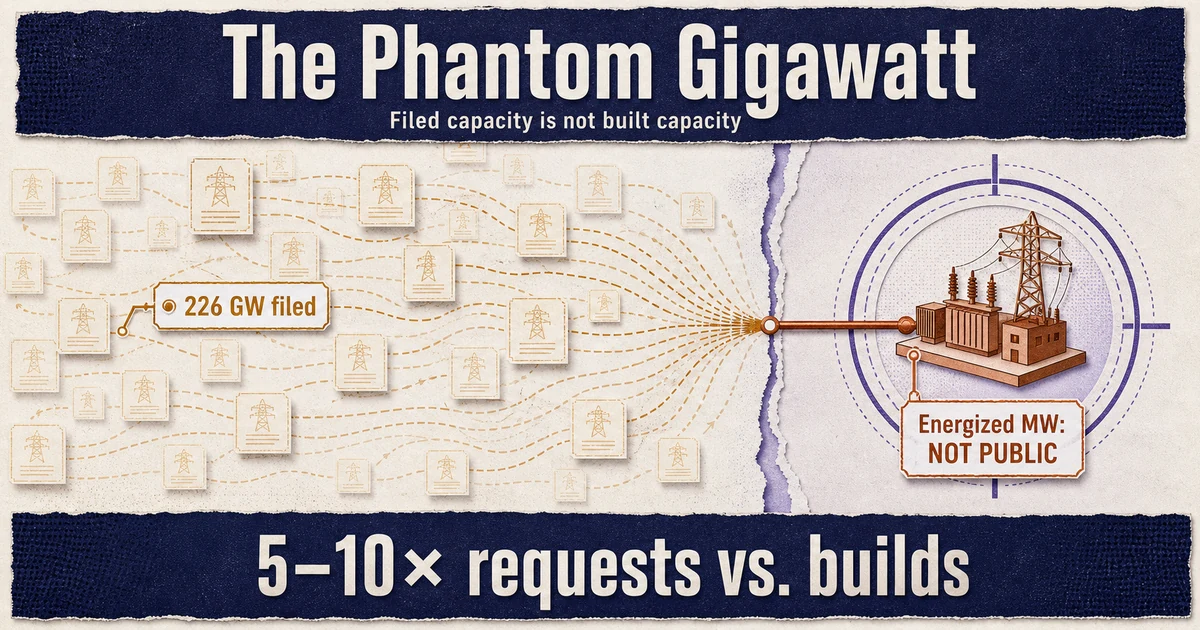
The queue looks like a construction boom. Some utilities increasingly treat it as a book of options. As of November 2025, 226 gigawatts of large-load demand sat in the interconnection queue of ERCOT, the Texas grid operator – up from 63 GW at the end of 2024, roughly 77% of it data centers aiming to connect by 2030. And it kept climbing: by ERCOT’s December 9 board meeting, planners were assessing more than 233 GW of large-load requests, an almost 300% jump over year-end 2024, more than 70% from data centers. Every AI-power headline this month leans on numbers like these. How much of that gigawatt pipeline actually exists is a question the utilities are already answering – in their planning, their contracts, and their queue math.
The pipeline has a human face this week
The consensus says the pipeline is demand. It has a human face this week: Georgia Power is building more than 1,000 miles of new transmission across five projects, a route map crossing more than 330 parcels of land, with nearly 30 homes on one 35-mile corridor facing potential demolition. The utility calls eminent domain a last resort – five uses last year, none residential – but the option sits behind every negotiation, and CBS News estimates put 70-80% of that corridor’s power with AI data centers, a figure Georgia Power has declined to confirm.
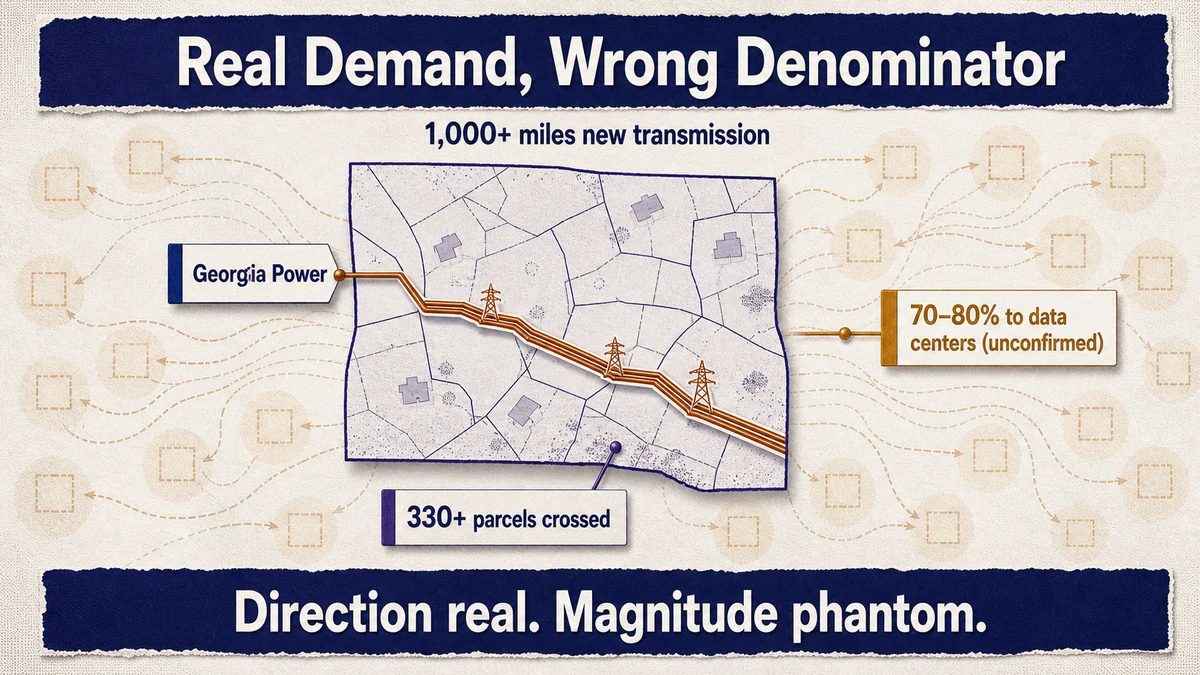
Households are negotiating against the demand story, which makes the size of that story a fair thing to audit. If announced gigawatts translate into consumed gigawatts, the buildout is rational. If they do not, ratepayers and displaced homeowners are funding a forecast.
The people processing the requests do not believe most of it
The first crack appears when you ask the utility side how many requests are real. Astrid Atkinson, CEO of Camus Energy, estimates that interconnection requests run roughly five to 10 times the number of data centers actually being built. The mechanism is mundane – filing is cheap, capacity is scarce, so a developer files in several states for what is functionally one project, builds in one place, and lets the other applications sit. Each duplicate filing adds requested capacity that exists in a spreadsheet but may never be built.
An EPRI utility survey makes the discount explicit. Ten of them reported data-center requests amounting to half or more of their current peak load; not one of them expects actual data-center load to exceed 35% of that same peak within five years. Watch the denominator: both figures are shares of existing peak load, not a conversion rate for the queue – the survey does not say 35% of requests get built.
What it does establish is that those 10 high-exposure respondents plan for less data-center load than their request books describe; separately, about 30% of surveyed utilities report derating requests using maturity signals – land actually purchased, permits actually filed.
Utilities are underwriting against the number, not for it
Talk is one thing; contract terms are another. Dominion Energy and Appalachian Power have proposed requiring data centers to pay for 60-80% of their contracted demand whether they use it or not, and Rappahannock Electric requires collateral of up to 100% of contracted load. Minimum-take structures serve several purposes at once – recovering the cost of dedicated infrastructure, shielding existing ratepayers, managing customer credit risk – but they share one premise: the utility does not treat contracted capacity as demand that will simply arrive.

Whatever the motive mix, the provisions attach a financial consequence to capacity that goes unused, which is what you build when a headline number cannot be taken at face value.
Even the real projects cannot be energized on that schedule
Even the projects that are fully real collide with timelines. The IEA estimates grid constraints could delay around 20% of planned data-centre projects to 2030, notes that building new transmission lines takes four to eight years in advanced economies, and reports that lead times for transformers and cables have doubled in three years. The same physical constraint extends from the electrical steel inside the transformers to what the power bill does to AI economics.
The point here is narrower: even a zero-phantom pipeline could not be energized on the schedule the headline number implies.
What is real, and what is not
The consensus does not fail completely, and honesty requires saying so. Real money is moving: a thousand miles of new transmission in Georgia alone, with real households in its path. Demand growth is genuine, large, and disruptive. What fails is the denominator. Announced gigawatts mix filed, duplicated, speculative and real projects into one number that the utilities’ own planning already refuses to take literally – EPRI’s most exposed respondents plan for data-center load far below what their request books imply, and the IEA separately estimates grid constraints could delay about 20% of planned projects.
One rule applies to capacity claims of any kind: an announcement, a filing, a contract and an energized megawatt are four different events, and only the last proves that forecast demand became delivered load. The numbers worth tracking in this story are the boring ones – minimum-take contracted megawatts, and energized megawatts reported after the fact. Two markers to watch:
- queue-to-energization conversion rates, if grid operators begin publishing them;
- the spread of minimum-take contracts from Virginia’s utilities to other data-center states.
The first would measure the phantom share; the second could shrink it by making speculative requests expensive.
The conversion rate exists. It is worse than the queue implies.
That first marker has now been measured, and it does not need a grid operator to volunteer it. Of the projects that entered ERCOT screening by 2020, about 40% have reached an interconnection agreement or begun operating. In PJM the same cohort converted at 24%. Those are completion rates for a generation of requests old enough to have finished, which is the only honest way to read a queue: not by what is in it, but by what fraction of an equivalent book historically came out the other side.
Apply either number to a filing total and the arithmetic changes character. ERCOT’s large-load queue reached roughly 238.6 gigawatts by March 2026, with data centers accounting for 77.5% of it — and 198 gigawatts of large load applied in the first quarter alone, which is to say the queue is now growing faster per quarter than most national grids are large. A 24-to-40% historical conversion does not turn that into a forecast. It turns it into a range whose low end is still enormous and whose high end was never real.
The mechanism behind the gap is mundane and worth naming precisely, because it is not fraud. A developer facing uncertain transmission will file the same project into several utility queues at once, keeping options open until one clears. Every one of those filings is a genuine intention; only one becomes a building. The queue counts intentions. The grid gets buildings.
PJM shows what happens when the two are reconciled late. Thirty-eight gigawatts were cancelled there in 2025 — more than ten times the new generation that successfully connected in the same year — while the operator projects a capacity shortfall reaching 15 gigawatts by 2030. Cancellation at that scale is not a market failing to grow. It is a market discovering which of its own filings were options rather than plans, and discovering it after planners have already had to act on them.
AI’s power demand is real; ERCOT’s queue – 226 GW in November, past 233 GW by December – is a filing total, not a build forecast. A utility-side estimate puts interconnection requests at five to ten times actual builds, the most exposed utilities in EPRI’s survey plan for far less data-center load than their request books describe, and the IEA warns grid constraints could delay about a fifth of planned projects. Read every “gigawatts of AI demand” headline the way a utility now reads an interconnection request: as an opening bid.
The useful thing about a queue is that it eventually empties, one way or the other. Four numbers will say which way.
- ERCOT’s own conversion rate, published. The 40% figure comes from an outside reading of a decade-old cohort. If ERCOT or PJM begins reporting queue-to-energization conversion as a standing statistic, the phantom share stops being an inference. If neither does while the queue keeps growing, that silence is itself the finding.
- Cancellations against connections. PJM cancelled 38 gigawatts in 2025 and connected less than a tenth of that. A second consecutive year at that ratio would confirm the book is mostly options; a narrowing ratio would mean the filings are hardening into projects.
- Minimum-take contracts spread, or stay in Virginia. A contract that charges for reserved capacity whether or not it is used is the cheapest available filter on speculative filings. Watch whether utilities outside Virginia adopt it. Adoption would shrink the queue without any new transmission being built.
- Energized megawatts get reported at all. Every party to this has an incentive to publish requests and none to publish deliveries. A developer, hyperscaler or utility stating energized load at a named site — not contracted, not announced, energized — would be the first number in this story that cannot be an opening bid.
Sources
- Latitude Media — ERCOT large-load queue at roughly 238.6 GW as of March 2026 with data centers at 77.5% of it; 198 GW of large load applied in Q1 2026 alone (2026)
- utilitydive.com — 5-10x speculative-to-built estimate (Camus Energy CEO); EPRI survey: none of the 10 utilities expects actual data-center load to exceed 35% of its current peak load within five years; ~30% derate by maturity; Dominion/AEP 60-80% minimum-take proposals; Rappahannock collateral up to 100% (2025-05-15)
- iea.org — IEA Energy and AI: ~20% of planned data-centre projects to 2030 at risk of delay from grid constraints; new transmission lines take 4-8 years in advanced economies; transformer and cable lead times doubled in three years (2025-04-10)
- Ascend Analytics — Historical conversion for the cohort that entered screening by 2020: about 40% of ERCOT projects and 24% of PJM projects reached an interconnection agreement or operation; developers file identical requests into multiple utility queues to hedge transmission risk (2026)
View all sources
- EnkiAI — Trade summary, not an operator disclosure: PJM cancelled 38 GW in 2025, more than ten times the new generation connected that year, against a projected capacity shortfall reaching 15 GW by 2030 (2026)
- fortune.com — Georgia Power: 1,000+ miles of new transmission across five projects; route crosses 330+ parcels; ~30 homes face potential demolition on the Ashley Park-Wansley corridor; eminent domain a last resort (5 uses last year, none residential); CBS estimate 70-80% of the corridor’s power for data centers, unconfirmed by the utility (2026-07-26)
- utilitydive.com — ERCOT board meeting Dec 9, 2025 (VP Kristi Hobbs): >233 GW of large-load requests under assessment, almost 300% above year-end 2024, >70% from data centers (2026-01-06)
This article is for informational and educational purposes only and does not constitute investment, financial, or legal advice.