The robot arrived, but the market did not wait for it. A robotic satellite mechanic was supposed to demonstrate its capabilities in geosynchronous orbit in spring 2021 – a spacecraft with arms that could inspect another satellite, fix what had gone wrong and bolt on new hardware. DARPA initiated that program, Robotic Servicing of Geosynchronous Satellites, in 2017. It launched on July 21, 2026 aboard a Falcon 9, and because the vehicle spirals out to geosynchronous orbit on electric propulsion – “its yearlong journey,” in DARPA’s phrasing – the arms are expected to begin servicing operations around 2027. Four years were planned; operations are now expected roughly ten years after the program began. In the gap, a simpler design began selling an overlapping service: life extension for fuel-limited GEO satellites.
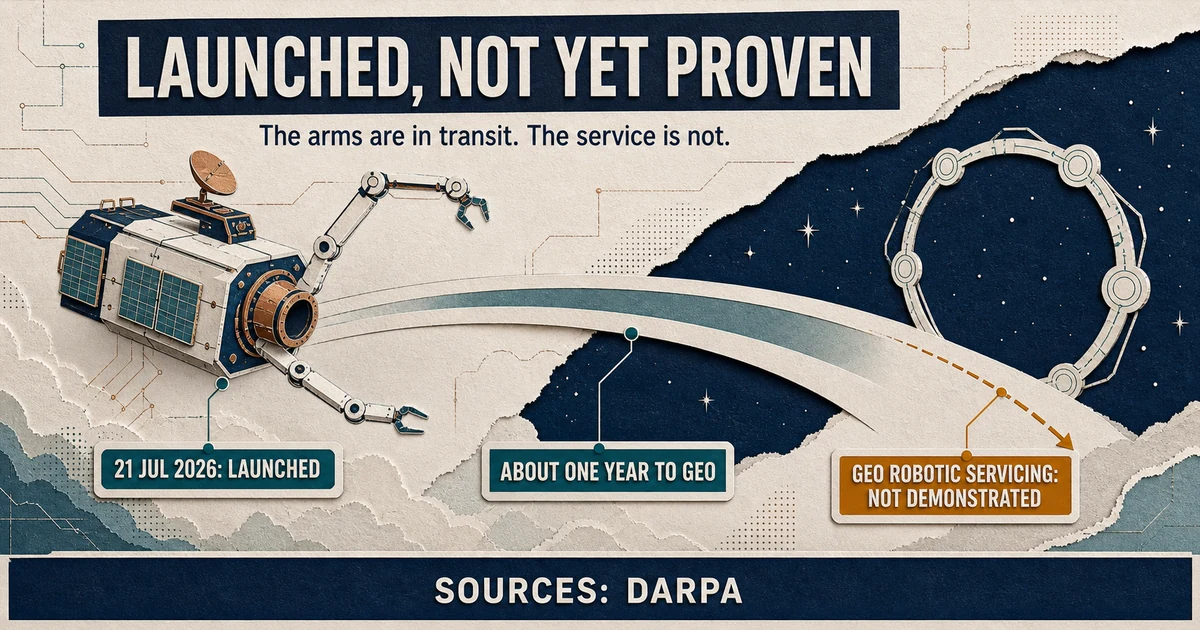
Mission Overview: Testing Robotic Arms in Geostationary Orbit
The specification is unusually concrete for a robot. Each of the two manipulators carries “seven high-strength, high-performance joints and a specialized tool drive” with interchangeable tools; the vehicle is designed for “in-orbit upgrades, inspections, anomaly resolution, and satellite relocation,” and to install propulsion “jet packs” that add six or more years of life to satellites already in orbit. DARPA led the robotics with the Naval Research Laboratory; Northrop Grumman’s SpaceLogistics built the bus and will operate it.
Every item on that list is work a technician does with hands, performed 36,000 kilometres away on hardware nobody can bring down, on client satellites never designed to be serviced. Terrestrial robots fail cheaply, and their tactile hardware wears out and gets replaced. This one does not get that option.
Proven Life Extension: Why Armless Docking Tugs Scaled First
While the dexterous machine slipped, a blunter one began selling an overlapping service in the same commercial market. On February 26, 2020, Northrop Grumman’s Mission Extension Vehicle-1 docked with Intelsat 901 – the first docking of two commercial satellites – and assumed station-keeping for a customer running out of fuel.
MEV-1 has no manipulator arms. It grapples the client and flies it, becoming the satellite’s missing propulsion and attitude-control layer rather than repairing its hardware. For a fuel-limited GEO satellite such as Intelsat 901, that substitution can extend service life without touching onboard components.
SpaceLogistics now reports more than ten combined years of life-extension service across its two MEVs and three successful docking operations. That is company-reported operating history, not a claim that robotic inspection or repair has already been commercialized.
The scoreboard that follows is lopsided but not final. The capability that removed manipulation from the problem has accumulated more than ten combined service-years across two vehicles; the capability that requires manipulation is expected to begin operations around 2027. The former proves paid propulsion and attitude-control service. It does not pre-judge whether arms can create a broader repair and upgrade market.
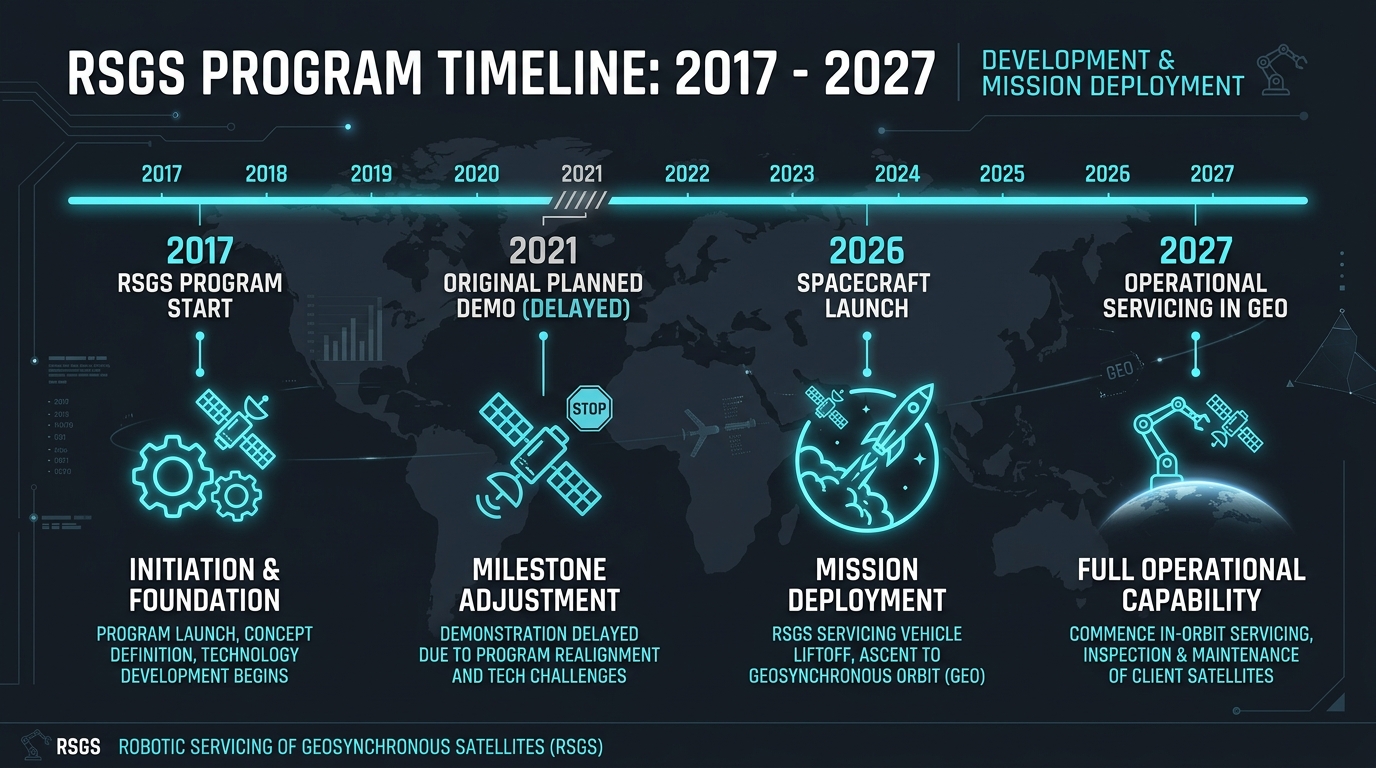
Technical & Development Challenges Behind the 6-Year Slip
The public record describes a program, not a robotics failure.
Maxar, the original contractor, abandoned the effort in 2019 amid a lawsuit. Northrop picked up the contract in 2020 and was, at that point, slated to launch in 2024. Program manager Robert Hauge attributes the further slip to seams rather than grippers: “Both the bus, the satellite bus provided by Northrop Grumman, as well as the payload, the robotic payload provided by DARPA, are very complicated. So, it’s challenges with integrating those, as well as we need to have all the software to be able to work together” – compounded by post-COVID supply chains.
Two organizations, two complicated halves, one interface, and software that has to reconcile them before anything approaches a live customer satellite. None of that is a manipulation problem; it is an integration schedule.
Earlier that month, a different orbital capability produced a concrete result. On July 10, China caught a Long March 10B first stage in a net strung across a ship, becoming the second country to recover an orbital-class booster and the first to do it with a net rather than landing legs. Catching a falling booster is a demanding control problem. The recovery shows guided bulk-motion control reaching a concrete milestone; by itself, it does not establish a broader schedule record.
In this comparison, manipulating client hardware has delivered later than supplying propulsion; ground robots show a related, but not equivalent, gap between mobility and dexterous handling, as in humanoid brains are nearly solved and the hands are not.
One program, one contractor exit and one pandemic do not establish a rule. They do suggest that announced dates for moving things and announced dates for manipulating them deserve different discounts.
Market Dynamics: Commercial Competitors Capture Low-Hanging Servicing Rungs
Related Analysis: What $8 Billion Buys That a Rocket Cannot Build — Rocket Lab & Iridium Merger
Six years of slip did not leave the market empty. Northrop Grumman’s SpaceLogistics remains the only company to have sold and delivered commercial life extension, which is why its Mission Extension Vehicles keep being the reference point rather than a footnote. But the ground beneath that position has been taken by companies attacking the problem from other directions. Astroscale has assembled contracts across several governments for inspection, rendezvous and docking, debris removal and refuelling, including a $25 million award to build a refuelling vehicle and demonstrate it in orbit. Starfish Space raised $29 million in 2024 for autonomous vehicles aimed at both GEO life extension and low-orbit debris removal, and its Otter Pup 2 mission targets a first commercial docking with a satellite that was never designed to be docked with. ClearSpace, MDA, Orbit Fab, Redwire, Moog, Thales Alenia, Airbus and Blue Origin’s Honeybee Robotics all hold pieces of the same stack.
Read that list against the capability ladder and the pattern from the article’s own argument repeats one level up. The rungs that involve moving a client — dock to it, push it, hold its attitude — have multiple credible suppliers and at least one with a revenue history. The rung that involves manipulating a client with arms and tools has exactly one vehicle on its way to work, and it has not started. Competition arrived in the easy half of the problem first, which is the same asymmetry that produced the six-year slip.
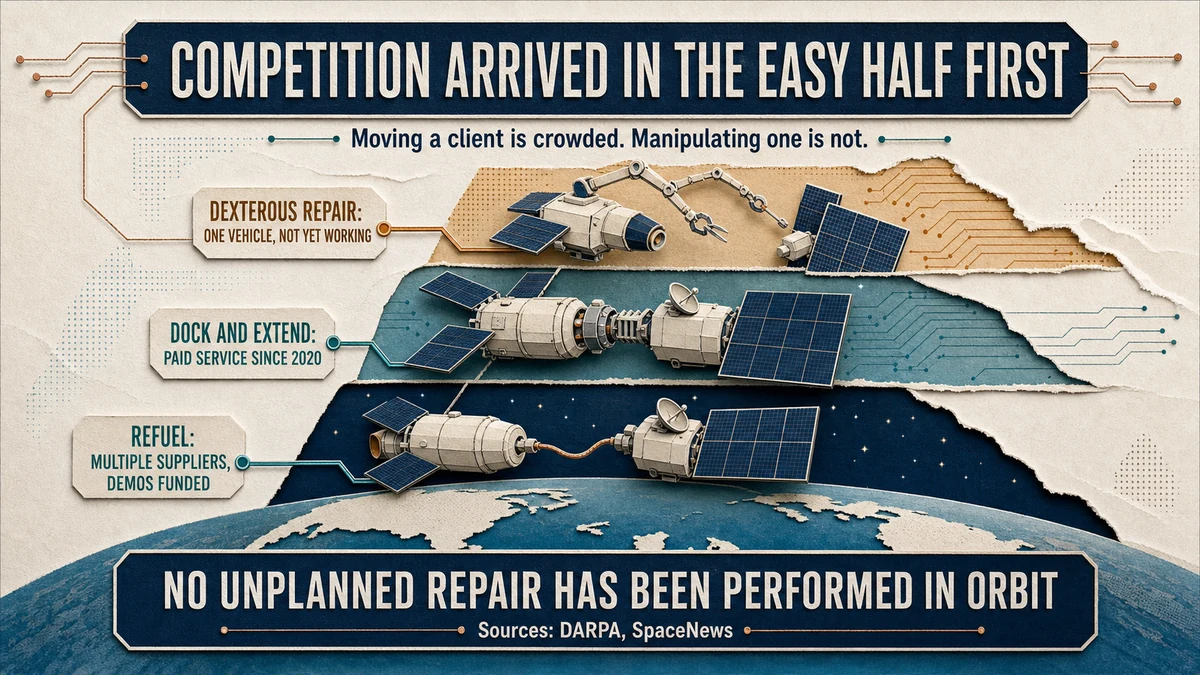
The money has followed the easy half too. The on-orbit servicing market is put at roughly $3.1 billion in 2026 rising toward $6.7 billion by 2033 in one market-research estimate — real, but modest against the value of the GEO fleet it proposes to service, and small enough that a single failed demonstration would reprice the category. Four US servicing missions are slated for 2026, which means the evidence base is about to get thicker quickly. What it does not yet contain is a repair.
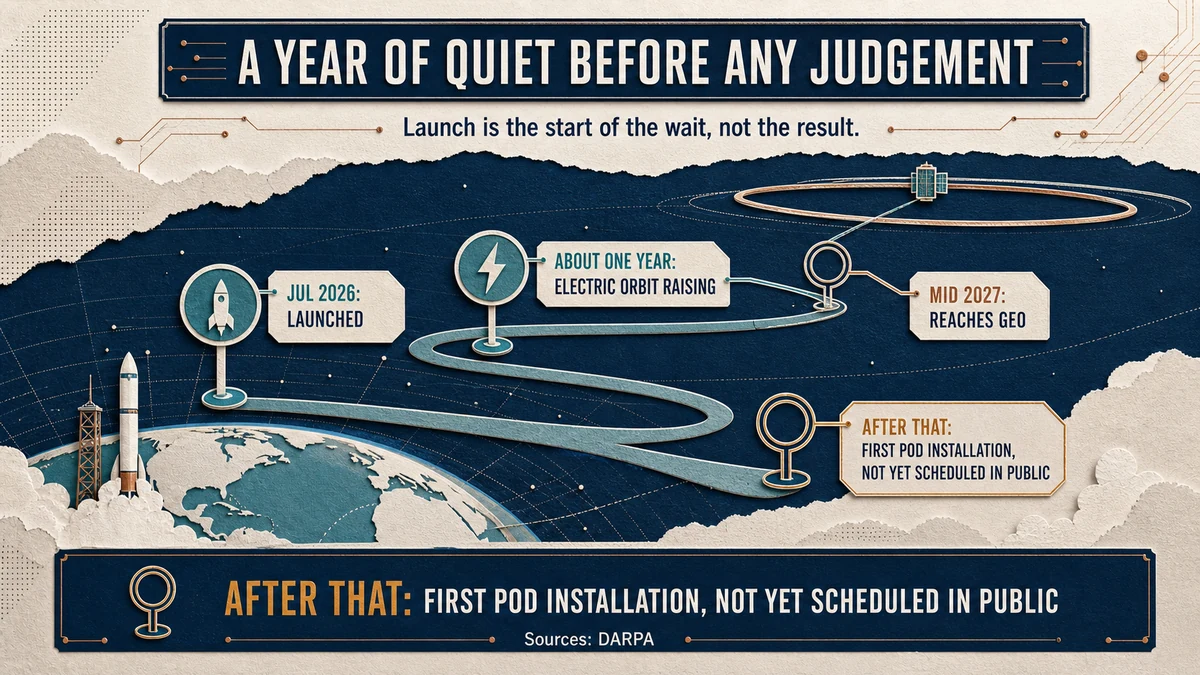
Strategic Conclusion & Verification Milestones
On-orbit servicing did not fail to arrive; it arrived first in the shape that dodged the hard part, and that simpler shape has accumulated paid service history. The arms are on their way, nine years after the program started, with about a year of transit before anyone can judge them. A planned pod installation would prove the mechanism works. Repeated safe client operations — and eventually an anomaly response or upgrade that propulsion alone cannot substitute for — would prove the mechanism has become a service.
A year of transit is a year of nothing to report, which is exactly when a schedule claim should be written down. Here is what to hold it to.
- The transit ends on schedule, or it does not. Electric propulsion should place the vehicle in geostationary orbit around mid-2027. That date is the cheapest possible test of the programme’s own estimates: it depends on physics and a thruster, not on a customer. A slip here, before any arm is used, would say the schedule discount this article argues for is still too small.
- A pod goes on a real client. Installing a Mission Extension Pod on a satellite that did not launch expecting one is the first task that uses the arms for something a docking tug cannot do. A completed installation, named client and stated added life would convert the dexterity claim from specification to service. A demonstration on a cooperative target instead would be a rehearsal, and should be read as one.
- Somebody else docks with an unprepared satellite. Starfish Space’s Otter Pup 2 is aimed at exactly that in low orbit. If a smaller company reaches an uncooperative client first, the capability gap this article describes is narrower than the contract history suggests, and the six-year slip looks like a programme problem rather than a physics problem.
- An anomaly gets resolved that was not scheduled. This is the one that matters and the one nobody can plan. An unplanned repair — something broke, arms fixed it — is the only result that separates servicing from life extension. Until it happens, every figure in this market is priced on a capability that has been demonstrated on the ground and nowhere else.
Sources
- SpaceNews — Trade reporting on the competitive field: Northrop Grumman SpaceLogistics as the commercial life-extension pioneer; Astroscale’s multi-government contract book including a $25 million refuelling-vehicle award for an in-orbit demonstration; Starfish Space’s $29 million 2024 raise and its Otter Pup 2 attempt at a first commercial docking with an unprepared satellite; ClearSpace, MDA, Orbit Fab, Redwire, Moog, Thales Alenia, Airbus and Honeybee Robotics active in the same stack
- Persistence Market Research — Market-research estimate, not audited disclosure: on-orbit satellite servicing at roughly $3.1 billion in 2026 rising toward $6.7 billion by 2033 (2026)
- Air & Space Forces Magazine — Four US on-orbit servicing missions slated for 2026 (2026)
- DARPA — RSGS lifts off — launch, yearlong GEO transfer, arm/tool configuration and intended tasks (2026-07-21)
- DARPA — original RSGS program description — on-orbit demonstration target within five years and intended servicing capability (2016-03-25)
- Intelsat — MEV-1 docking with Intelsat 901 — first commercial-satellite docking and life-extension service (2020-02-26)
- Northrop Grumman — SpaceLogistics — MRV launch, MEV operating history, three dockings and more than ten combined service-years (accessed 2026-08-04)
View all sources
- Northrop Grumman — Space’s Swiss Army Tool — combined MEV service history and MRV capability claims (2026)
- Breaking Defense — contractor transition, integration explanation and prior schedule (2026-05-20)
- SpaceNews — Long March 10B recovery — the article’s retained bulk-motion comparison (2026-07-10)
This article is for informational and educational purposes only and does not constitute investment, financial, or legal advice.