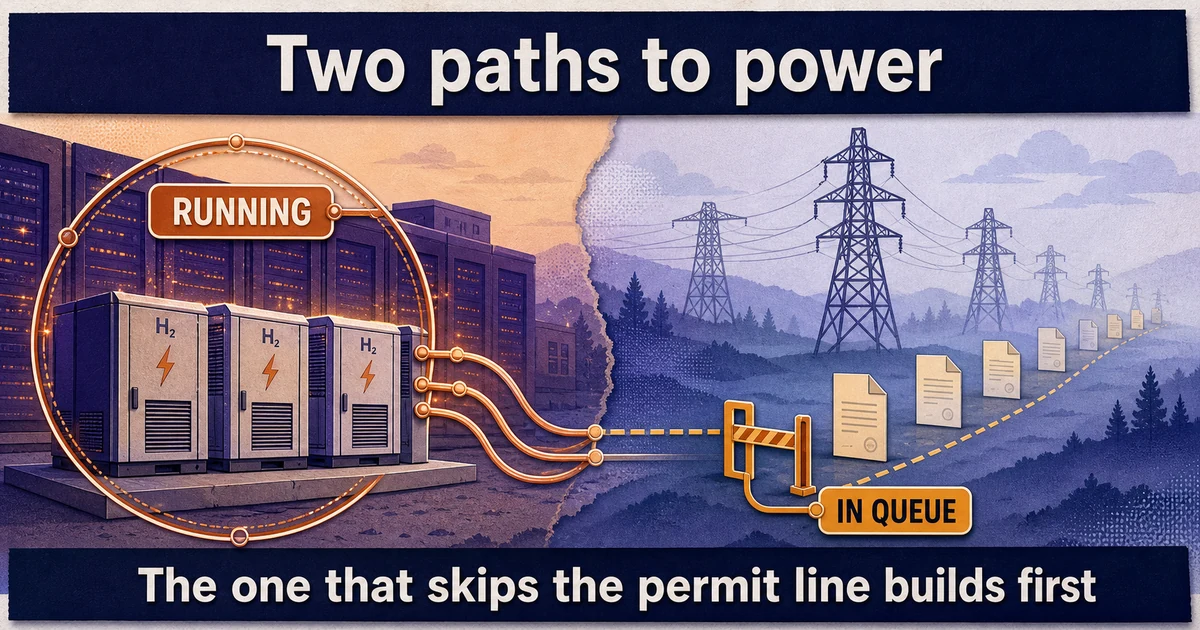
In April, Monroe Township, New Jersey banned data centers outright. By June a developer had sued the town for $300 million, and by July the case had moved to federal court. It is not an isolated fight. In Cave City, Kentucky – population roughly 2,500 – the city passed a 12-month moratorium on a $4.8 billion, ten-building project planned near Mammoth Cave National Park, and the developer sued within weeks, calling the pause illegal. In Hill County, Texas, a county commission passed a one-year data-center ban; the developer sued, and the county rescinded the ban about a week later. An estimated $64 billion in US data-center projects has been blocked or delayed by local opposition of this kind so far, and one industry count puts the number of jurisdictions with an active ban or moratorium past 500 nationwide.
The Fight That Looks Decisive Isn't
Read enough of these stories in a row and a pattern emerges that the headlines miss: the town rarely wins. Hill County folded in a week. Monroe Township's own council reportedly acknowledged in a June statement that an outright ban "would lead to litigation" – they passed it anyway, and got exactly that. That is not the end of it: in late July Monroe moved to have the suit dismissed, its attorney arguing that a zoning ordinance is not a speech restriction and that the developer never held a binding contract. The motion is unresolved, so the one case here with a live docket has not actually gone the developer's way yet. Local opposition is real, it is expensive, and it occasionally kills a specific site. But as a brake on the industry, it looks more like a speed bump that developers are pricing in and paying through than a wall anyone expects to hold.
So if the political fight isn't what actually decides which data centers get built first, what does? This desk has already argued that the honest answer starts with the grid: the interconnection queue that ERCOT and other operators are sitting on is mostly a filing list, not a construction schedule, and utilities themselves plan for far less demand than the announced gigawatts imply.
That reading got a fresh confirmation this month – Wood Mackenzie now projects that US utilities will likely commit to only about 28% of the 1,066 gigawatts requested for data centers nationally, and Texas Governor Greg Abbott ordered a full audit of every data center seeking grid access on August 3, pausing approvals and putting $13 billion in industry revenues at risk, by BloombergNEF's estimate. The known workaround for that queue is to skip the grid and generate power on site.
What hasn't been widely reported is that the workaround has itself split into a race between two different technologies – and the fight between them is being decided by a second permitting queue almost nobody outside the power industry is watching.
Why One Kind of Generator Skips the Line
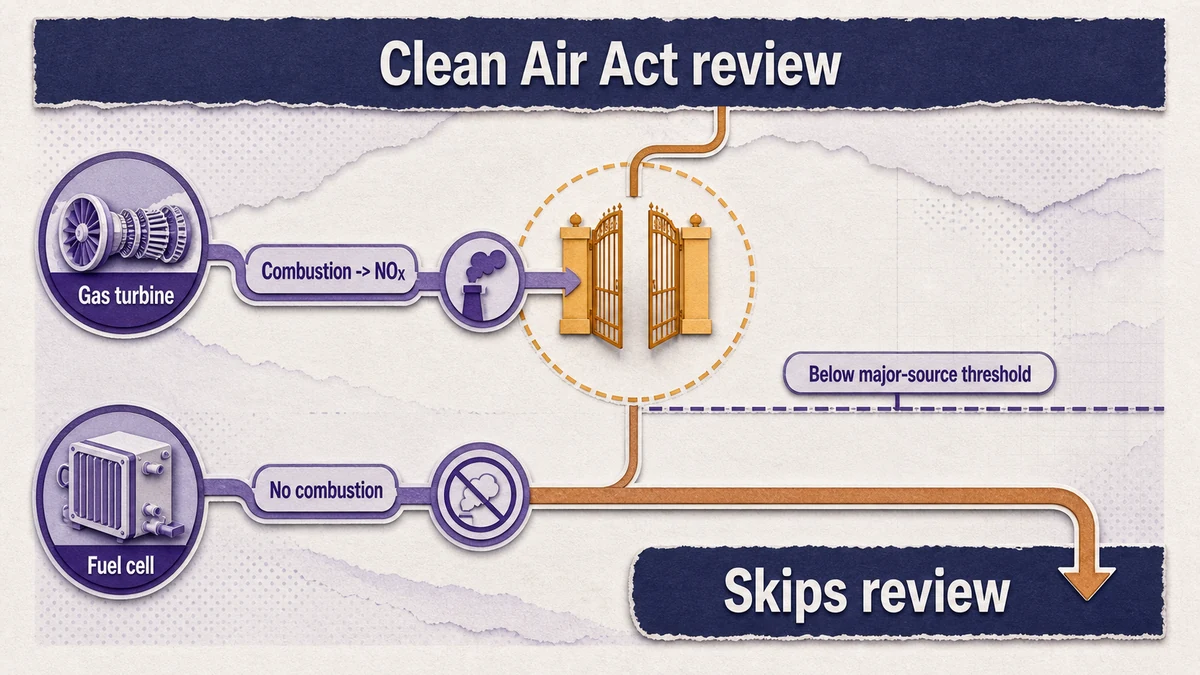
A gas turbine generates electricity by burning fuel, and burning fuel makes nitrogen oxide. Above a fairly low threshold, that triggers a Clean Air Act review that can take years to clear – the same kind of multi-year review that already makes new grid interconnections such a bottleneck. A fuel cell generates electricity electrochemically, with no combustion at all, and in many configurations it falls under the threshold that would classify a site as a regulated "major source".
That single difference is why a fuel cell can often be permitted and installed on a timeline a combustion turbine cannot match, and it is the actual mechanism behind a sentence that otherwise sounds like a stray earnings-call remark. On Bloom Energy's Q2 2026 call, CEO KR Sridhar said customers who had already ordered combustion turbines and reciprocating engines were canceling those orders and switching to Bloom instead – and named Nebius as one of them.
That is a company changing its equipment order after the fact, for a reason that has nothing to do with a town council. It also lines up with an unglamorous but important fact: turbines themselves are now capacity-constrained. BloombergNEF puts the cost to build a new combined-cycle gas turbine plant at $2,157 per kilowatt in 2025, up 66% from under $1,500 in 2023, with manufacturer backlogs stretching toward the early 2030s.
A buyer facing a multi-year wait for the turbine itself, on top of a possible multi-year air-permit review once it arrives, has a real reason to look elsewhere – even before comparing the electricity bill.
The Named Deal Behind the Number
The concrete version of that switch became public the week of August 13, 2026, when Nebius confirmed it had chosen Bloom Energy's solid-oxide fuel cells to power a 300-megawatt AI data center in Vineland, New Jersey, on site and behind the meter. Nebius described the choice as delivering power "quietly and ultra-low emissions," with "no significant impact expected on the project timeline". Bloom Energy's stock rose about 13% on the news, to roughly $238, and FuelCell Energy – a smaller rival chasing the same substitution – rose about 11%.
Bloom's underlying business is growing fast enough to support that reaction on its own: Q2 2026 revenue hit $1,065.4 million, up 165.5% from $401.2 million a year earlier, and the company raised full-year guidance to $3.9-4.2 billion from the $3.4-3.8 billion it had set in April.
None of that means the electricity itself got cheaper. Bloom has published exactly one per-kWh figure in its corporate history: $0.099, posted in July 2023 with the Series 10 managed service – five-year term, maintenance and 24/7 monitoring included. US industrial customers actually paid 8.71 cents per kWh in May 2026. One side of that comparison is three years stale, and it is the only side Bloom's own disclosures offer. Lined up against comparable published rates, the actual trade looks less like a discount and more like a bounded toll:
| Power path | Time to power | Cost basis | Information level |
|---|---|---|---|
| Grid interconnection | Years-long queue; PJM applications now average roughly eight years from filing to commercial operation, per this desk's prior reporting | $0.0854/kWh, 2026 US industrial average | Confirmed (EIA-sourced) |
| On-site gas turbine | Blocked on equipment: manufacturer backlogs run toward the early 2030s | Plant capex $2,157/kW (2025), up 66% since 2023; no independently verified $/kWh found this run | Confirmed (capex, BloombergNEF); not disclosed ($/kWh) |
| On-site fuel cell (Bloom) | No federal air-permit review in most configurations; Nebius reported no material timeline impact from choosing it | $0.099/kWh, vendor-posted 2023 Series 10 starting price – the only per-kWh figure Bloom publishes | Confirmed (vendor-stated), not independently audited |
Bloom's own number sits roughly 14% above what industrial customers actually paid this May, not below it. What buyers are purchasing with that premium is a technology that clears a permitting review the alternative cannot, on a timeline a compute buildout running an 18-month model cadence can actually use.
That is the trade this story is actually about, and it is a narrower, more specific claim than "fuel cells are cheaper" – a claim several industry blogs made this year with cost figures that could not be traced to any named source and that contradicted each other across the same sites' own other posts. Those figures are not used here.
The Bottleneck Behind the Bottleneck
This desk's July 29 read on the AI power narrative argued that utilities themselves do not believe the gigawatt pipeline they are quoted – that the announced number is mostly a filing total, not a build forecast. Its August 4 follow-on, on Anthropic's $19 billion TeraWulf lease, argued that already-energized sites now command a premium because a fresh grid connection can take longer than a lab's entire product cycle, and it flagged in a single unexplored line that gas-turbine suppliers were "booking orders as developers build on-site generation to skip the queue entirely".
This month's evidence is the direct continuation of that sentence, and it sharpens rather than overturns the earlier calls: the workaround for the energization gap is real and growing, but it is not one technology – it is a contest between two, decided less by the price of a kilowatt than by which one can clear a second, mostly invisible federal review. Whichever wins that contest is what actually sets the pace of the buildout next, not the interconnection queue alone and not the town-hall fights making the local news.
Two things would change this reading. If fuel-cell projects start drawing the same kind of local opposition combustion turbines already face – over water use, noise, or land, the way Cave City's fight is about a national park's water table rather than emissions – the "second queue" advantage narrows to nothing, because permitting speed was never the community's actual objection in every case. And if Bloom's or FuelCell Energy's own order books start stretching the way turbine backlogs already have, the arbitrage closes from the supply side instead.
Until one of those happens, the number worth tracking is not another gigawatt announcement – it is whether the Vineland project actually energizes on the "no significant impact" timeline Nebius described, and whether the same substitution shows up at the scale of the pipeline utilities are already discounting, rather than in one 300-megawatt project at a time.
Sources
- inquirer.com — Hexa Builders' $300M suit against Monroe Township: ordinances passed 2026-04-22, filed 2026-06-05, moved to federal court 2026-07-06, site "about 170 acres" (2026-07-17)
- inquirer.com — Monroe Township's late-July motion to dismiss and the grounds for it (2026-08-05)
- nj1015.com — local coverage of the same filing; the June council statement is reported here only (2026-07)
- gadgetreview.com — Cave City, KY $4.8B project, 12-month moratorium, lawsuit claims, $64B nationwide blocked/delayed estimate (2026)
- yahoo.com — Hill County, TX one-year ban, lawsuit, rescission about a week later (2026)
- finance.yahoo.com — Bloomberg-sourced: Wood Mackenzie 28% commitment estimate on 1,066GW requested; Texas Governor Abbott's August 3 grid audit order, $13B at risk (2026-08-12)
View all sources
- finance.biggo.com — Nebius-Bloom Energy 300MW Vineland, NJ deal; Sridhar quote on customers canceling turbine/engine orders for Bloom, naming Nebius (2026-08)
- finance.yahoo.com — Bloom +13%/FuelCell +11% stock move, Nebius "no significant impact" quote, Bloom Q2 2026 revenue and guidance (2026-08-12)
- techcrunch.com — BloombergNEF-sourced CCGT plant cost: $1,500/kW (2023) to $2,157/kW (2025), turbine manufacturer backlogs (2026-04-27)
- fuelcellenergy.com — Company-published explanation of Title V "major source" permitting avoidance mechanism for combustion-free fuel cells (2026)
- investor.bloomenergy.com — Bloom's own Series 10 launch release: "Starting from $0.099/kWh", 10 MW, five-year term, maintenance and 24/7 monitoring included. Bloom has published no newer per-kWh figure. (2023-07-24)
- eia.gov — EIA Electric Power Monthly, Table 5.3: US average retail price to industrial customers, May 2026 = 8.71 cents/kWh (preliminary). Replaces a think-tank restatement of an EIA projection. (2026-07-23)
- Ai Phantom Gigawatts — This desk's prior analysis: ERCOT queue growth, utility-side discounting of announced demand (2026-07-29)
- Anthropic 19 Billion Ai Power Bottleneck — This desk's prior analysis: energized-site premium, PJM interconnection timelines, gas-turbine order-booking line (2026-08-04)
- tomshardware.com — Headline-level count of jurisdictions with data-center bans/moratoriums past 500 nationwide (page body returned only navigation on direct fetch; used here as an attributed, hedged figure, not independently verified in full) (2026)
- sec.gov — Bloom Energy 8-K Exhibit 99.1: Q2 2026 revenue $1,065.4M, +165.5% vs $401.2M; FY2026 guidance raised to $3.9-4.2B; Sridhar on "customers who traditionally defaulted to combustion technologies" now choosing Bloom (2026-07-28)
- investor.bloomenergy.com — Bloom's April guidance, "Revenue: $3.4B – $3.8B" – the baseline the July raise was measured against (2026-04-28)
🇰🇷 Read this analysis in Korean (한국어판 보기)
This article is for informational and educational purposes only and does not constitute investment, financial, or legal advice.