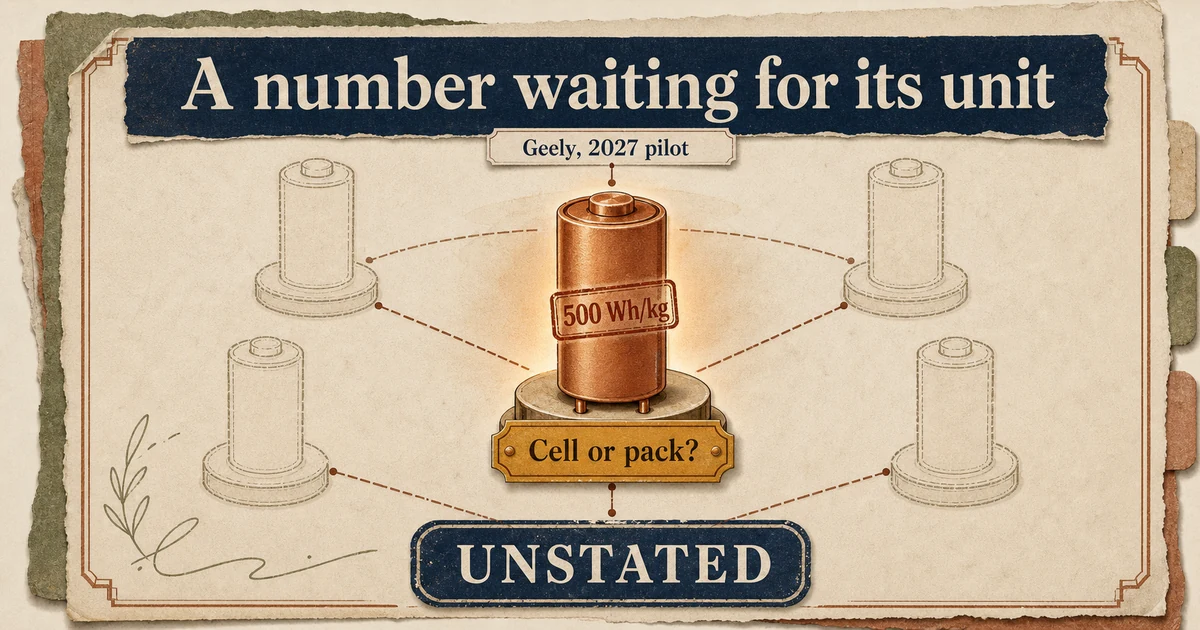
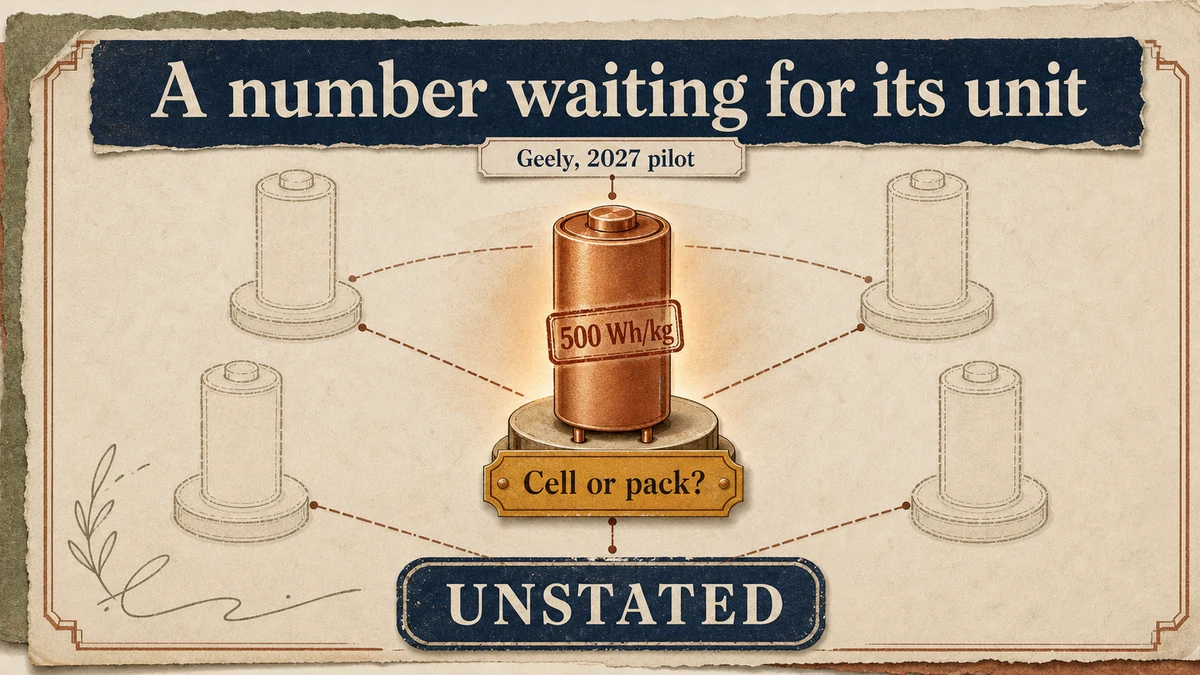
Five hundred watt-hours per kilogram. In one week, eight outlets repeated Geely's number for its new 621-mile solid-state battery. Not one of the headlines said whether that number describes a single cell, or the whole finished pack bolted under the car.
That distinction sounds like pedantry. It is not. It is the difference between matching the hardest target in the industry and beating it by a margin nobody else claims to have reached.
CATL Uses the Same Number for a Much Smaller Thing
CATL entered trial production of 20 amp-hour solid-state sample cells in November 2024, at what the company calls, explicitly, a cell-level figure: 500 Wh/kg. The technology sits at level 4 of 9 on CATL's own maturity scale, with a 2027 target of level 7 or 8 – enough for small-quantity production, not mass commercialisation. CATL's chairman has separately said mass commercialisation before 2030 is unlikely.
Geely's number is the same size. But the two outlets that covered Geely's announcement in the most technical detail – Electrek and CarNewsChina – both describe it as a pack figure, and Electrek says plainly that "Geely's own materials have been inconsistent on whether 500 Wh/kg is a cell-level or pack-level figure". No chemistry disclosed. No cell format. No cost. A Dow Chemical materials partnership is the one specific, checkable detail in the whole announcement.
If Geely's number really is pack-level, it is claiming, for an entire finished battery, the identical figure the industry's most advanced cell programs treat as their hardest target for one cell. Held against the only independently measured, already-shipped solid-state cell in this comparison – QuantumScape's 301 Wh/kg, cross-checked against the US Department of Energy's own test method – a genuinely pack-level 500 would be roughly two-thirds higher than the best verified cell result anywhere in the industry, at the harder of the two levels to hit.
Why a Pack Never Matches Its Own Cell
A finished battery pack always reports a lower number than the cell sitting inside it. The pack carries mass the cell does not: structure, current collection beyond the cell's own, thermal or clamping hardware, the management electronics that keep hundreds of cells balanced. None of that stores energy. All of it adds weight.
Solid-state batteries carry their own extra version of this tax. A liquid electrolyte wets whatever shape it is poured into. A solid one has to be physically clamped against the electrodes and held there, and the force needed to do that grows with the size of the cell – a constraint this desk measured directly three weeks ago, in the same 500-square-centimetre-and-up range that scales a phone-sized cell into an automotive one. A pack built to survive that clamping load is carrying still more mass that never stores a joule.
So a cell number and a pack number of the same size are not the same achievement. The pack number is the harder one, by a margin nobody in this comparison has actually closed.
500 Wh/kg Has Meant Five Different Things This Year
Line up every company or program that has put a specific figure on the record this year, and the pattern is not that Geely is obviously wrong. It is that almost nobody states which kind of number they mean.
CATL: 500 Wh/kg, cell level, stated explicitly, trial-production sample cells. The US Department of Energy's own Battery500 Consortium: up to 500 Wh/kg, cell level, a target it has chased since 2017 – and reached only 350 Wh/kg, with cycle life past 350 cycles, as of its last public figure. QuantumScape: 301 Wh/kg, cell level, not a target but a measurement of an actual shipped cell. Samsung SDI: 900 Wh/L for its own 2027 line – a different unit, and its own press release never says cell or pack either.
Geely: 500 Wh/kg, reported at the pack level by the two outlets that looked closest, unconfirmed by Geely's own materials either way, and flagged as unclear by a third outlet in Korea as well.
Data
One company on that list is not a Chinese rival at all. It is the same company most likely to be compared against Geely by anyone actually shopping for a battery supplier.
The Same Blank Space, One Company Over
Samsung SDI's own newsroom, in a release announcing its 900 Wh/L target for 2027 mass production, states the number, states the "40 percent higher than prismatic batteries currently in mass production" comparison, and never once says whether that figure describes a bare cell or a finished pack. Samples have already gone out to electric-vehicle, embodied-AI, and humanoid-robotics customers, on the same production timeline Geely and CATL are chasing.
This matters beyond one earnings call. A reader, an investor, or a rival engineering team comparing these numbers as if they were the same kind of claim will rank whoever disclosed least ahead of whoever is furthest along – which is a real cost, not just an editing quibble, if it steers attention or capital toward the vaguer announcement.
The Fair Reading of Geely's Number
None of this proves Geely is overselling anything. Electrek's own language is that Geely's materials are "inconsistent," not that Geely has stated a pack-level figure outright. It is entirely possible the 500 Wh/kg is a cell number too, simply keeping pace with CATL's own frontier target rather than beating it by a wide margin – in which case the real story is a trade-press habit of dropping the qualifier, not one company's claim.
That reading deserves to be taken seriously, because the alternative – treating an unclear number as proof of exaggeration – is the same sloppiness this piece is pointing at, aimed the other direction. The honest position is that the number cannot currently be checked. Not that it is false.
What We Already Said About Numbers Like This One
Three weeks ago, this desk argued that solid-state battery chemistry is not the open problem – cells like it have been sold since 1972 – and that what has never scaled is size: the current a square centimetre can carry, and the clamping force needed to hold a large cell together. The piece named its own test for when that reading would need to change: a manufacturer publishing cell area, level, and operating pressure together, on one document. No maker had done it as of that date.
Geely's announcement is the first real test of that standard since it was written, and the standard has not been met – not by Geely, and not by any of the four other companies compared here. What is new is exactly where the gap sits. It is not a missing measurement of dendrite formation or clamping force. It is a missing word: cell, or pack. A company can answer that question in one sentence, and as of this week, none of the five has.
The One Word Missing From Every 2027 Battery Announcement
Real engineering is happening at every name in this piece, Geely included – a materials partnership with Dow Chemical for an adhesive stable across a 160-degree range is not marketing copy, it is a specific, checkable supply-chain fact. The 2027 window is real for several of these companies in some form. What is not yet real is a way to compare any of them honestly.
The fix is not complicated, and that is what makes its absence worth noting rather than shrugging off. A cell-or-pack qualifier costs a company one word in a press release. Until one of these five adds it, the honest way to read "500 Wh/kg" is as a number waiting for its unit – not a verdict on whether Geely's engineers have quietly out-built everyone else's, or simply repeated the same target everyone else is already chasing.
Sources
- carnewschina.com — Geely's announced pack figure, range, lifespan claim, 2026-2027 timeline, brand rollout list, and Dow Chemical materials partnership (2026-08-18)
- electrek.co — The cell-vs-pack ambiguity in Geely's own materials, undisclosed chemistry, absence of third-party cycle-life data, and comparison figures for production cells and Zeekr's liquid pack (2026-08-20)
- digitaltoday.co.kr — Independent, third-outlet confirmation of the same cell/pack ambiguity (2026-08)
- electrive.com — CATL's cell-level 500 Wh/kg figure, 20Ah trial-production sample cells, and TRL 4-of-9 status with a 2027 target of TRL 7-8 (2024-11-07)
View all sources
- energy.gov — The US DOE Battery500 Consortium's cell-level 500 Wh/kg target and its reported 350 Wh/kg, 350-plus-cycle progress as of this update (2020-05)
- quantumscape.com — QuantumScape's own measured cell-level energy density (301 Wh/kg gravimetric, 844 Wh/L volumetric) for an actual physical QSE-5 sample, cross-checked against the DOE's USABC method (2024-10-23)
- quantumscape.com — Confirmation that QuantumScape's measured cells continued shipping to automotive partners into the current comparison window (2025-10-22)
- news.samsungsdi.com — Samsung SDI's own 900 Wh/L target for 2027 mass production, stated without a cell-or-pack qualifier (2024-12-03)
- pmc.ncbi.nlm.nih.gov — Independent confirmation that 400-500 Wh/kg functions as a cell-level marker across the wider solid-state field (2024-12-19)
This article is for informational and educational purposes only and does not constitute investment, financial, or legal advice.