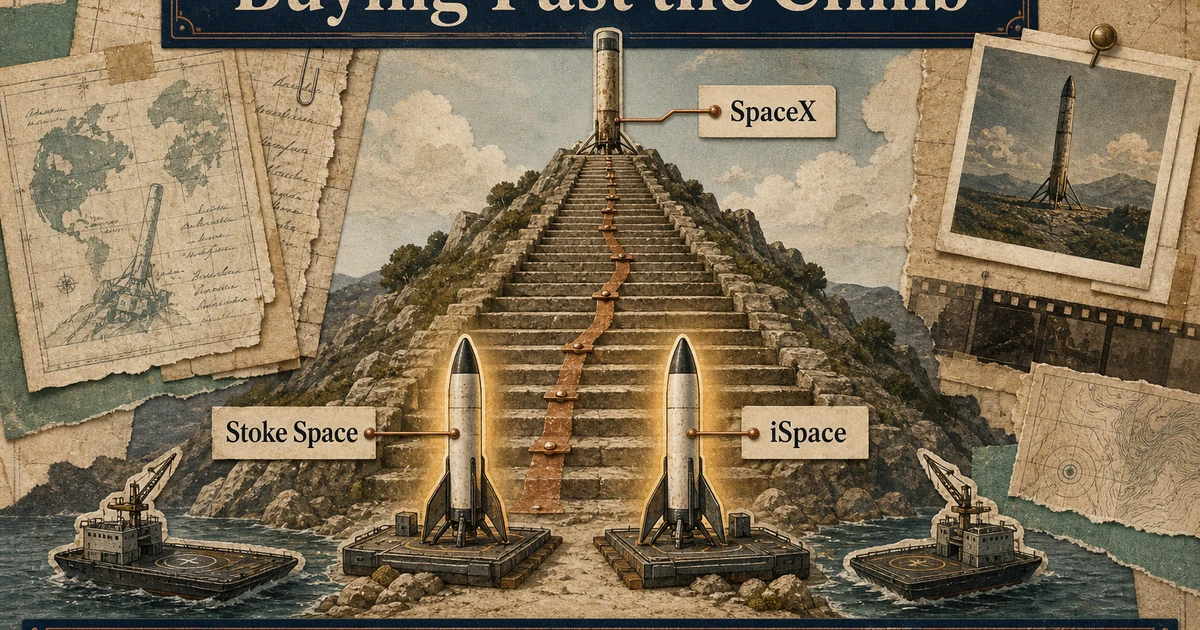
Stoke Space wants investors to fund something no Falcon 9 has ever done: bring an entire rocket home, not just the booster. A few thousand miles away, on iSpace's side of the Pacific, the bet is even more aggressive – a recovery ship is already being positioned for a rocket that has never flown, waiting to catch a first stage on the same flight that will prove, for the first time, that the rocket works at all.
A Recovery Ship Waiting for a Rocket That Has Never Flown
Hyperbola-3 is iSpace's partially reusable launch vehicle, rated at 8,500 kg to low Earth orbit when the first stage comes back and 13,400 kg when it is thrown away, and a first-stage booster-landing attempt is part of the first flight plan rather than saved for a later, lower-stakes test. iSpace has stayed deliberately vague on the exact debut date, saying only that it expects to fly "before the end of the year." The company isn't short on capital to try, though the pile is smaller than the headlines suggest.
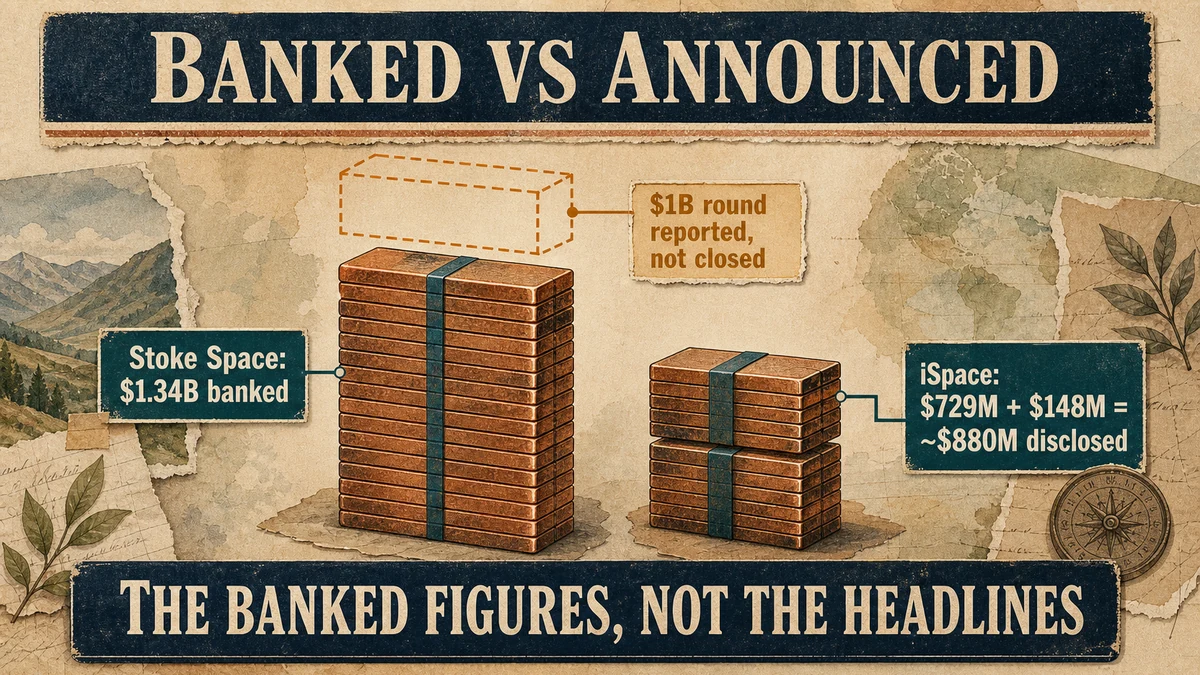
Its record D++ round closed in February 2026 at $729 million, and the opening batch of a Series E added about $148 million (1 billion yuan) on August 12, with that round still being raised. Call it roughly $880 million of disclosed capital, dominated by asset-investment arms of China's state banks.
A parallel bet just got larger on the other side of the Pacific. Bloomberg reports Stoke Space is raising $1 billion at a valuation of roughly $9 billion, aiming to close the round this month. That round is not closed. What Stoke has actually banked is on its own record: $1.34 billion to date, after February's $350 million extension took the Series D to $860 million, earmarked for activating Launch Complex 14 at Cape Canaveral and expanding Nova production.
The money funds Nova, a rocket built around a more ambitious version of reuse than SpaceX has ever attempted: Stoke wants to recover the entire vehicle, both stages, after every flight – something Falcon 9, which SpaceX designed to expend its upper stage on every mission, was never built to do. Nova's first liftoff, from Cape Canaveral's Launch Complex 14, is expected sometime in 2026.
The Three Years SpaceX Spent Not Trying to Land Anything
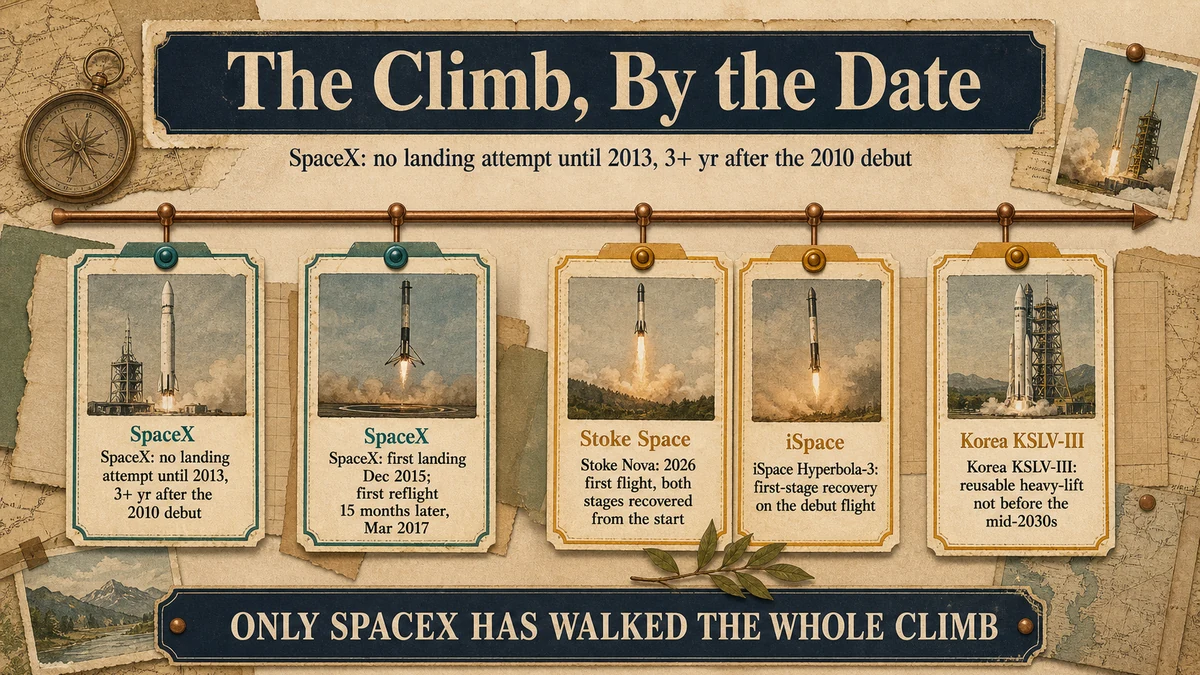
It is worth being precise about what SpaceX's own record actually says, because the loose assumption that "SpaceX solved landing almost immediately" doesn't hold up against the dates. Falcon 9 first flew on June 4, 2010. SpaceX did not attempt any controlled landing at all – not a failure, not a near-miss, simply no attempt – until the Falcon 9 v1.1 era beginning in September 2013, more than three years later, when it started flying controlled reentries and, by July 2014, a soft touchdown in the open Atlantic.
Three publicized drone-ship attempts then failed in turn: a hard impact in January 2015, a booster that toppled over on the deck in April 2015, a mechanical failure in January 2016. The first fully successful landing, on solid ground at Landing Zone 1, came in December 2015 – roughly five and a half years after the rocket's debut flight, and years after SpaceX had already flown Falcon 9 as a purely expendable vehicle dozens of times. From that debut to the first reflight of a recovered booster is six years and ten months.
That order matters for reading what Stoke and iSpace are actually attempting now. SpaceX proved the rocket could fly reliably first, then spent years learning to land it, then took 15 more months to trust a landed booster enough to refly it, on the SES-10 mission in March 2017. Stoke and iSpace are folding all three of those steps – reliable flight, recovery, and reuse-by-design – into a single vehicle's opening chapter.
What Each Side Has Actually Banked
Landing a rocket once is not the same problem as running a reuse business, and conflating the two is the mistake this whole comparison is built to correct. A landing proves the physics: the vehicle can survive reentry and touch down under control.
What actually gates a paying reuse cadence is everything that happens after the touchdown – inspecting a stage that just took reentry heat and structural loads for damage that isn't visible from the outside, requalifying engines and avionics that flew through conditions a fresh vehicle never sees, and building enough confidence in that specific piece of hardware to sell a customer a second flight on it.
SpaceX's own fleet did not reach a sub-month turnaround until 2021 – six years after the first landing – and by April 2022 its fastest pad-to-pad interval was still 21 days, with roughly 700 km of towing eating most of that time even after refurbishment itself had shrunk to 9 days.
Combined, Stoke's and iSpace's current rounds add up to roughly $2 billion aimed squarely at compressing that inspection-and-trust curve rather than the landing itself, which both companies seem to treat as the easier problem. That reframes the story: the two billion dollars isn't really buying a rocket. It's buying an attempt to skip years of exactly the kind of operational trust SpaceX had to earn one flight at a time, with no one else's playbook to borrow from.
The bet has ripples outside rocketry. Launch insurers, who price recovery and reflight risk into premiums, have almost no actuarial history for a company attempting full second-stage reuse or a debut-flight recovery – early Nova and Hyperbola-3 missions will likely carry premiums closer to a maiden-flight rate than a proven-vehicle rate, regardless of how the landing itself goes.
Satellite-constellation operators watching China's Qianfan and Guowang programs, and US customers watching Nova's manifest, have a direct stake in whether either vehicle reaches cadence years faster than SpaceX did, since a compressed timeline is the difference between one more expendable-class launch provider and a second real driver of falling per-satellite launch cost. And national-security launch customers, who typically want a vehicle's early, riskiest flights kept off their own manifests, will be watching how each company sequences test flights against paying ones.
The Timeline These Two Bets Are Racing Against
| SpaceX, measured | Stoke Space | iSpace | KSLV-III (Korea) | |
|---|---|---|---|---|
| Debut to first controlled landing | 5 yr 6 mo (Jun 2010 to Dec 21 2015) | recovery of both stages attempted from flight one | first-stage sea recovery attempted on the debut flight | – |
| First landing to first reflight | 15 months (Dec 2015 to Mar 30 2017) | not yet flown | not yet flown | – |
| Debut to first reflight | 6 yr 10 mo | – | – | fully reusable heavy-lift targeted mid-2030s, at 10 launches/yr |
| Capital for the attempt | – | $1.34B banked; a $1B round reported, not closed | $729M (D++, Feb 2026) + $148M (series E first batch, Aug 2026) | ₩23tn of Hanwha's ₩55tn through 2040 |
| A recovered stage flown again? | yes, since Mar 2017 | not yet | not yet | – |
China's state programme is the nearest live test of the same question: a Long March 10B first stage was caught in July 2026, and no reflight of it has been confirmed since.
Why catching a rocket is not the same as a reusable cadence, our July read of this exact gap, still stands, and it is worth restating precisely because it hasn't yet been tested by an outcome. China's Long March 10B caught its first stage in a net that same month, and CASC said it planned to refly the recovered stage before the end of 2026. As of the most recent reporting, that reflight has not happened: no second flight of the recovered stage has been demonstrated, and CASC has not disclosed how the refurbishment is going.
The July catch, in other words, remains exactly what it was the day it happened – a real engineering achievement that answered the landing question and left the cadence question open.
Stoke and iSpace change what that open question is actually testing. It's no longer only "can China compress SpaceX's curve" – it's now a three-way experiment, with a fully private US company betting on the hardest version of reuse (both stages) and a Chinese private company betting on the earliest version (recovery attempt number one), against the one complete public record of how long the climb actually took the company that invented it.
It's the same distinction that separated a demonstrated capability from a service somebody actually pays for when the orbit-servicing arms arrived late in another corner of the launch industry: a recovery is the demo, and a demo is not yet a business.
The Case for Skipping Ahead
None of this means Stoke and iSpace are being reckless with investor money. The strongest case for their approach is that neither company is discovering reuse blind the way SpaceX was between 2013 and 2017. Both can study a decade of public flight data, patents, and post-flight teardown commentary that didn't exist when Falcon 9 first flew – avionics choices that worked, structural failure modes to avoid, the rough shape of a workable requalification process.
Copying a solved problem is a fundamentally different, faster exercise than solving it, and a serious argument exists that this alone should cut years off the historical curve regardless of how large the check is. What that argument does not establish is how many years, or whether "faster" still means "years" rather than "months" – the specific number this whole comparison is meant to pin down, and one that stays unanswered until either rocket actually flies.
Korea Isn't Trying to Beat the Clock
A third data point belongs in this comparison precisely because it isn't trying to compress anything. South Korea formally ratified its own 2035 constellation plan in July 2026, and Hanwha, the industrial group behind it, pledged 55 trillion won – roughly $35.9 billion – through 2040, with about 23 trillion won ($15 billion) of that earmarked for launch vehicles at Hanwha Aerospace.
Notably, the plan prices a fully reusable heavy-lift vehicle as a mid-2030s deliverable, at a cadence of only 10 launches a year once it arrives – a full decade out, and a fraction of the flight rate either Stoke or iSpace is implicitly targeting. A state-backed program with deep pockets and a clean-sheet design chose to budget for something much closer to SpaceX's actual multi-year curve than to bet against it. That is itself a data point about how the industry prices this specific risk, independent of anything Stoke or iSpace has claimed about its own odds.
Bottom Line
The honest read of roughly $2 billion in new 2026 rocket funding isn't that reusable-launch competition has arrived – it's that two companies are now paying real money to find out whether SpaceX's slowest years were a discoverable-once R&D cost or a floor set by the physics of trusting flown hardware. Nova recovering its second stage on an early flight, or Hyperbola-3 landing its booster on flight one, would be the first real evidence for the first answer.
A quiet retreat to expendable-first flying after a failed attempt – the same sequencing SpaceX itself eventually used – would be evidence for the second, and would make South Korea's decade-long timeline look less conservative and more simply accurate. Either way, the number to watch isn't the size of either round. It's whichever company gets to a second reflight first, and how long that actually takes them.
Sources
- bloomberg.com — Bloomberg (paywalled; read here via the Kent Reporter reprint, kentvalleywa.com/news-and-resources/recent-news/p/item/68740) – Stoke Space's $1B raise, ~$9B valuation, full-vehicle recovery design, 2026 first-liftoff target (2026-08-13)
- stokespace.com — Stoke Space's own release – Stoke's $1.34B total raised to date, Nova's first-stage and heatshield-plus-legs second-stage recovery design (2026-02-10)
- china-in-space.com — (newsletter; the series E figure it carried is superseded by C4) – Hyperbola-3's first-stage recovery attempt built into its debut flight plan; Series E target of 7 billion yuan (~$1.02B) (2026-05-01)
- spacenews.com — SpaceNews (Andrew Jones) – series E opening batch "nearly $148 million (1 billion yuan) … with fundraising still ongoing"; the February D++ at $729 million; Hyperbola-3 at 8,500 kg LEO reusable / 13,400 kg expendable; debut before end-2026 with a first-stage recovery attempt (2026-08-12)
View all sources
- apod.nasa.gov — NASA APOD – the 2015-12-21 landing, "the first of its kind". Timeline context: Falcon 9's June 2010 debut, the Sept 2013 start of controlled-reentry attempts, the three failed 2015-2016 drone-ship landings, and the December 2015 first successful landing (2015-12-28)
- techcrunch.com — TechCrunch – "the first-ever reflight of an entire orbital class rocket"; the booster had flown CRS-8 in April 2016. SpaceX's first reflight of a landed booster, SES-10, March 30, 2017 (2017-03-30)
- teslarati.com — SpaceX's 21-day booster turnaround record and 9-day refurbishment window, reached in April 2022 (2022-04-29)
- spacedaily.com — Confirmation that CASC has not yet demonstrated a reflight of the July 2026 Long March 10B recovered stage (2026-07)
- satnews.com — South Korea's 2035 constellation plan and its mid-2030s, 10-launches-a-year reusable heavy-lift target (2026-07-06)
- en.sedaily.com — Hanwha's 55 trillion won ($35.9B) investment pledge, including ~23 trillion won ($15B) for launch vehicles (2026-07-03)
🇰🇷 Read this analysis in Korean (한국어판 보기)
This article is for informational and educational purposes only and does not constitute investment, financial, or legal advice.