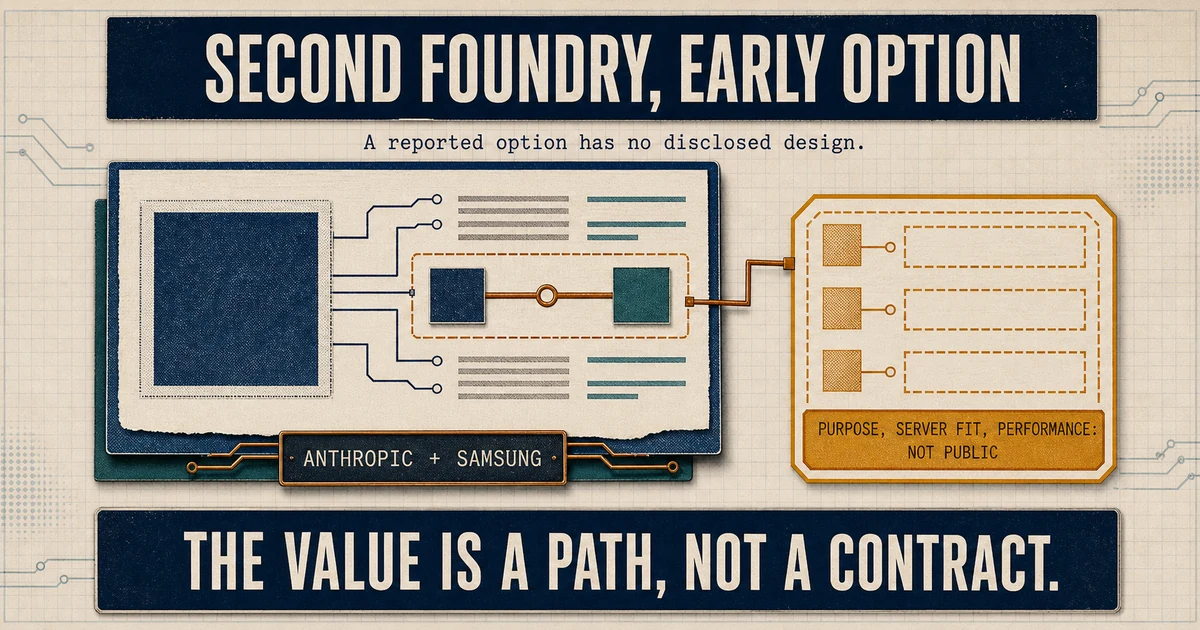
When the first window is overbooked, the second one does not have to be perfect. It has to be open. The reported contact between Anthropic and Samsung carries no stated purpose, no server fit and no performance target — and that emptiness is the most accurate thing about it.
The Report Is an Option, Not a Design Win
TechCrunch reported on July 2, citing The Information, that Anthropic is in contact with Samsung about a possible custom AI chip collaboration. The chip’s purpose, server fit and performance targets were all still undecided. That caveat is the story. This is a reported discussion, not a design win, tape-out or manufacturing contract.
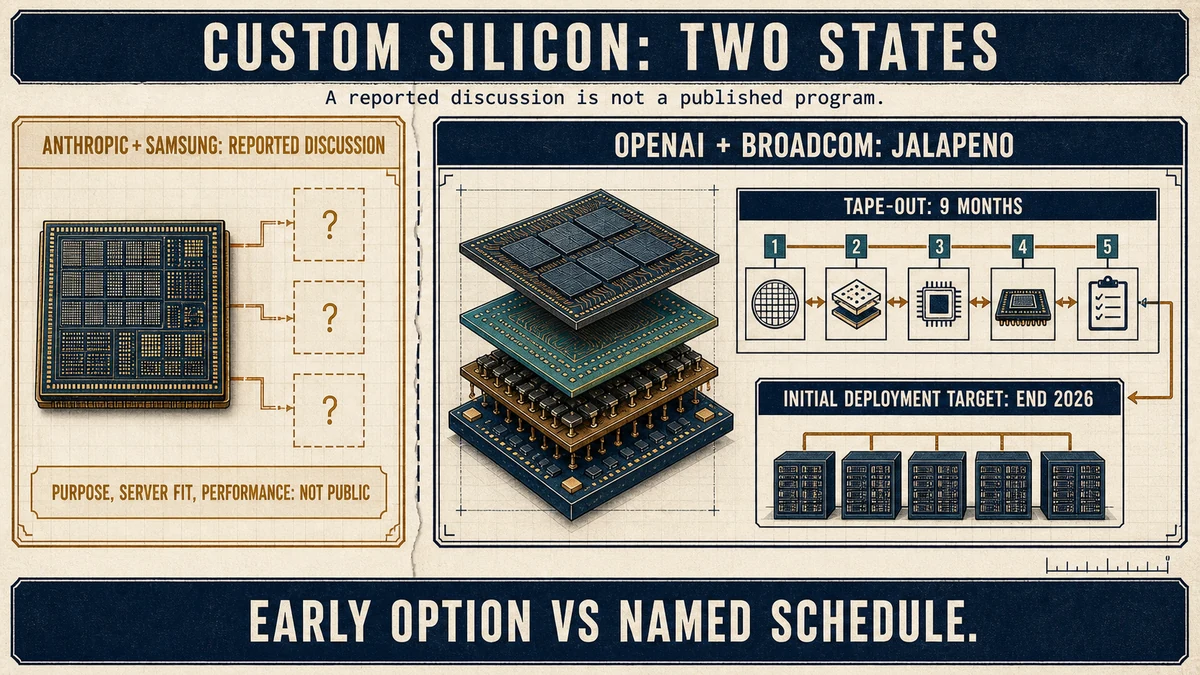
The useful reading is not that Anthropic is about to ship a Samsung-made chip. It is that Anthropic is examining more hardware paths because compute has become a strategic constraint. A discussion can create negotiating and scheduling value before either company settles the architecture, process, package or volume. An option has value before it has a contract.
The timing makes the difference in maturity unusually clear. A week earlier, OpenAI and Broadcom unveiled Jalapeno, a custom inference chip that reached tape-out in nine months and targets initial deployment by the end of 2026. Those are company claims about a named program and a published schedule. The Anthropic-Samsung report describes a much earlier state: an option without a disclosed workload or accountable milestone.
Anthropic is not beginning from a cold relationship. Its May Series H announcement named Samsung, SK hynix and Micron as strategic infrastructure partners whose technologies play a role in memory, storage and logic supply. Anthropic also described compute agreements with Amazon, Google, Broadcom and SpaceX as part of an effort to expand capacity. These are Anthropic’s claims about its infrastructure network. They do not prove a Samsung chip deal, but they make the reported conversation consistent with a broader effort to scale compute reliably.
The Bottleneck Is a Usable Date
“Did Samsung beat TSMC?” is the wrong question. Reporting in the published baseline put TSMC at roughly 72% of foundry revenue in Q1 2026, and nothing in the Anthropic report changes its central position in advanced manufacturing. The current bottleneck is not the existence of a capable supplier. It is a slot in a crowded manufacturing queue with a usable date attached to it.
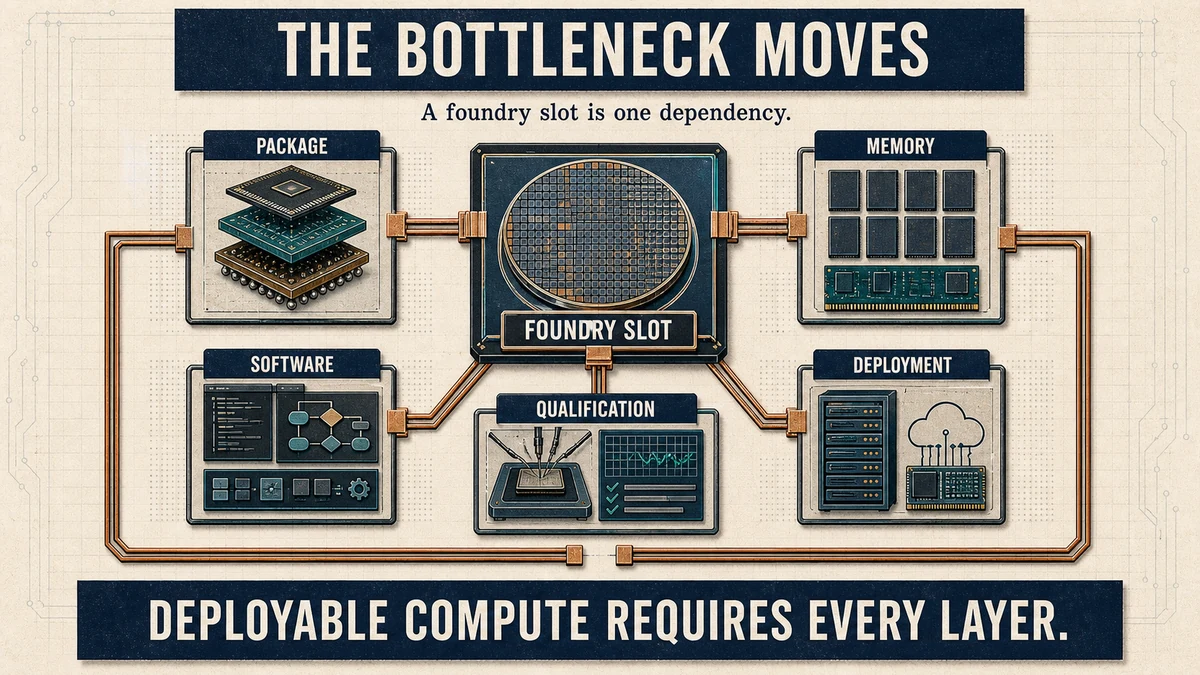
AI infrastructure combines leading-edge wafers, advanced packaging, HBM, power and data-center schedules. Pressure on any one of those layers can delay the entire system. A second evaluated foundry path can remove some dependence on one queue, provide another possible delivery calendar and give the buyer a schedule against which to negotiate. The alternative does not have to be universally better than the incumbent. It has to be credible and available when the buyer needs it.
Removing the single-queue problem creates a new one. Capacity on a different process has to be designed for, qualified and connected to a package, memory supply, board, rack and software stack. Those dependencies do not disappear because a wafer start becomes available. If the foundry slot opens before the compiler, package or data center is ready, the buyer has not secured deployable compute. It has secured inventory, delay and carrying cost.
Samsung’s company claim to the evaluation seat rests on breadth. Its foundry materials present logic process technology and advanced packaging as connected capabilities, while the wider semiconductor business spans memory as well. That can support a broader discussion than wafers alone for a customer whose bottlenecks cross several layers. It does not prove that those layers will arrive together at the required cost, yield and date.
The distinction matters because the constraint in AI hardware has been descending out of the chip and into the layers underneath it. A second wafer source can relieve one queue only to expose packaging tools, substrates, HBM or assembly as the next limiting resource. The moving bottleneck is the real competitive map.
The Clock Jalapeno Started
Nine months to tape-out, with initial deployment targeted by the end of 2026, is a schedule other custom programs will be measured against. Whatever Jalapeno eventually proves in production, a published clock changes expectations. It becomes the comparison used by executives deciding whether another program should be funded and how quickly it should move.
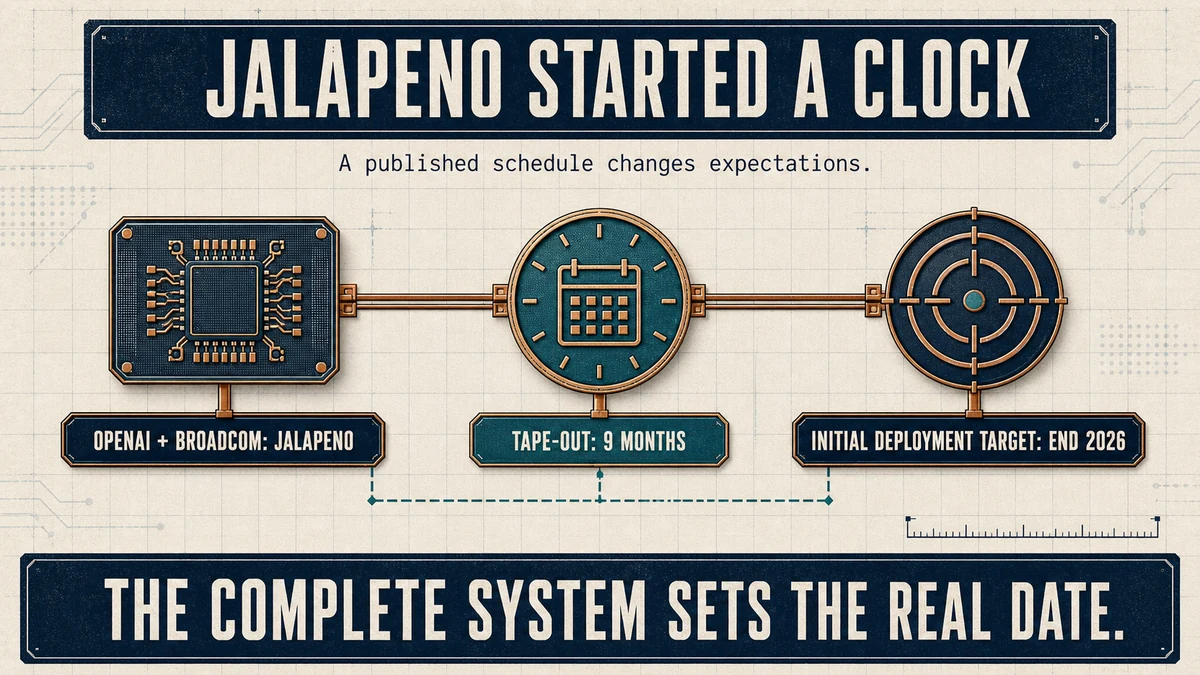
Strip the vocabulary away and custom silicon is a sequence of linked clocks. Architecture, process targets, physical design, packaging, memory supply, rack integration, data-center deployment and software readiness each carry their own lead time. They do not run in parallel by default. Faster design can expose packaging as the new bottleneck. Reserved packaging can expose HBM or substrate supply. Installed hardware can expose compilers, kernels and workload migration.
A foundry slot that arrives before the compiler is not capacity. It is inventory. The same is true of a qualified chip without a package allocation or a populated rack without power. What matters is not the fastest isolated step but the date on which the complete system can perform useful work.
A serious custom program also needs an internal hardware organization spanning architecture, systems, compilers, networking and supply chain. A supplier can offer wafers, packaging and memory capabilities. It cannot sell the customer the organization that decides what the chip should do or makes the software use it. That makes Anthropic’s organizational signals at least as informative as another supplier meeting.
Yield Determines Whether the Option Is Economic
The strongest version of this story would mislead if it skipped Samsung’s execution risk. TrendForce reported on March 31 that sources put Samsung’s 2nm yield above 60% at the upper end. The published baseline also described a later report around the mid-50s. These are reported estimates from different sources and moments, not one stable company-certified production figure.

A single yield number carries less information than it appears to. Yield varies with design, die size, defect sensitivity and process maturity. An encouraging engineering result does not establish repeatable economics for an undisclosed Anthropic design, and an estimate for one test vehicle cannot automatically be transferred to another product.
Yield also determines more than technical prestige. When fewer good dies emerge from a wafer, wafer, equipment and processing costs are spread across fewer saleable units. More wafer starts may be needed to deliver the same volume. That can consume scarce equipment time, weaken schedule confidence and raise the cost of maintaining a second source. Better yield removes those penalties only when it is stable enough to support planning.
Materials and packaging can alter the result again. A good die still needs an available substrate, memory allocation and qualified assembly flow. Each interface must meet reliability, thermal and performance requirements. Qualification therefore becomes the next bottleneck after basic process feasibility: the relevant chip and package must demonstrate repeatable behavior, not merely appear in a general process update.
The distinction is familiar from the case of Intel’s 18A, where improving reported yields and an empty customer chair could coexist. The narrow interpretation remains the sound one. A prospective customer at Samsung’s table is evidence that the process sits inside a consideration set. It is meaningful, but it is a long way from a production ramp.
What Would Convert the Option
An option becomes a commitment through specifics, and the important specifics remain missing: a stated training or inference purpose, architecture, server fit, performance target, process, package, volume, accountable tape-out date and deployment schedule. A jointly confirmed design agreement would move the story further than another isolated yield estimate.
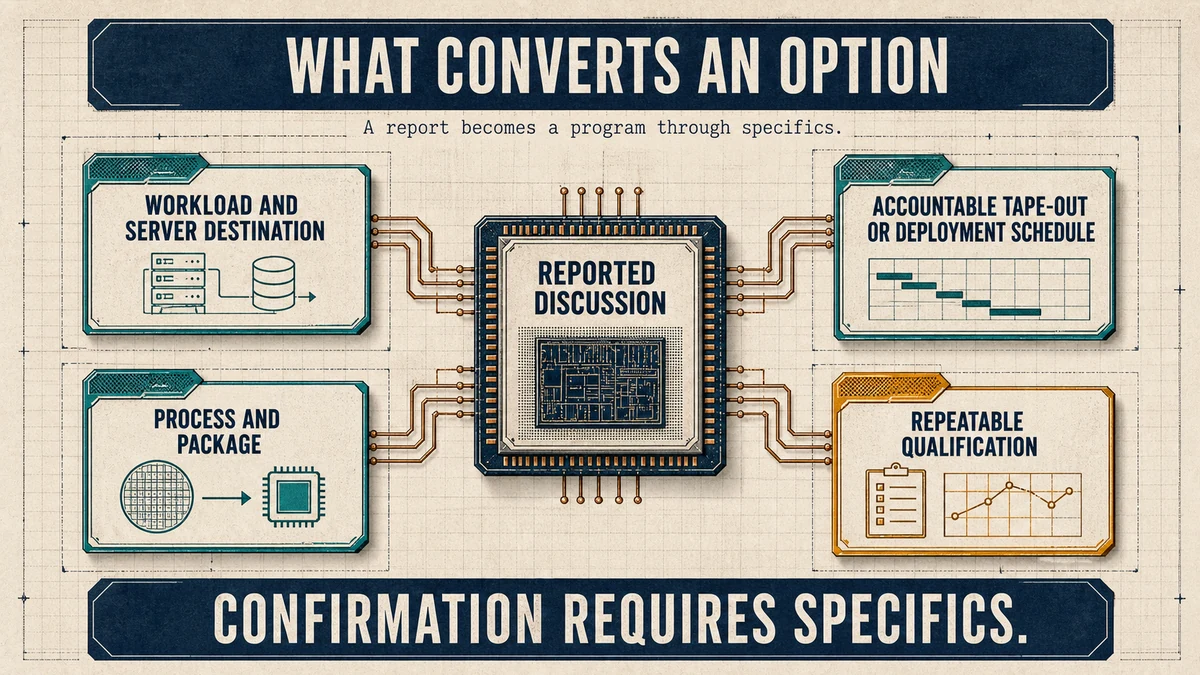
Those details would also reveal where the bottleneck moves next. A workload and architecture would show what software Anthropic has to own. A process and die plan would expose yield and wafer-cost sensitivity. A package would expose dependencies on equipment, substrates, HBM and assembly capacity. Qualification milestones would show whether the program had moved from technical possibility to dependable production.
What to watch: a confirmed design agreement from either company; a disclosed workload and server destination; a named process and package; an accountable tape-out or deployment schedule; evidence that yield reports are converging toward repeatable production; and hiring that shows Anthropic can own architecture, compilers, systems, networking and supply-chain decisions.
Until those signals appear, the value lies in preserving a path. The discussion may remove the risk of having no alternative to evaluate, but it does not remove the execution work required to use one.
Who Owns the Value and the Risk
Anthropic owns the value of optionality. A credible second route can improve schedule resilience, strengthen bargaining leverage and reduce exposure to a single manufacturing queue. Anthropic also owns the risk of defining the wrong chip, assembling its hardware organization too slowly, or allowing software and deployment plans to lag the silicon.
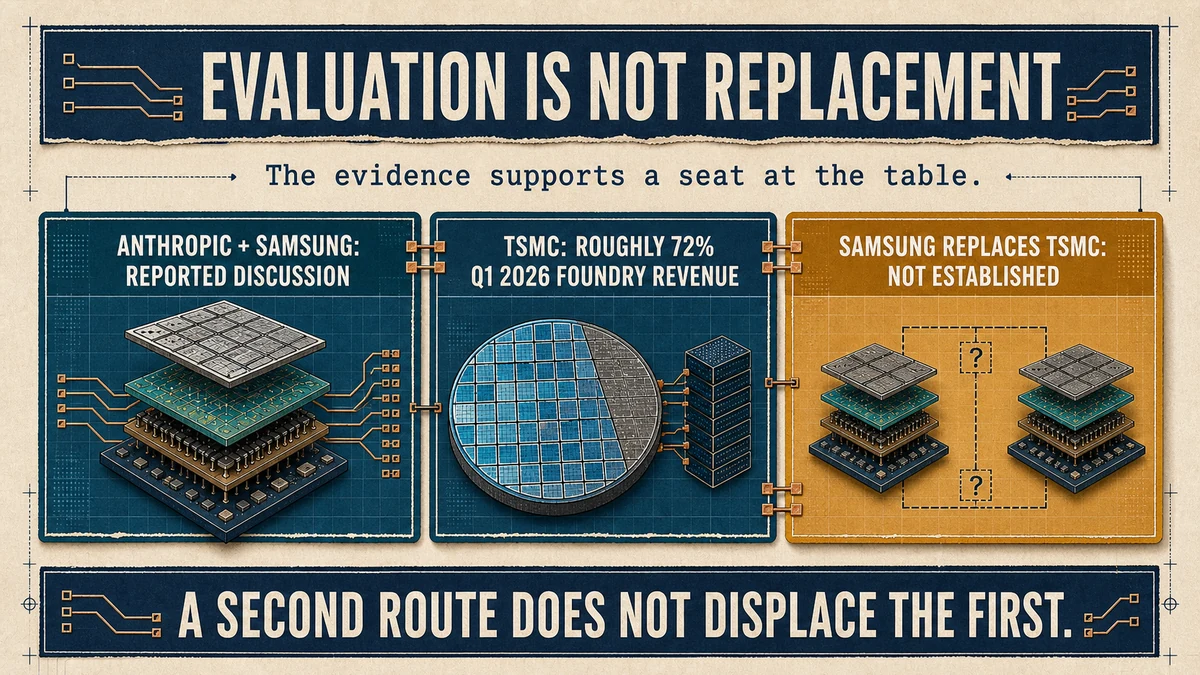
Samsung owns the opportunity to convert an evaluation into foundry and packaging demand, with potential value across the broader semiconductor stack. It also owns process execution, yield improvement, qualification support and delivery risk. An available slot has little value if its cost, yield or package schedule cannot support the customer’s system.
TSMC retains the value of incumbent scale, process maturity and customer trust. Its capacity pressure creates the opening in which a second schedule becomes valuable, but a reported evaluation does not amount to displacement. The option is valuable precisely because the first supplier remains important and heavily demanded.
Does this mean Samsung is replacing TSMC for Anthropic? No. The reported discussion has no confirmed purpose, design or manufacturing agreement, and the baseline evidence places TSMC at roughly 72% of Q1 2026 foundry revenue. This is a seat at the evaluation table, not a supplier switch.
The bottom line is that AI infrastructure has entered a capacity-management phase. Frontier labs need manufacturing, packaging, memory, power, software and data-center schedules to align with model roadmaps. A second evaluated supplier is worth something before it wins anything because the scarce good is an available date that can survive every later dependency. Samsung’s opportunity is not to replace TSMC. It is to be judged, one customer and one node at a time, as a place a complete schedule can be built.
The evidence remains early and thin by design, which is what an option looks like before anyone exercises it. The contested asset is not simply a process node. It is a usable schedule, and schedules are settled by organizations, qualification work and coordinated supply rather than by announcements.
This article is for information and industry analysis only. It is not investment advice. The Anthropic-Samsung discussion remains a reported, early-stage matter unless the companies confirm a formal agreement.
Sources
- TechCrunch – Anthropic-Samsung custom-chip discussion, via The Information (2026-07-02)
- Anthropic – Series H; Samsung, SK hynix and Micron named as strategic infrastructure partners (2026-05-28)
- OpenAI – Jalapeno inference chip; nine-month tape-out (2026-06-24)
- TelecomLead / TrendForce – TSMC roughly 72% of Q1 2026 foundry revenue (2026-06-12)