Quick Brief
- Tesla has stated a 10-million-unit annual capacity target for a planned second-generation line at a new Texas plant, a long-term goal named on its Q1 2026 earnings call — separate from Fremont, where the company’s own long-term target is 1 million units a year and where volume production had not started as of the most recent guidance.
- Figure AI completed an 11-month BMW Spartanburg pilot in November 2025: Figure 02 logged 1,250+ operating hours and supported 30,000+ vehicles on the X3 line.
- Figure raised over $1 billion in its September 2025 Series C at a valuation approaching $39 billion, roughly 15x the prior round.
What Happened
The first half of 2026 turned humanoid robots from demo reels into deployment logs, though not everywhere at once. Tesla has said it will convert its Fremont Model S and X lines into an Optimus factory, with a long-term goal of a million units a year there and ten million at a planned second line in Texas — but as of its most recent earnings guidance, that conversion had not started and the S/X line was still building cars into early May 2026. Figure AI closed its BMW Spartanburg pilot in November 2025 after roughly 10 to 11 months, reporting 1,250+ operating hours, 30,000+ vehicles supported, and 90,000+ parts handled by Figure 02.
The money followed the milestones. Figure raised more than $1 billion in a September 2025 Series C at a valuation approaching $39 billion-about 15x its prior mark-and its BotQ line scaled from a few units a month in 2025 to one robot per hour by April 2026, with over 350 units delivered by that point. Physical Intelligence was reported to be discussing a roughly $1 billion round above an $11 billion valuation. Robotics companies overall have raised a record sum in 2026, with Dealroom figures cited at $55.8 billion year-to-date as of June 2026, nearly double the prior peak.
Then came the tell. At GTC Taipei on May 31, 2026, Nvidia introduced an open Isaac GR00T reference humanoid for academic research-a platform meant to give universities and labs advanced hardware and an open software stack without a proprietary one-assembled on Unitree’s H2 Plus chassis with Sharpa Wave tactile hands and a Jetson AGX Thor computer. Named early users are Ai2, ETH Zurich, Stanford’s Robotics Center and UC San Diego, and Nvidia discloses no price. Weeks later, Morgan Stanley doubled its China shipment forecast toward 50,000 units for 2026, citing commercial orders, policy support, and an estimated 16% decline in parts prices reported in the bank’s January note. Unitree, preparing an IPO, reported first-quarter 2026 revenue of 423 million yuan, up 68.49% year over year-in the same filing that shows adjusted net profit down 52.55%, on sharply higher R&D and sales spending, and growth decelerating from 332.64% the year before.
What This Means
The industry narrative has been an AI story: vision-language-action (VLA) models are the “brain,” and whoever trains the best one wins. That framing is now half-obsolete. When Nvidia-the company selling the compute for those brains-needs to demonstrate a working humanoid, it does not build the body itself. It bolts its software onto a Chinese chassis and Singaporean hands. That single design choice says more about where value is bottlenecked than any funding headline.
Here is how the mechanism actually works. A VLA model is one neural network that ingests camera images plus a language instruction and outputs motor actions directly; Figure’s Helix was trained on roughly 500 hours of multi-robot data, and Nvidia’s GR00T offers a shared foundation any developer can fine-tune. The software has converged fast because it rides the same transformer scaling that produced chatbots-more data, more compute, better policies. What has not converged is the last 30 centimeters: a human-grade hand.
1X’s tendon-driven Neo hand, shown in July 2026, packs 25 degrees of freedom, all force-controlled and backdrivable, plus fingertip tactile sensors that detect slip and shear in real time. Reproducing that in a durable, cheap, mass-manufacturable unit is the hard part-each high-torque joint actuator is estimated at $500-$2,000 at low volume, and a hand stacks a dozen of them behind sensing and tendons.
That constraint reshapes corporate strategy. Tesla, Figure, and 1X are vertically integrating downward-designing their own hands and actuators-precisely because the brain is becoming a commodity layer while the mechanical stack is where differentiation and margin now live. Figure’s decision to redesign Figure 03 “from the ground up for high-volume manufacturing” is an admission that the manufacturability of the body, not the intelligence, sets the ceiling on unit economics.
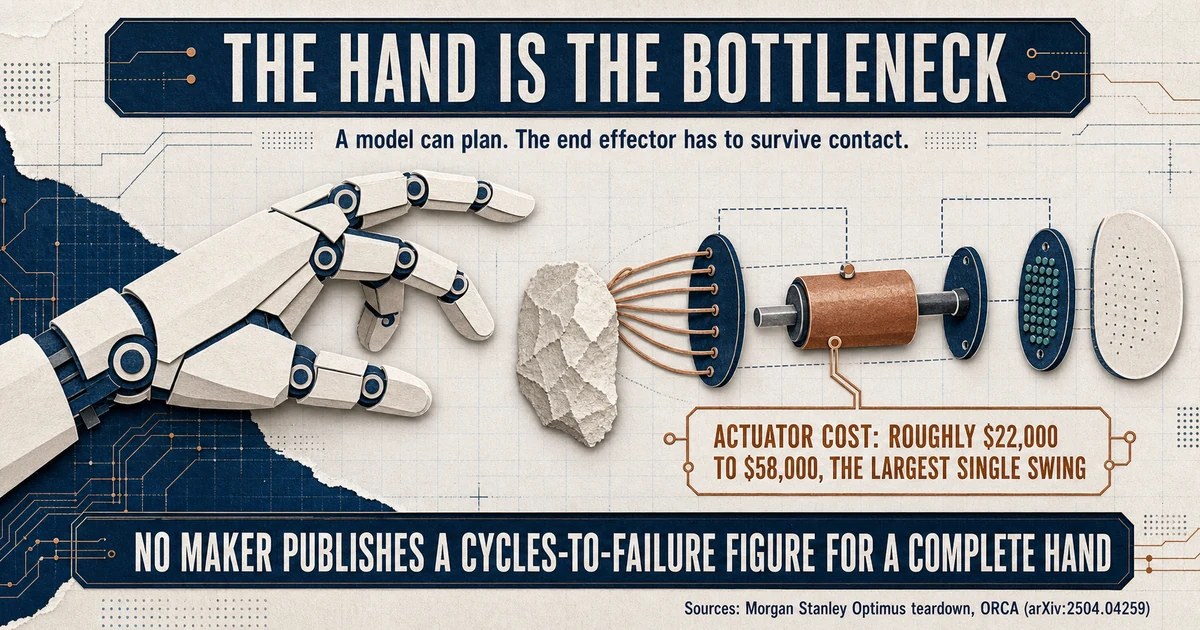
The market change is a cost curve, though the timeline needs care: Goldman Sachs measured build costs falling from an estimated $50,000-$250,000 per unit to $30,000-$150,000 between early 2023 and early 2024, a 40% drop against its own 15-20% annual forecast. More current figures point the same direction from a different starting line: Bank of America puts a China-built 2025 bill of materials near $35,000, while Morgan Stanley’s teardown of Tesla’s Optimus Gen 2 finds a roughly $46,000 bill of materials that rises to about $131,000 without China in the supply chain-actuators alone going from about $22,000 to about $58,000, the single largest swing in the whole robot. Whoever controls the cheapest reliable actuators sets the floor price for everyone-and today that is the country whose absence from the supply chain costs the most to replace.
Descend one more layer and the picture sharpens. Under the humanoid is the VLA model; under the model is the actuator; under the actuator is the rare-earth magnet; under the magnet is refined neodymium and dysprosium. China accounts for roughly 69% of rare-earth mining and about 90% of the processing that turns it into magnets, by McKinsey’s count-Unitree manufactures its own motors and reducers in-house and sits atop that domestic supply, which is why it can post steep revenue growth (even as its own margins compress on rising R&D spend) and price aggressively while Western firms still assemble from a thinner component base. The AI is not the moat. The magnet is.
The cross-industry ripple is already forming. For manufacturing labor, a $30,000 robot running two shifts approaches the loaded annual cost of a single human line worker in high-wage regions-BMW’s pilot is the proof point, and procurement teams now model humanoids as capex, not novelty. For logistics and warehousing, the same actuator economics that lower robot cost also lower the automation break-even for parcel handling, pressuring the labor math at the exact tier of jobs that resisted fixed automation.
For defense and industrial policy, a humanoid supply chain rooted in Chinese actuators and rare earths becomes a sourcing-security question, echoing the semiconductor and battery debates-expect friction on components, not just finished robots.
The global market reaction has been to treat humanoids as the next trillion-dollar AI wager rather than a niche. Morgan Stanley sketches a China market growing from an estimated $2 billion in 2026 to $15 billion by 2030, and a global market near $5 trillion by 2050-forecasts that are directional, not gospel. US-listed component and chip names ride the theme, but the near-term revenue is concentrating in the unglamorous layer: reducers, screws, frameless torque motors, and hands.
Worth weighing:
- Deployment hours remain thin relative to the hype-Figure’s 1,250 hours across a single BMW line, against an 84-second cycle time and a target above 99% placement success per shift, is a real milestone but a small sample from which to extrapolate mass reliability.
- The “China owns the hands” thesis can reverse if Western actuator and rare-earth capacity scales, or if magnet-free motor designs mature; the bottleneck is structural today, not permanent.
- Tesla’s stated external price target of $20,000-$30,000 for Optimus is a vendor aspiration at volumes that do not yet exist; early external units will almost certainly cost more.
- Valuations like Figure’s ~$39 billion price in a mass-market outcome that no company has yet demonstrated at scale.
What to watch:
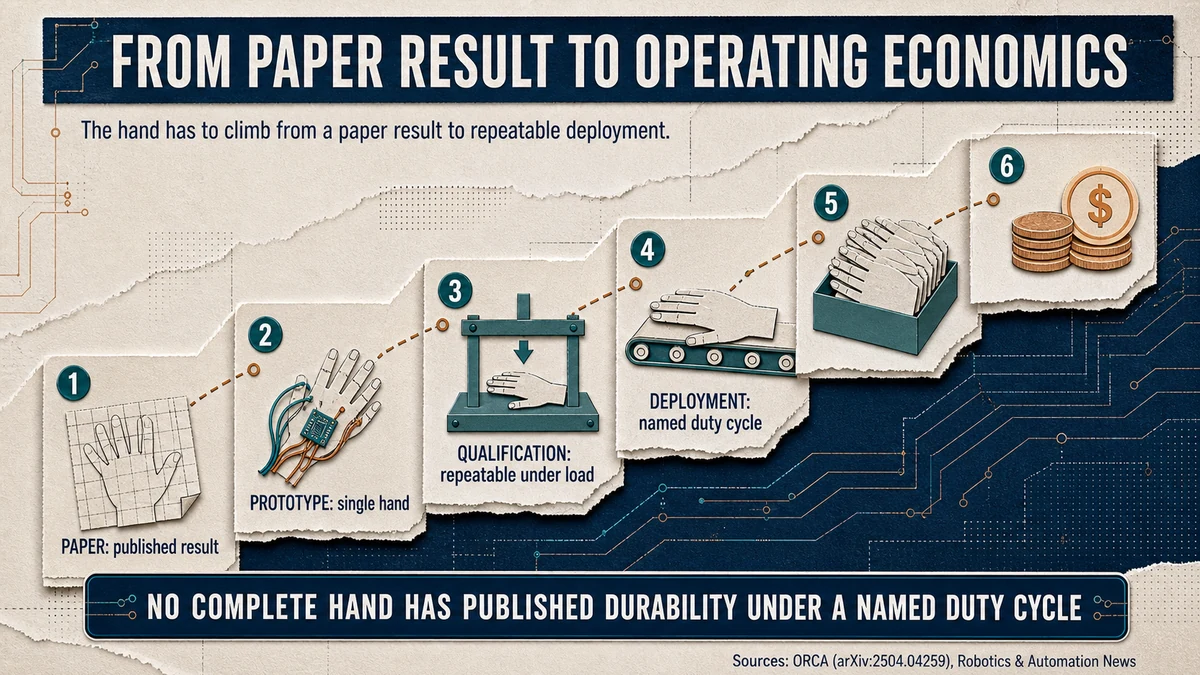
- If any vendor mass-produces a 20+ DoF tactile hand at under ~$2,000 per unit by year-end 2026, the mechanical bottleneck is easing; if hand cost stays above the rest of the arm, it isn’t. No maker currently publishes a cycles-to-failure figure for a complete hand under a named duty cycle, which means the bottleneck cannot yet be graded on durability, only on price and degrees of freedom.
- Figure’s own April 2026 disclosure puts its BotQ line at one robot per hour, a 24x throughput gain in under 120 days, with over 350 units delivered by that point against a stated 12,000-unit annual line capacity-watch whether that rate holds through Q4 or stalls at a fraction of stated capacity; a plateau signals the body, not the brain, is the limiter.
- If reported 2026 China shipments land near Morgan Stanley’s raised 50,000 target, the commercialization catalyst is real; a miss below ~30,000 means the pilot-to-platform jump slipped again.
The price collapse is real, and it is not where the hard part is
The cost test above can already be partly scored, and the answer is more interesting than a yes or no. Chinese suppliers have compressed hand prices dramatically: against a research reference point of roughly $300,000 for a Shadow Hand, entry five-finger hands now start under $1,500 and the cheapest models are quoted below $1,000. But the hands that clear the $2,000 line are not the hands the argument is about. Flagship 20-plus-degree-of-freedom hands with tactile sensing still list between roughly $7,000 and $28,000. The collapse is real and it is stratified: what got cheap is a hand, not a dexterous, sensed hand. The bottleneck did not clear; it moved up a specification.
One layer down, the same pattern holds with different geography. Reducers, servo systems and controllers account for more than 70% of a humanoid’s cost, and Chinese domestic production of those parts is estimated at 75% to 90% — which is the mechanism behind the $46,000-versus-$131,000 bill of materials this article already cites, stated as a supply-chain fact rather than a price. Japan still holds the precision layer: Nabtesco is put at roughly 22% to 25% of global harmonic and cycloidal reducer revenue by market-research estimate, alongside Harmonic Drive. That position is being worked at from below, with Chinese makers such as Suzhou Green Harmonic expanding on price.
So the profitable layer is not the robot and increasingly not the hand either. It is the reducer, the actuator and the magnet inside it — and two different countries hold two different parts of it. A Western maker choosing to build hands in-house is not just protecting a differentiator; it is choosing which of those two dependencies to accept.
Editorial Perspective
The humanoid robot story sold to the market is an intelligence story, and the intelligence is arriving on schedule – VLA foundation models like Helix and GR00T have made a general-purpose robot brain a shipping reality. But the constraint that decides who profits sits one layer beneath the demo: the dexterous hand and the actuator, and beneath those the rare-earth magnet that China’s supply chain currently dominates. The most important fact of 2026 is not a funding round – it is that Nvidia built its own reference humanoid on a Unitree body. The zoom-out for anyone outside robotics is a supply-chain one. If humanoids scale the way capital is betting, the leverage point is the same magnet-and-motor chokehold that already shapes EVs, wind turbines, and precision weapons—so automakers, logistics operators, and defense planners, not just AI labs, are the ones who should be reading the actuator bill of materials.
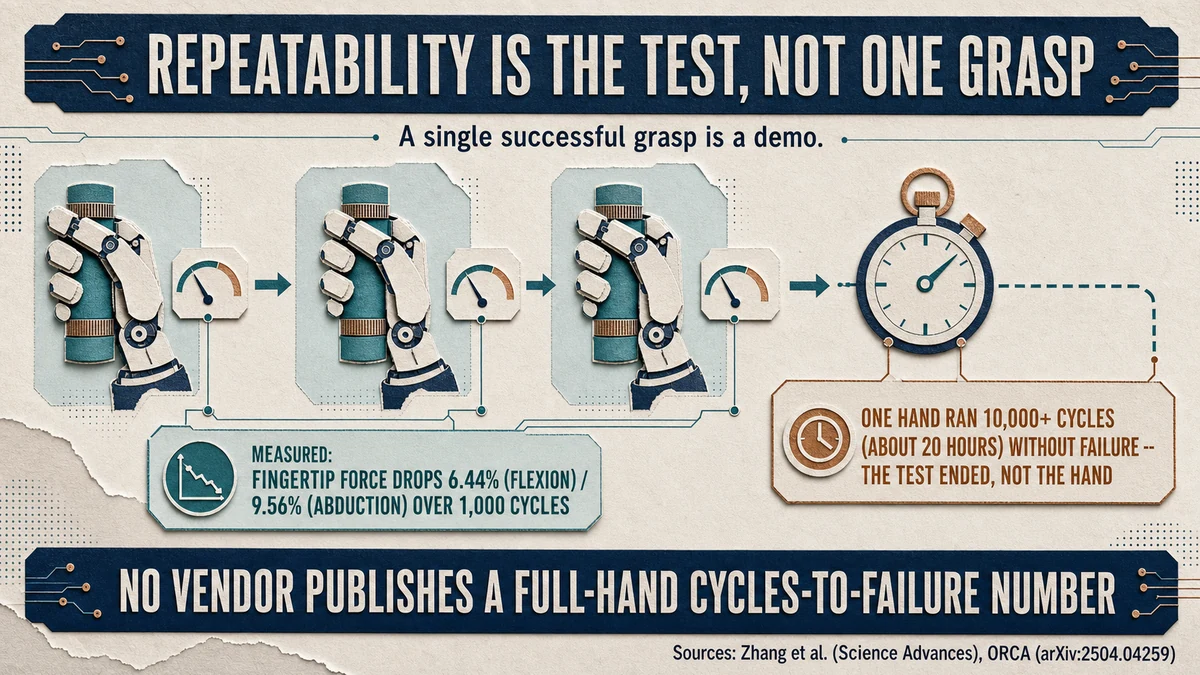
The same question continues one layer down in the tactile-skin analysis and in the Atlas factory test. The one measured endurance baseline in this piece comes from a published biomimetic-finger study rather than a vendor demo: fingertip force fell 6.44% to 9.56% over 1,000 actuation cycles.
The bottleneck moved up a specification rather than clearing, which makes it measurable. Four measurements would show whether it moves again.
- A dexterous hand crosses $2,000. The test has to name the specification or it means nothing: 20-plus degrees of freedom with tactile sensing, mass-produced, under roughly $2,000. Entry hands already cleared that price and did not clear that spec. If a sensed high-DOF hand lands there, the mechanical bottleneck is genuinely easing; if the gap between a $1,500 hand and a $7,000 one holds, dexterity is still the thing that costs money.
- Somebody publishes cycles to failure. No maker currently states a complete-hand service life under a named duty cycle. The only measured endurance figures in this field come from academic work. A vendor publishing a cycles-to-failure or replacement-interval number for a full hand would make the bottleneck gradeable on durability rather than on price and joint count alone.
- The reducer share moves. Japan’s hold on precision reducers is the quietest part of this chokepoint. If reported share shifts measurably toward Chinese suppliers such as Suzhou Green Harmonic, the cost floor drops again and the Japanese position looks like the magnet position: structural today, not permanent. If Nabtesco and Harmonic Drive hold their share through 2027, the layer is more defensible than the hand.
- Figure’s line rate holds or plateaus. BotQ was disclosed at one robot per hour with over 350 units delivered against a stated 12,000-unit annual capacity. Sustained output near that rate would show the body is no longer the limiter; a plateau at a fraction of stated capacity, with the brain shipping fine, points the finger back at the hand and the actuator.
Sources
- Sourcebotics — Trade buyer’s guide, list prices not audited disclosure: entry five-finger hands from under $1,500 and some models below $1,000, against a Shadow Hand research reference near $300,000; flagship 20+ DOF hands with tactile sensing listed at roughly $7,000-$28,000 (2026)
- DigiTimes — China’s price war halves humanoid hand costs while precision transmission parts resist; reducers, servo systems and controllers exceed 70% of total humanoid cost with Chinese domestic production estimated at 75-90% (2026-07-01)
- Verified Market Reports — Market-research estimate, not company disclosure: Nabtesco at roughly 22-25% of global harmonic and cycloidal reducer revenue, with Chinese entrants including Suzhou Green Harmonic expanding on price (2026)
- Tesla Q4 2025 earnings call transcript — Musk on Fremont Optimus conversion as a future plan and on production volume timing (2026-01-28)
- The Robot Report — 10-million-unit annual capacity target for a new Texas robotics plant, from Tesla’s Q1 2026 earnings call (2026-04-22)
- Figure AI — F.02 at BMW Spartanburg: 1,250+ hours, 30,000+ vehicles, 90,000+ parts, 84-second cycle time, >99% placement target (2025-11-19)
- Figure AI — Figure Series C: over $1 billion in committed capital at a $39 billion post-money valuation (2025-09-16)
- Figure AI — BotQ production rate of one robot per hour, over 350 units delivered, over 9,000 actuators across 10+ SKUs (2026-04-29)
- NVIDIA Newsroom — Isaac GR00T reference humanoid for academic research, GTC Taipei, on a Unitree H2 Plus chassis (2026-05-31)
- Goldman Sachs Research — Humanoid build cost falling from $50,000-$250,000 to $30,000-$150,000 between early 2023 and early 2024 (2024-02-27)
View all sources
- Figure AI — Figure 03 engineered from the ground up for high-volume manufacturing; stated 12,000-unit annual line capacity (2025-10-09)
- Figure AI — Helix VLA model trained on approximately 500 hours of teleoperated multi-robot data (2025-02-20)
- SCMP — Morgan Stanley Optimus Gen 2 teardown: BOM ~$46,000 rising to ~$131,000 without China; 16% parts-price decline (January 2026 note) (2026-01-29)
- SCMP — Morgan Stanley raises 2026 China humanoid shipment forecast to 50,000 units from 28,000; 2030 to 446,000 (2026-06-24)
- CNBC — Dealroom: robotics funding of $55.8 billion year-to-date as of June 2026, a record pace (2026-06-03)
- Zhang et al., Science Advances (DOI 10.1126/sciadv.adu2018) — Measured fingertip force degradation of 6.44% (flexion) and 9.56% (abduction) over 1,000 loading-unloading cycles on a biomimetic finger, attributed to tendon relaxation and material fatigue (2025-04-23)
- Christoph et al., ORCA (arXiv:2504.04259) — Open-source 17-DoF hand withstood over 10,000 continuous operation cycles (~20 hours) without hardware failure, censored by experiment duration rather than failure (2025-04-05)
- Robotics & Automation News — 1X Neo hand: 25 degrees of freedom, all force-controlled and backdrivable, IP68, fingertip tactile slip/shear sensing (2026-07-17)
- BofA Global Research — China-built humanoid bill of materials estimated near $35,000 for 2025 (2026-03-12)
- McKinsey & Company — China’s share of rare earths: roughly 69% of mining and about 90% of processing capacity (2026)
- Shanghai Stock Exchange (STAR Market filing) — Unitree registration statement: first-quarter 2026 revenue of 423 million yuan, up 68.49% year over year, with adjusted net profit down 52.55% against 332.64% growth the year before (2026)
This article is for informational and educational purposes only and does not constitute investment, financial, or legal advice.