Editor’s note, July 22, 2026: This article has been substantially revised to clarify that Hyundai Motor’s current labor dispute centers on compensation and retirement-age issues. Potential Atlas deployment at Korean production facilities is not part of the current labor-management discussions. Earlier language drew too direct a connection between the strike and Atlas.
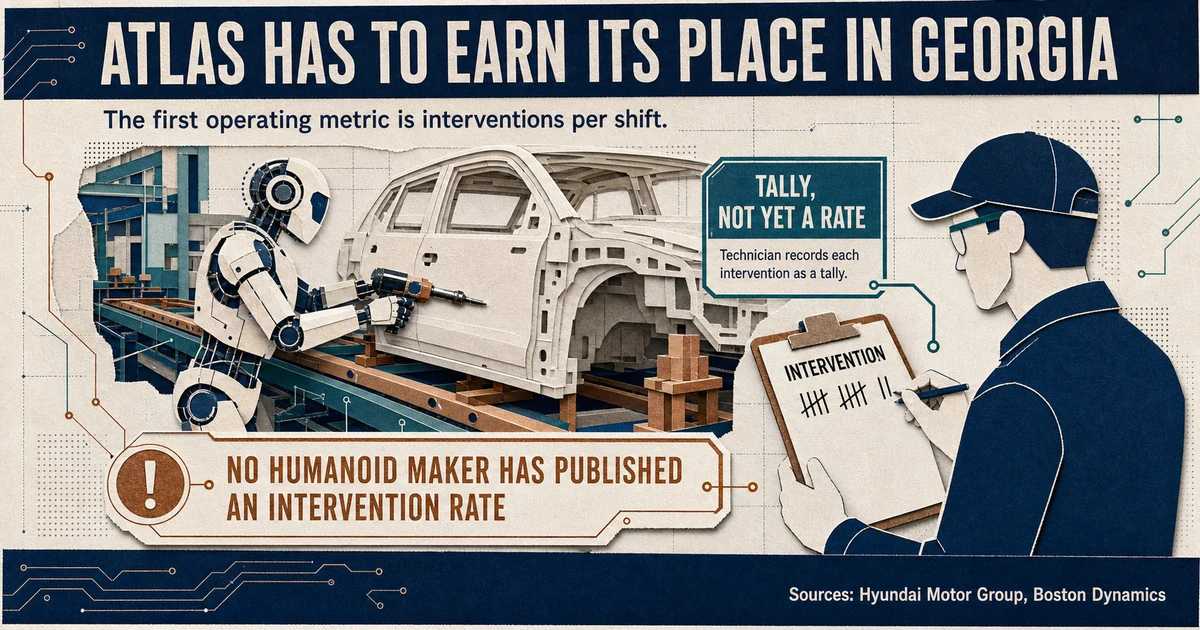
The strike was about pay and retirement age. The Atlas story begins elsewhere: in Georgia, where Hyundai says its current deployment focus is Hyundai Motor Group Metaplant America. There, the first number that matters may not be fleet size, but the frequency of human intervention.
Hyundai’s own July statement frames the dispute around bargaining issues, while the deployment question is separately tested through published intervention taxonomies for mobile robots.
A correction changes the geography
Hyundai Motor workers staged three days of partial strikes from July 13 to 15, after the union’s central dispute committee voted for action on July 8. Day and night shifts each stopped work for two hours, twelve hours of stoppage in all. The mandate behind it was not close: of 39,668 members, 37,348 voted and 34,371 backed industrial action, 92% of the ballots cast. Hyundai filed a production-suspension disclosure on July 13; the divisions it covers booked 78.8 trillion won in 2025, 42.3% of the company’s consolidated revenue.
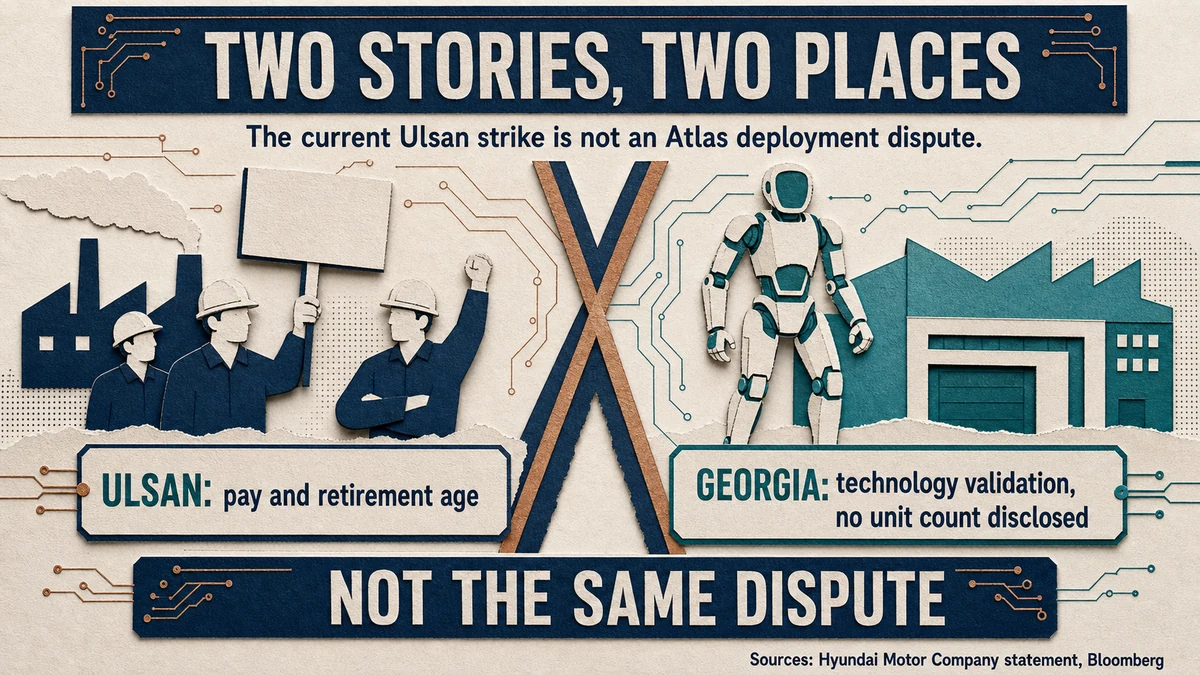
The dispute centered on familiar bargaining issues: a monthly base-pay increase of 149,600 won excluding the seniority-step raise, performance pay set at 30% of the prior year’s net profit, and an extension of the retirement age from 60 to 65. Hyundai told this publication that compensation and retirement age are the issues at the center of the current dispute.
References to robots did appear in reports on the union’s broader demands. The Korea Times described requests for employment and working-condition guarantees related to AI. Bloomberg reported job-security concerns in the age of AI and robots alongside the bonus dispute. Other reports went further, describing a demand for labor-management agreement before robots enter Hyundai workplaces.
Those reports and the company’s explanation are not necessarily describing the same thing. The reporting describes what the union has asked for; Hyundai describes what is currently on the negotiating table. Both can be true at the same time, and the union’s written demands have not been independently reviewed for this article. The demand most often quoted as a deployment veto — that introducing new technology or machinery move from union notification to union consultation, with an added employment-guarantee clause — is attributed in Korean reporting to Kia’s union rather than Hyundai Motor’s.
That points to a broader, longer-term debate over automation. It does not show that Atlas caused the current strike.
Hyundai’s clarification also makes the geographic scope clear. Potential robot deployment at Korean production facilities is not part of the current labor-management discussions. The company’s present Atlas focus is Hyundai Motor Group Metaplant America in Georgia, where Atlas will support production operations. Hyundai said any future deployment at another facility would depend on local operating needs and involve discussions with employees and workforce representatives at that site.
Atlas has to earn its place on the factory floor
Moving the story from Ulsan to Georgia changes the engineering question. It is no longer whether a union demand can block an imagined Korean rollout. It is whether a humanoid can become useful equipment inside a running automotive plant.
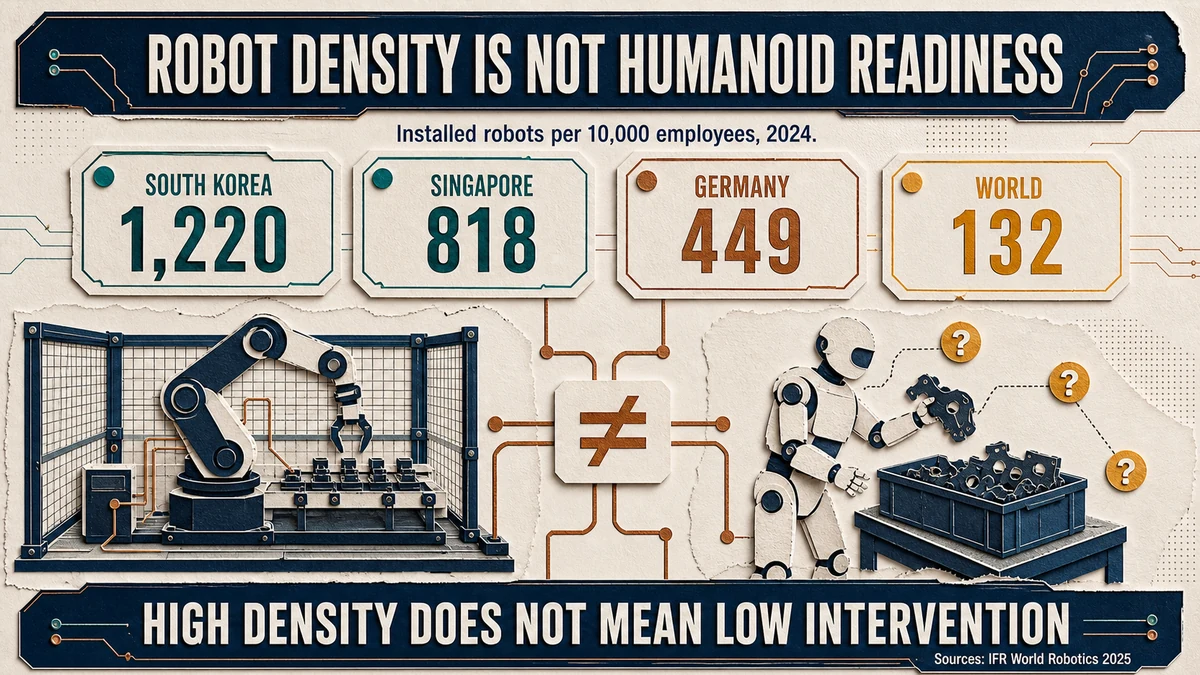
South Korea ran 1,220 industrial robots per 10,000 employees in 2024, the world’s highest density, according to the International Federation of Robotics’ World Robotics 2025 — Singapore second at 818, Germany 449, the world average 132. That figure reflects a form of automation that factories already know how to integrate: fixed cells, defined work envelopes, and equipment built around repeatable tasks.
A humanoid carries a different promise. Atlas is supposed to work in spaces built for people and eventually move between jobs. That flexibility is Atlas’s core value proposition. It is also its biggest integration risk.
A compelling demonstration shows that the machine can perform a particular task under controlled conditions. A factory deployment has to prove much more: safe interaction with people, repeatable quality, recovery after faults, compatibility with existing production software and enough productive output to justify the costs of supervision, maintenance, and downtime.
Boston Dynamics does publish what the machine is: 56 degrees of freedom, a 2.3-metre reach, a 50-kilogram lift, a rated operating range from −20 °C to 40 °C, and — the specification that matters most here — three operating modes, autonomous, teleoperated, and steered from a tablet. A humanoid that can be driven by a person is a humanoid whose autonomy is a measurement question rather than a property, which is why the next number in this article is the one to ask for.
The first number is not fleet size
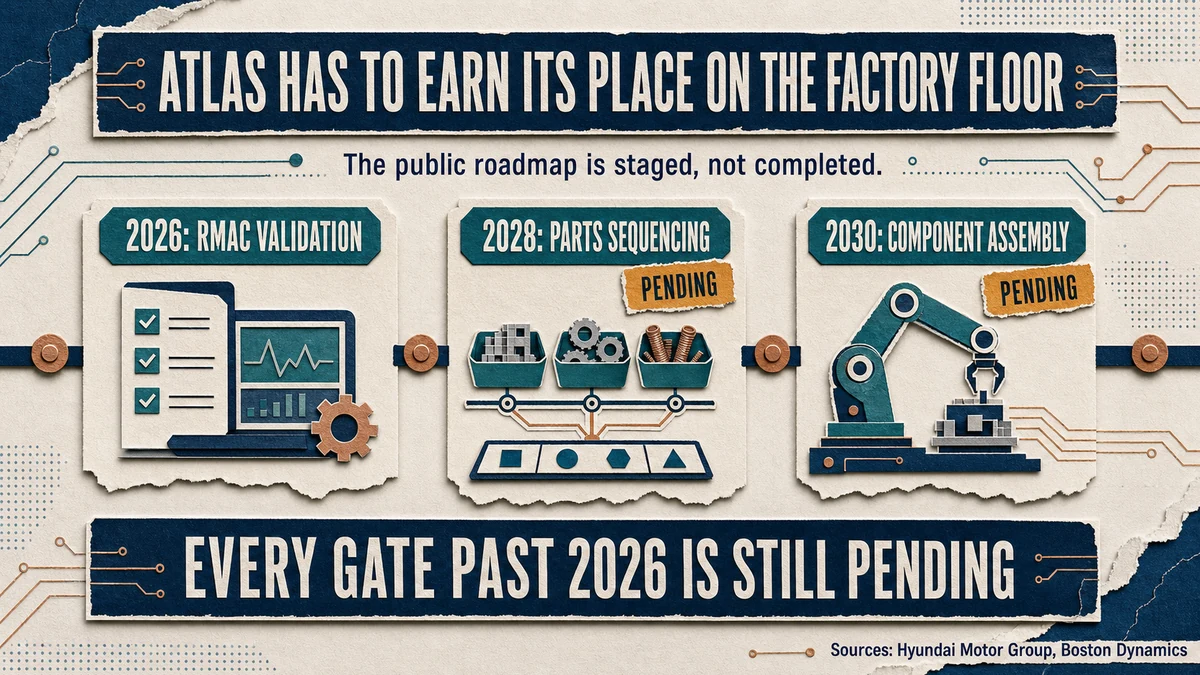
Hyundai did not say, in its statement to this publication, how many units will enter the Metaplant or what Atlas will do there first. Its own published statement nine days earlier is more specific than the reply: Atlas is to begin parts sequencing at the Metaplant in 2028 and move toward component assembly by 2030, subject to continued technology validation, operational readiness and business requirements. The fleet figures were not third-party estimates either. Hyundai Motor Group gave them itself, at an investor session hosted by JPMorgan in Boston on May 19: more than 25,000 Atlas units for Hyundai and Kia plants, against a target of 30,000 a year by 2028. What a company tells investors about a fleet and what it tells a reader about a site turn out to be different documents.
That order book is not a market-clearing signal. The two numbers are measured differently: more than 25,000 units is a cumulative allocation to Hyundai and Kia plants, while 30,000 a year by 2028 is a production-capacity target. Read together they describe a manufacturer building for itself, which is evidence of manufacturing intent rather than of external demand.
The 2026 machines are not going to a production line at all. Boston Dynamics says every 2026 Atlas is committed to Hyundai’s Robotics Metaplant Application Center — a training and validation hub opening this year, where data from real operations flows back for retraining — and to Google DeepMind. On the published schedule Georgia is set to get working robots in 2028, with the two years before that given over to teaching them.
Those missing details matter, but fleet size will not be the most revealing early metric. The frequency of human intervention will.
Every intervention reveals a situation the robot could not resolve on its own: a misplaced part, a perception failure, an unexpected obstruction, a communications failure, or a recovery procedure that still requires a technician. A fleet can look productive in aggregate while quietly consuming labor through resets, supervision and exception handling.
An intervention is the robotic equivalent of a self-checkout lane calling an attendant: the machine handled everything up to some point, then a person had to step in to finish the transaction. Count how often that call happens per hour of real use, and you have a number that says more about whether the machine actually works unattended than any total of hours or units ever could.
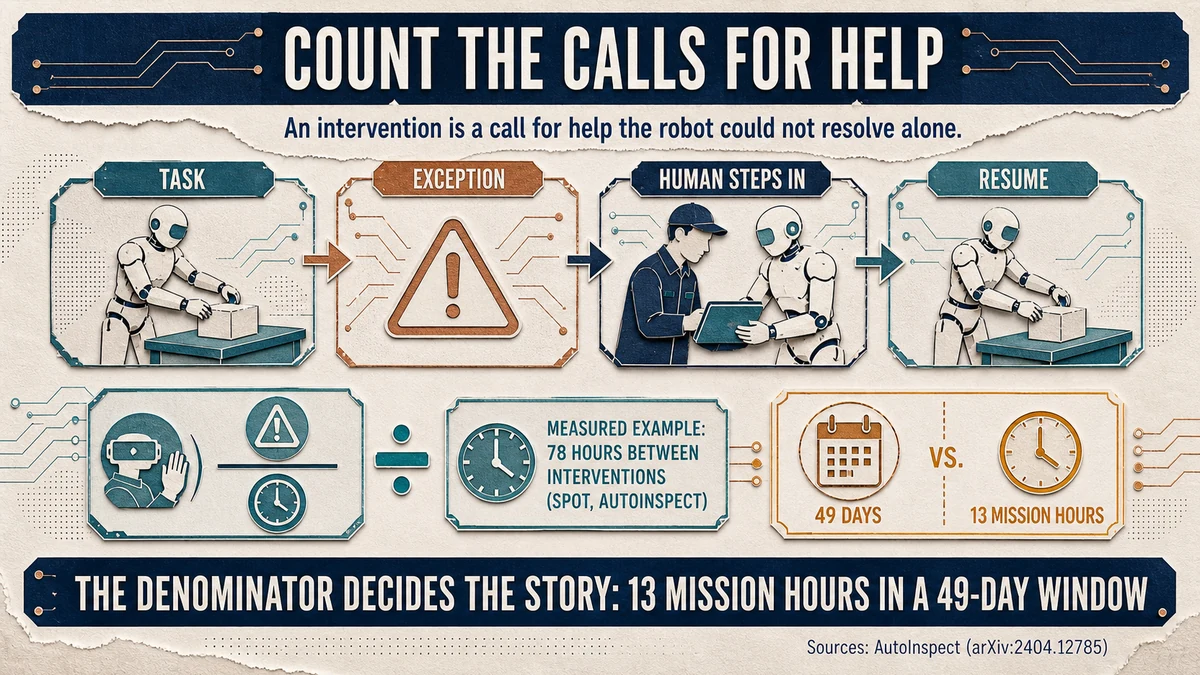
There is a measured version of this number, and it does not come from a humanoid maker. An Oxford field-robotics group ran a Boston Dynamics Spot with a custom inspection payload through a 49-day deployment at an industrial test facility and reported a mean time between interventions of 78 hours, rising to 140 hours across a 35-day run inside the Joint European Torus fusion reactor. The figures are legible only because the authors published their taxonomy first: minor interventions — map edits, software faults that break nothing — are excluded from the count; serious ones mean restarting part of the system; fatal ones mean restarting the whole software stack or the hardware. Twenty-five interventions in total at the first site, nine serious and four fatal.
The denominator is the part to hold on to. Seventy-eight hours between interventions sounds like a machine that runs for three days without help. It describes a 49-day window in which the robot was actually on mission for thirteen hours. An intervention rate is only as good as the time it divides by, which is why the number has to arrive with its protocol attached — and why “Atlas ran the whole shift” would tell a reader nothing at all.
Where humanoids specifically have been measured, the numbers are larger and more honest. A 2026 study of human-in-the-loop humanoid manipulation reports that 25.5% of episode time went to human intervention on erasing a whiteboard, and 4.5% on putting bread into a toaster, before reinforcement learning lifted task success from 45% to 80%. A quarter of the clock, on a whiteboard.
Intervention rates should be evaluated alongside uptime and throughput. How long does Atlas operate between recoveries? Does it complete work at the quality and pace required by the line? Does it reduce ergonomic strain and safety risks, or simply shift those burdens to maintenance staff? And after integration costs are counted, is the task cheaper or merely more novel?
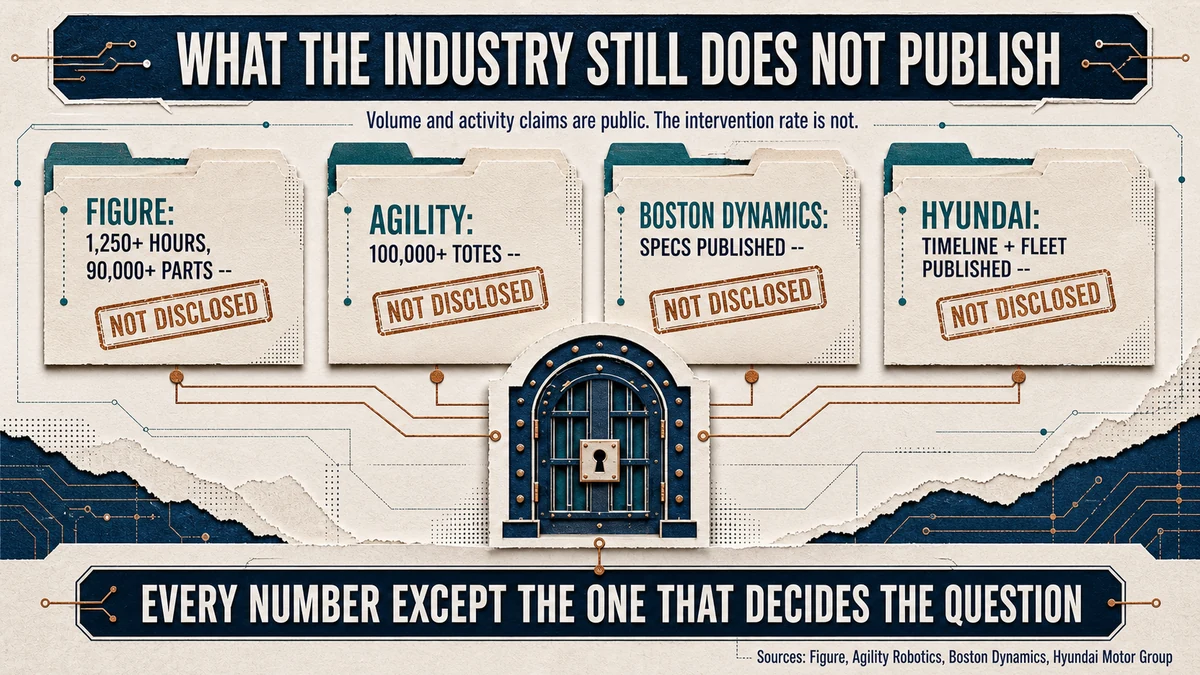
Which brings up what nobody publishes. Figure ran an eleven-month deployment on a BMW line and reported more than 1,250 operating hours, more than 90,000 parts loaded and more than 30,000 vehicles supported — and named interventions per shift as its own key metric while publishing only the goal for it: zero per shift. Not the achieved figure. Its successor deployment at the same plant reports no autonomy, uptime or intervention number at all. Agility’s flagship commercial milestone is a tote count. Boston Dynamics’ Atlas launch lists payload, reach and temperature range and no reliability metric of any kind. Hyundai’s July statement gives no unit count and no acceptance threshold. The industry has agreed on which number decides the question and has published every number except that one.
Georgia is therefore more than a first deployment location. It is where Hyundai can establish the performance threshold Atlas must meet before taking on another task or entering another plant. Consultation with employees should be part of that evaluation, not an afterthought. Hyundai has already said future sites will be considered individually and in dialogue with their workforces.
The site is also further along than the framing suggests. Hyundai’s Metaplant is a 12.6-billion-dollar plant built for 300,000 vehicles a year and planned for 500,000, with 8,500 jobs by 2031 — and Boston Dynamics robots already work there, a Spot fleet doing exterior quality inspection since before Atlas was announced. Georgia is not robot-virgin ground. It is a plant that has already integrated one Boston Dynamics platform and can therefore say, with some authority, what the second one costs to keep running.
This also suggests a more accurate sequence for assessing the labor implications. First come a specific site, a defined task, and real-world operating results. Then comes a local deployment proposal — and the labor discussions associated with it. For Korean plants, Hyundai says that proposal is not currently on the table.
Who is already being paid, and on what basis
The disclosure gap looks different once you see what buyers are actually billed for. Figure’s BMW Spartanburg deployment is reported at roughly $25 per robot-operating-hour with placement accuracy above 99% — a price quoted in the unit that matters, machine time. Agility took a different route: roughly $300 million in contracted multi-year revenue from GXO Logistics, Toyota Motor Manufacturing Canada and Schaeffler, a Salem, Oregon plant it says can scale past 10,000 Digit units a year, and a merger valuing the company near $2.5 billion, making it the first publicly listed pure-play humanoid maker with robots in commercial operation. Apptronik opened a roughly 90,000-square-foot Austin facility on June 30, 2026, where Apollo 2 fleets run production tasks continuously, and its Apollo robots move assembly kits on Mercedes-Benz lines.
Read the three together and the shape of the market appears. Figure sells machine time. Agility sells contracted capacity. Apptronik is buying its own training data by running a plant. Every one of those models is priced on the assumption that the robot mostly runs unattended — which is precisely the assumption an intervention rate would test, and precisely why none of the three publishes one.
The scale should be kept honest too. By mid-2026 no humanoid programme had been deployed above the low hundreds of units in a sustained, commercially priced production environment; the GXO-Agility and BMW-Figure programmes are the clearest data points that exist. Hyundai’s 25,000-unit plan is therefore not a late entry into a crowded market. It is an order of magnitude beyond anything anyone has yet run, which makes the Georgia acceptance threshold the more interesting number, not the fleet total.
Perspective
At this stage, Atlas appears to be less a story about labor replacement than a test of factory integration. If Georgia produces low intervention rates, reliable output and a credible cost case, the employment implications will become concrete at each plant. Until then, rollout forecasts and robot-versus-worker narratives are running ahead of the evidence.
One number would settle it faster than any forecast: interventions per shift at the Metaplant, published with the taxonomy that says what counts as one and with a denominator measured in operating hours rather than calendar days. The academic literature manages that disclosure routinely. No humanoid maker has managed it yet, and Hyundai has until 2028 to be the first.
The strongest objection to weighing intervention rate this heavily is economic rather than technical: a fleet large enough can absorb a mediocre per-unit rate if the labor saved elsewhere outweighs the labor spent on interventions, the same way early industrial robots earned their keep at failure rates no one would tolerate today. Scale can buy down the cost of an imperfect number. It cannot make the number disappear, and Hyundai has not disclosed enough about Georgia’s fleet size, task mix or shift structure for a reader to run that trade-off in either direction.
None of this resolves in argument. It resolves in four disclosures, each of which either arrives before 2028 or conspicuously does not.
- A public company has to file. Agility’s listing changes the disclosure calculus: a public humanoid maker reports to shareholders on a schedule. Watch whether robot-hours, uptime, or an intervention or exception rate appear in its filings and calls. If contracted revenue is reported without a single operating-reliability figure, the industry’s silence is a choice rather than an oversight.
- Somebody publishes the achieved number, not the goal. Figure named interventions per shift as its key metric and published only the target of zero. The test is narrow: any maker stating an achieved per-shift or per-hour intervention figure with the taxonomy that says what counts. The academic literature does this routinely; a vendor doing it first would reset what a deployment claim has to contain.
- The price per robot-hour moves. Roughly $25 per robot-operating-hour is a number a buyer can hold against a wage. If it falls materially while task scope stays constant, the economics are working. If it holds while deployments stay in the low hundreds of units, the cost of human supervision is being carried somewhere the price does not show.
- Georgia’s validation year produces a threshold. Every 2026 Atlas is committed to a training and validation hub, not a line. The checkable output of that year is not a robot count but an acceptance criterion: a stated bar Atlas must clear before parts sequencing begins in 2028. If 2027 arrives with no published threshold, the 2028 date is a plan rather than a schedule.
Sources
- Technology.org — Trade survey of what is actually deployed: no humanoid programme above the low hundreds of units in sustained commercially priced production as of mid-2026; Figure 03 at BMW Spartanburg reported at ~$25 per robot-operating-hour with 99%+ placement accuracy; Agility ~$300m contracted multi-year revenue (GXO, Toyota Motor Manufacturing Canada, Schaeffler), RoboFab capacity beyond 10,000 Digit units a year, ~$2.5bn merger as the first publicly listed pure-play humanoid maker in commercial operation (2026-07-18)
- Tech Times — Apptronik Robot Park, a ~90,000-square-foot Austin facility opened June 30, 2026 where Apollo 2 fleets run production tasks continuously; Apollo moving assembly kits on Mercedes-Benz lines (2026-07-25)
- Hyundai Motor Group — Company statement: Atlas to begin parts sequencing at the Metaplant in 2028 and component assembly by 2030, subject to validation and operational readiness; no unit count given (2026-07-16)
- Hyundai Motor Company — Global PR statement provided to this publication: the current dispute centers on compensation and retirement age; robot deployment at Korean facilities is not part of current labor-management discussions; the Atlas focus is the Georgia Metaplant (2026-07-21)
- Bloomberg — Partial strike, bonuses and reported job-security concerns involving AI and robots (2026-07-13)
- International Federation of Robotics — World Robotics 2025: South Korea 1,220 robots per 10,000 employees in 2024, the world’s highest density; Singapore 818, Germany 449, world average 132 (2026-04-08)
- Staniaszek et al., AutoInspect (arXiv:2404.12785) — Measured mean time between interventions on a Boston Dynamics Spot: 78 hours over a 49-day industrial deployment and 140 hours at the Joint European Torus, with the minor/serious/fatal taxonomy and 13 hours of mission time inside the 49-day window (2024-04-19)
View all sources
- Hyundai Motor Group — Metaplant grand opening: USD 12.6bn invested, 300,000 vehicles a year rising to 500,000, 8,500 jobs by 2031, Spot already in service for exterior quality inspection (2025-03-26)
- Boston Dynamics — Atlas specification (56 DoF, 2.3 m reach, 50 kg lift, −20 °C to 40 °C) and its autonomous, teleoperated and tablet-steered modes; all 2026 units committed to the Robotics Metaplant Application Center and Google DeepMind (2026-01-05)
- Figure — Eleven-month BMW deployment: 1,250+ operating hours, 90,000+ parts, 30,000+ vehicles; interventions per shift named as the key metric with only the goal published (2025-11-19)
- Figure — Successor deployment announcement carrying no autonomy, uptime or intervention figure (2026-06-30)
- Agility Robotics — Digit Moves Over 100,000 Totes in Commercial Deployment — a tote count, with no uptime, hours, robot count or intervention rate (2025-11-20)
- Xiao et al., ROVE (arXiv:2606.17011) — Humanoid manipulation under human intervention: 25.50% of episode time on erasing a whiteboard, 4.53% on toasting bread; success 45% to 80% across three iterations (2026-06-15)
- The Korea Herald — More than 25,000 Atlas units for Hyundai and Kia plants and a 30,000-a-year capacity target, given at a JPMorgan-hosted investor session in Boston on May 19 (2026-05-20)
- The Korea Times — Union demands concerning AI, employment and working conditions; performance pay at 30% of prior-year net profit (2026-06-25)
- Etnews — Strike authorization vote: 34,371 of 39,668 members in favour, 92.03% of ballots cast (2026-06-24)
- Herald Business — Hyundai’s production-suspension regulatory filing of July 13: affected divisions booked 78.7667 trillion won in 2025, 42.3% of consolidated revenue (2026-07-13)
- Seoul Economic Daily — Kia union’s technology-introduction demand (notification to consultation, employment guarantee) distinguished from Hyundai Motor’s own demand (2026-05-04)
- Asia Economy (아시아경제) — July 8 decision by the union’s 2nd Central Dispute Committee to begin partial strikes (2026-07-08)
- Money Today (머니투데이) — Each shift stopped work for two hours; the immediate wage dispute (2026-07-13)
- Hyundai Motor Group — Robotics Metaplant Application Center described as a training and validation hub where data from real operations returns for retraining (2026-01)
- Boston Dynamics — Google DeepMind named as a 2026 Atlas recipient; the arrangement discloses no payment, unit count, equity stake or term (2026)
Later in this series
This article is for informational and educational purposes only and does not constitute investment, financial or legal advice.