Forbes headlined it plainly: the United States bans Chinese humanoid and quadruped robots. The determination underneath never mentions China – and the paperwork that gets a robot out from under it asks about American factories.
What the market bought, and what the order says
The headlines invited a simple trade: Chinese machines were being cleared out of the American market, and whoever was not Chinese would fill the gap. That reading travelled faster than the document did.
Open the determination and the word “China” is not in it. Asked directly whether the action targets any country, the agency’s published answer is a single line: “No, this action is country neutral”. “Foreign-produced” is defined by borrowing a federal procurement term — anything that “would not qualify as a ‘domestic end product,’ as that term is defined in 48 CFR § 25.101(a)”. That regulation is a number, not just a cross-reference: domestic components must exceed 65 percent of total component cost for anything delivered through the end of 2028, rising to 75 percent from calendar year 2029. A quadruped assembled in Ulsan sits inside that definition on exactly the same terms as one assembled in Hangzhou, and both would need to clear a three-quarters domestic-content bar within three years to escape it.
That reading rests on a premise the document does not contain. And one detail makes the mismatch stranger still. In the FCC’s own Conditional Approval guidance, a maker applying to get its robot out from under the listing files ownership records, a bill of materials with country-of-origin data — and a dated plan to establish or expand manufacturing inside the United States.
Hold that for a moment; the rest of the order has to come first, because the exemption only makes sense once you know how narrow the gate actually is.
The four tests a device has to meet
On July 28, 2026, the Federal Communications Commission’s Public Safety and Homeland Security Bureau added two categories to its Covered List — foreign-produced advanced robotic devices and foreign-produced connected power inverters — in Public Notice DA 26-786, acting on national security determinations an interagency body had transmitted the day before under the Secure and Trusted Communications Networks Act, codified at 47 U.S.C. §§ 1601-1609. The legal effect is narrow and specific. Under section 2.903(a), equipment on the list “is prohibited from receiving equipment authorizations”. In the agency’s own summary, “[m]ost electronic devices require FCC equipment authorization prior to importation, marketing, or sale in the United States”.
The FCC did not originate the determination either: under the Secure Networks Act it “cannot update this list on its own and is required to implement determinations that are made by our national security agency experts”, here a White House-convened interagency body.
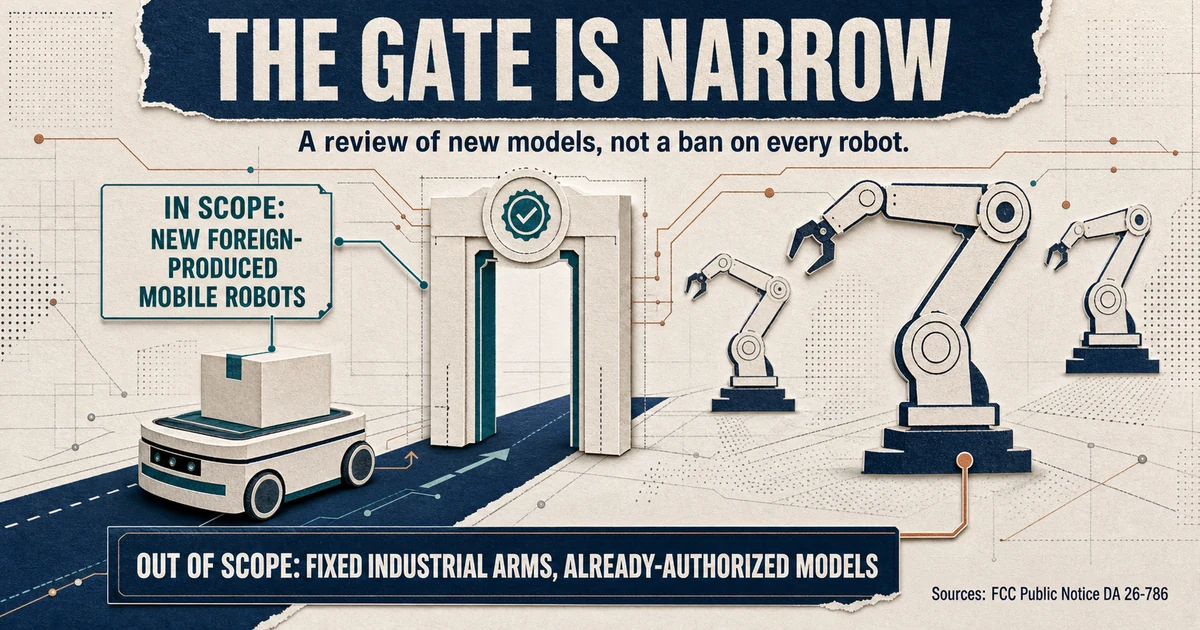
The definition runs to four cumulative tests. An “advanced robotic device” is “[a] mechanical mobile device, including autonomous mobile robots, humanoid robots, and quadrupeds” that “is capable of locomotion, obstacle avoidance, navigation, or movement on the ground”, operates at a distance from a human operator, and whose combined weight “of the device and, if applicable, ground station or docking station is over 4.4lbs”.
It must also carry three components: an environmental sensor, a connection capable of “at least 200 kbps in either direction”, and software – “including firmware and AI or machine-learning model weights” – that controls autonomous navigation, movement perception, data collection or remote command-and-control.
Then comes the exclusion list, which is more revealing than the definition. Out: connected vehicles of any weight, rail vehicles, uncrewed aircraft, unmanned underwater vehicles, FDA-regulated medical devices down to wheelchairs and walkers, and “[a] fixed, stationary, non-mobile robot, including articulating, parallel/delta, Cartesian/gantry, or Selective Compliance Assembly, or Articulated, Robot Arm (SCARA) robots intended for industrial or medical use”. The fixed arms that fill American factory floors are excluded outright.
So the sorting question is never “who made this.” It is “does it cross a floor, and was it built outside the United States.” Two otherwise identical machines can land on opposite sides only if the Ohio-built unit also satisfies the procurement rule’s domestic-content test; the Ulsan-built unit does not qualify as a domestic end product.
What an equipment authorization actually gates
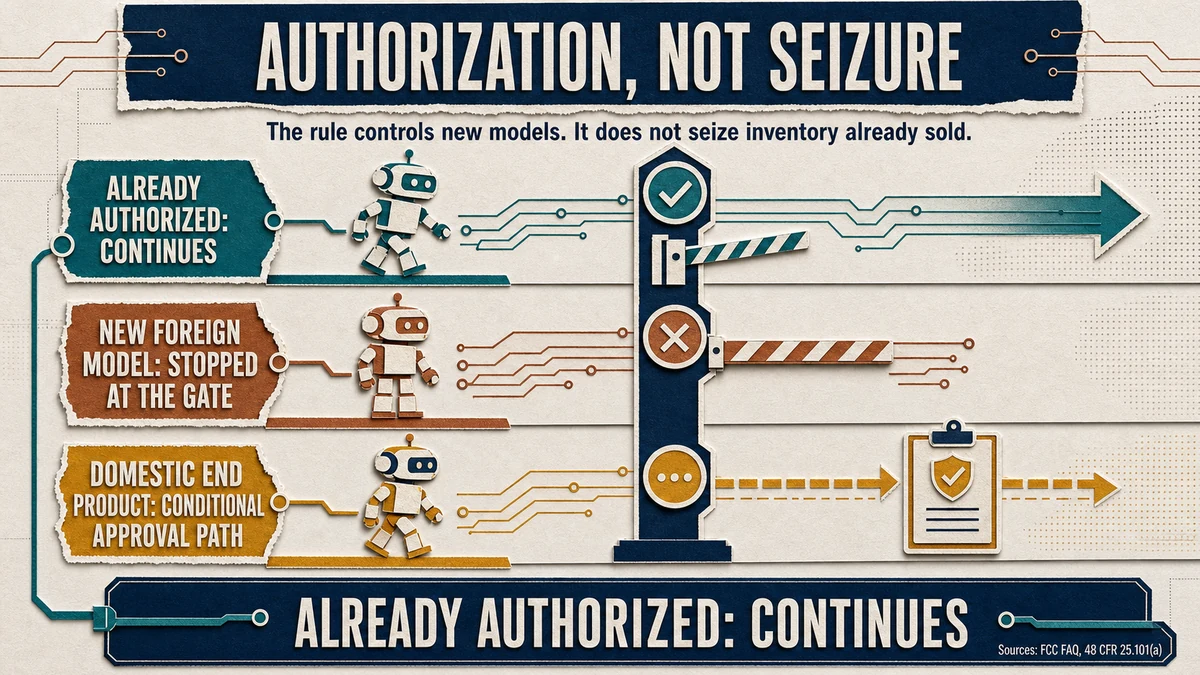
An FCC equipment authorization is the market-entry approval a radiofrequency device needs before it can be imported, marketed or sold, and it is granted per model. Placement on the FCC Covered List does not seize inventory or void certificates already issued; it blocks the issuance of new ones, and the agency closed the obvious workaround by confirming that the streamlined Supplier’s Declaration of Conformity route is barred too. Trade coverage of the order reached the same conclusion, noting that previously approved foreign robots and inverters may continue to be imported, marketed, sold and used.
A producer’s already-authorized models are untouched. Its next foreign-produced models are the ones that need an authorization the gate withholds, and for the ordinary commercial market the way through is the Conditional Approval process described further down. Federal sales sit outside the restriction, and small batches may still be imported for development and testing so long as they are not marketed or sold.
That distinction produces a set of carve-outs the agency states plainly. Models already authorized may continue to be imported, marketed and sold; consumers may keep using what they own; asked whether there is any restriction on consumer use, the FAQ answers “No”. Sale to the federal government is “entirely exempt”. Small batches may still be imported for development and testing, provided they are not marketed or sold. And a producer whose devices are covered does not itself become a listed entity – a meaningful difference from the Huawei-and-ZTE style of designation that built the original list.
The template is already two rounds old
The security rationale does not close the software channel either. A companion order from the Office of Engineering and Technology waives the rules that would otherwise bar firmware changes to covered equipment, so authorized robots and inverters “may continue to receive software and firmware updates that mitigate harm to U.S. consumers at least until January 1, 2029”, explicitly including patches for vulnerabilities.
It helps to notice that this is the third pass of the same template, not a one-off. The same order records that uncrewed aircraft joined the Covered List on December 22, 2025, that routers followed on March 23, 2026, and that both received a similar firmware waiver, extended in May to at least January 1, 2029. The agency itself says the robotics action is “very similar-both legally and in implications” to those two. Anyone modelling what happens next has two completed precedents to read rather than a blank page.
Two readings of the same order
The first reading says the action bites hard. A gate on new authorizations reaches a producer’s future models rather than the ones already earning revenue, and in a category still scaling up, the future models are most of the plan. Concentration sharpens that: TrendForce projected in April that China’s humanoid robot output would rise 94% in 2026, with Unitree and AgiBot together taking nearly 80% of that country’s output. Whether those units survive contact with a real deployment is a separate argument, one this desk has made at length about humanoid programs already on factory floors.
The effect may also travel past the legal boundary, because the same FAQ notes that the Cybersecurity and Infrastructure Security Agency “encourages organizations to use the Covered List for risk management analysis in their regulatory compliance efforts”. Connecting those two, a list built to gate authorizations can work as a procurement filter for buyers who face no legal restriction at all.
The second reading says the action is modest. Nothing currently on a shelf comes off it. Owners are untouched, federal buyers are exempt, test units still cross the border, firmware keeps flowing for more than two years, producers escape entity designation, and fixed industrial arms are written out of the definition entirely. On that account this is a forward-looking import control on one form factor, not a decoupling event.
Both readings are supported by the text, which usually means the disagreement is about something other than the text. Here it is about time. The second reading describes the market today; the first describes the model roadmap for 2027 and 2028. The instrument is built to bind the future, and the shape of its exemption says so. The listing itself is written as an exception – covered are foreign-produced robots “except those which have been granted a Conditional Approval” by the defense department.
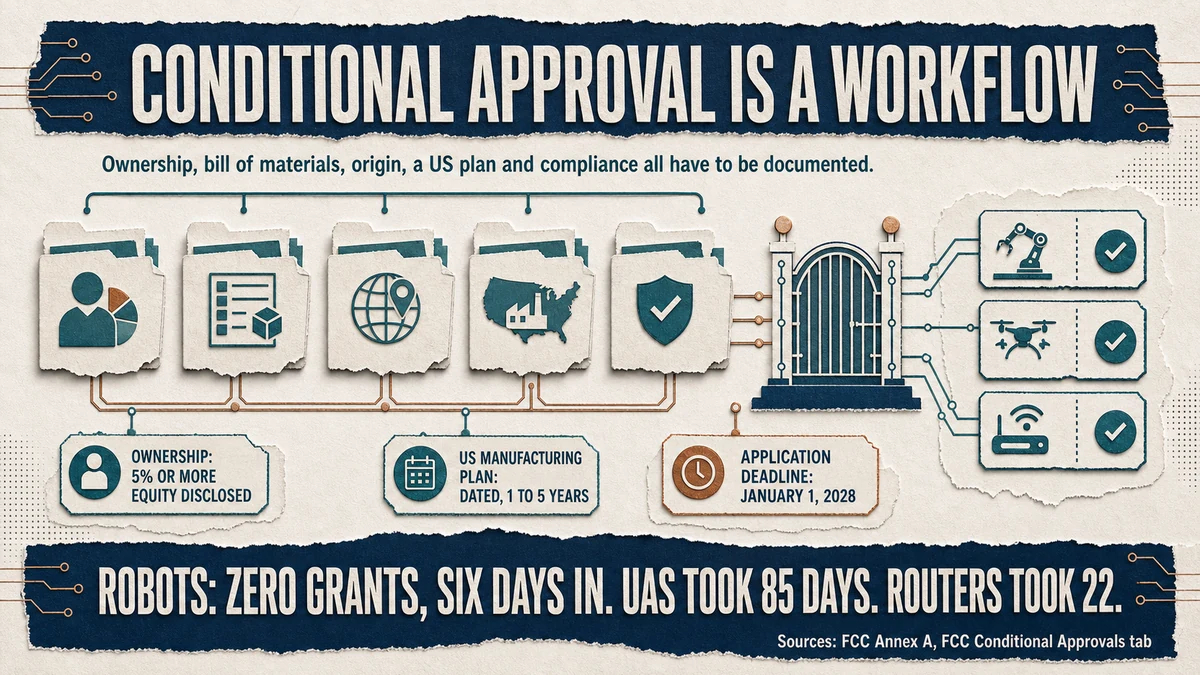
The FCC’s own Conditional Approval guidance, published the day before the listing, states that applicants for that exception must supply ownership and beneficial-ownership detail for anyone holding 5 percent or more equity, bills of materials with country-of-origin data, and “[a] detailed, time-bound plan to establish or expand manufacturing in the United States”, covering committed and planned capital expenditure, financing or other investment dedicated to US-based manufacturing “over the next 1-5 years, with timelines and milestones”. It also sets a deadline the exemption’s paperwork does not advertise on its face: applications must be submitted by January 1, 2028, after which the pathway this section describes closes. A July 30 client alert from the law firm Mayer Brown reports the same requirements and is consistent with the agency’s own text.
The 1-to-5-year factory schedule is the agency’s own condition, not a law firm’s extrapolation of one, and it sits closer to an industrial-policy commitment than to the paperwork of a cybersecurity audit.
Who actually has to change a plan
Start with a category the headline framing obscures. Run a typical docked household robot vacuum through the four tests: it navigates the ground, avoids obstacles, works away from any operator on sensor data, clears 4.4 pounds easily once its dock is counted, carries environment sensors and Wi-Fi far above 200 kbps, and runs navigation software. It matches none of the six exclusions. Reading the definition that way is an inference rather than an agency statement – but if it is right, the practical center of gravity here is a mass-market consumer appliance category, not humanoids.
The effects reach past robotics in three specific places. Warehouse and third-party logistics operators buy autonomous mobile robots, which the definition names outright; where a replacement model is both new and foreign-produced, the purchase now waits on a Conditional Approval decision – a real cost in a category where, as this desk’s work on the robot skin and tactile sensing bottleneck found, fleet economics already turn on component replacement schedules. Residential solar installers are caught in the same order through the inverter listing, where the new-model gate lands on hardware chosen at system-design time.
And consumer-electronics retailers face an assortment problem rather than a recall problem: current SKUs are safe, next season’s imported models are conditional. Enterprise risk and insurance teams sit underneath all three, because CISA’s framing turns list membership into a compliance signal well before it becomes a legal one.
Two artifacts will settle which reading was right, and both are public. The FCC has committed to publishing every granted Conditional Approval on its Covered List page; the volume and identity of the first grants show whether the exemption is a real pathway or a formality. The second is the equipment-authorization record itself. Revocation is the wrong instrument to watch: the FCC’s own answers are right that it does not revoke existing authorizations here, but a codified procedure reaches already-authorized equipment without revoking it, narrowing the scope of an existing grant instead. That procedure took effect on July 16, 2026 — twelve days before this listing — and has already been proposed for the previous category added to the list. If it is invoked against robots, the narrow reading collapses without a single revocation appearing on the record.
As of publication the Conditional Approvals tab has not moved: it is stamped the day before this listing and carries tables for two prior categories — seventeen approvals for uncrewed aircraft, the first granted 85 days after that category’s own listing, and seventeen for routers, the first granted 22 days after. There is none yet for advanced robotic devices, six days in. That is not evidence the pathway is a formality; both precedents took weeks to produce a first grant. It is the dated, checkable state of the scoreboard as of publication, and it will resolve in public before the narrower legal question below does.
Suppliers outside China are watching the same two files, since Reuters-sourced reporting expects broad exemptions for them – while the production test itself does not care who owns the company. A Korean, Japanese or European maker producing outside the United States is covered on the same terms as any other; moving production inside the United States is the route out, but it is not automatic – the product still has to clear the procurement rule’s own domestic-content requirements to qualify as a “domestic end product”.
It is the same design question export-control drafting keeps running into: a rule written in terms broad enough to catch far more than the coverage of it suggests.
Who is already standing outside the gate
One procedural detail decides how to read the exemption, and it is not in the listing. The Conditional Approval that lets a covered robot through is not the FCC’s to grant: for advanced robotic devices, the Department of War alone may issue it. Applications go to a machine-readable filing, certified by a corporate officer, carrying corporate structure and beneficial ownership, a bill of materials with component origins and supply-chain concentration, and a time-bound US manufacturing plan with capital commitments and milestones. That is a defence-procurement disclosure package wearing a telecom docket number. The FCC implements the listing; the relief from it is decided somewhere else entirely, which is a second instance of the same pattern this article already describes.
That framing also identifies who benefits, and it is not who the headline implied. If the axis is production location rather than nationality, the makers structurally outside the gate are the ones already building in the United States — and three of them are. Agility’s RoboFab in Salem, Oregon is stated to scale past 10,000 Digit units a year. Apptronik opened a roughly 90,000-square-foot facility in Austin on June 30, 2026. Figure’s BotQ line carries a stated 12,000-unit annual capacity. None of those plants was built for this rule; all three now sit on the right side of it.
The reflexive trade — sell the Chinese makers, buy everyone else — therefore mis-sorts the field. A Korean or Japanese or German mobile robot faces the same authorization gate as a Chinese one, because the test never asked where the company is from. What separates a winner from a loser here is a domestic plant and a filing the Department of War accepts, and on that measure the early advantage sits with three American companies that happened to industrialize first.
Editorial View
The label is doing real damage to the analysis. Calling this a ban on Chinese humanoid robots gets the actor wrong — the FCC implements, it did not decide — and the axis wrong three times over: ground mobility rather than category, place of production rather than nationality, next model rather than current shelf. Forbes, to be fair, accurately reported country neutrality, the new-model scope, continued sales of authorized models and the federal carve-out in its body; its headline compressed that qualified account into a China-specific ban, and the market-facing coverage downstream carried the compressed framing. The most consequential line in the whole action may not be in the order at all. It is in the exemption paperwork, in the FCC’s own Conditional Approval guidance, where applicants are asked to commit to building or expanding manufacturing inside the United States by a fixed deadline.
Bottom Line
The reachable set on the FCC Covered List is a shape rather than a nationality: any machine that fails the government’s “domestic end product” test and crosses a floor under command or on its own, senses its surroundings, stays connected and clears 4.4 pounds counting its ground station or dock, with vehicles, aircraft, medical devices and fixed industrial arms written out. On the definition-based reading described above, that could put a mass-market consumer-appliance category alongside warehouse fleets, residential inverters and humanoids under the same instrument. For buyers outside robotics, the near-term question is not whether a supplier is Chinese but whether its next model has cleared a process that, in the FCC’s own Conditional Approval guidance, asks applicants for a dated US manufacturing plan before a January 1, 2028 deadline — and the two public records named above are where that answer will show up first.
Regulatory questions answer themselves in filings, on their own timetable. Four filings would answer this one.
- The first table appears, or it doesn’t. The Conditional Approvals tab carries seventeen grants for uncrewed aircraft and seventeen for routers, and none yet for robots. The precedents took 85 and 22 days respectively. If a robot table is still empty well past those windows, the pathway is narrower in practice than on paper — and the January 1, 2028 filing deadline starts doing the work the listing itself did not.
- A name on that table settles the nationality question. If the first grants go to firms manufacturing in the United States regardless of where they are headquartered, the production-location reading is confirmed in the strongest way available. If they cluster by country of origin instead, the country-neutral text is being applied with a thumb on the scale, and that is a different story than the one the document supports.
- The scope-limiting procedure gets aimed at robots. The codified tool that reaches already-authorized equipment without revoking it has already been proposed for uncrewed aircraft, naming nine companies and specific device IDs. If a comparable notice names robot makers and FCC IDs, the “nothing on the shelf is affected” reading expires on a date certain rather than in principle.
- A foreign maker announces a US plant and says why. The exemption asks for capital commitments and milestones, not intentions. A covered manufacturer announcing American production and citing this process would convert an industrial-policy inference into a stated cause — and would be the clearest evidence that the consequential line in this action was in the exemption paperwork rather than the ban.
Sources
- Morgan Lewis — Legal analysis of the same action, verbatim: “For advanced robotic devices, DoW alone may issue Conditional Approval”; submissions due January 1, 2028 as machine-readable PDFs certified by an authorized corporate officer, covering corporate structure and beneficial ownership, bill of materials with component origins and supply-chain concentration, and a time-bound US manufacturing plan with milestones and capital commitments (2026-08)
- Technology.org — Trade survey of US manufacturing capacity: Agility RoboFab in Salem, Oregon stated to scale past 10,000 Digit units a year; Figure’s BotQ line at a stated 12,000-unit annual capacity (2026-07-18)
- Tech Times — Apptronik’s ~90,000-square-foot Austin facility opened June 30, 2026 (2026-07-25)
- FCC — FAQ: full definition of ‘advanced robotic device’ including the 4.4 lb and 200 kbps thresholds, six exclusions, country-neutrality statement (2026-07-28)
- FCC — Public Notice DA 26-786: statutory authority at 47 U.S.C. §§ 1601-1609, dockets WC 18-89/ET 21-232/EA 21-233, section 2.903(a) prohibition, determinations transmitted July 27 (2026-07-28)
- FCC Office of Engineering and Technology — Public Notice DA 26-789: waiver permitting software and firmware updates for Class I and II devices, at least until January 1, 2029 (2026-07-28)
- FCC — Annex A: Conditional Approval guidance — 5% beneficial-ownership threshold, dated US manufacturing plan requirement, January 1, 2028 application deadline (2026-07-27)
- Federal Register — 91 FR 41023, PS Docket 26-72, DA 26-635: procedure limiting the scope of existing authorizations for covered equipment without revoking them, effective July 16, 2026 (2026-07-06)
- TrendForce — China’s humanoid robot output projected to rise 94% in 2026, with Unitree and AgiBot taking nearly 80% of China’s own output (2026-04-09)
- Forbes — Headline framing the action as a ban on Chinese robots, with body text accurately reporting country-neutrality (2026-07-28)
View all sources
- FCC — Fact sheet on the same action, including the encouragement to submit Conditional Approval applications (2026-07-28)
- eCFR — 48 CFR § 25.101(a): domestic-content threshold, 65% through 2028 rising to 75% from calendar year 2029 (2026-07-30)
- Federal Register — 91 FR 48108, PS Docket 26-184, DA 26-742: proposal to apply the same scope-limiting procedure to previously authorized uncrewed aircraft, naming nine entities and FCC IDs, comments due August 31, 2026 (2026-07-30)
- Mayer Brown — Client alert on the Conditional Approval guidance requirements, corroborating the agency’s own document (2026-07-30)
- Robot Newspaper — Korean robotics trade coverage: new-models-only scope, reported (not agency-confirmed) revocation authority (2026-07-29)
- Nextgov/FCW — The action applies only to new device models; previously approved foreign robots and inverters may continue to be sold (2026-07-29)
- FCC — Covered List page, Conditional Approvals tab: seventeen approvals listed for uncrewed aircraft with the first granted 85 days after that category’s listing, seventeen for routers with the first granted 22 days after, and no table yet for advanced robotic devices (accessed 2026-08-03)
This article is for informational and educational purposes only and does not constitute investment, financial, or legal advice.