

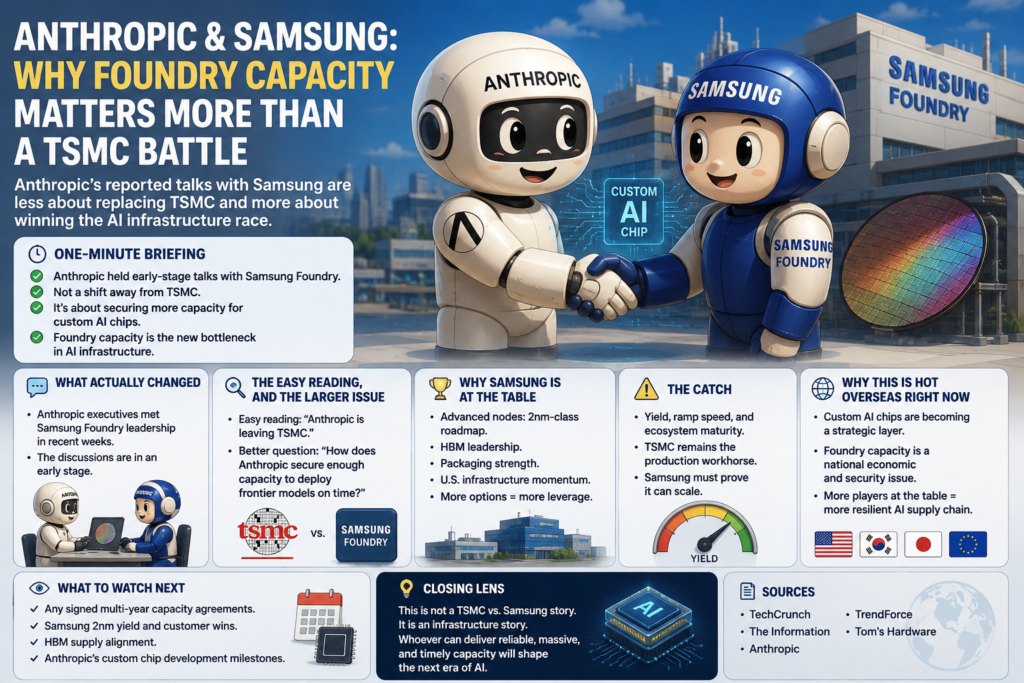
One-minute briefing
The report that Anthropic is discussing a custom AI chip collaboration with Samsung should not be read as a finished chip deal. After reading the coverage, I see it less as a Samsung-versus-TSMC headline and more as an early signal in a larger infrastructure shift. The important issue is not whether Samsung has “beaten” TSMC. It is why frontier AI companies are trying to widen their foundry and supply-chain options now.
The answer is capacity. TSMC remains the center of advanced foundry manufacturing, but AI accelerator demand is pushing leading-edge nodes, advanced packaging, memory supply, power, and data-center deployment into the same bottleneck. A strong supplier can still become a bottleneck if too many customers need the same scarce capacity at the same time.
That is why the Anthropic-Samsung report matters. It points to a world where AI companies are no longer only buyers of GPUs. They are becoming infrastructure planners, trying to shape the hardware, manufacturing, packaging, and deployment paths that determine how fast their models can scale.
This does not mean Samsung has already won a major AI chip customer. It means Samsung has a seat at a table that more AI companies may need to keep open.
What actually changed
On July 2, 2026, TechCrunch reported that Anthropic was in contact with Samsung to explore a possible collaboration on a custom AI chip, citing The Information. The same report noted an important caveat: Anthropic had not yet decided what the chip would be used for, how it would fit into a server, or how powerful it would need to be.
I would not skip that caveat, because it changes the story. A reported discussion is not the same thing as a design win, a tape-out, or a manufacturing contract. At this stage, the useful reading is not “Anthropic is about to ship a Samsung-made chip.” It is “Anthropic is examining more hardware paths because compute has become a strategic constraint.”
The timing also makes the story more interesting. Just one week earlier, OpenAI and Broadcom unveiled Jalapeno, a custom inference chip designed for large language model workloads. OpenAI said the chip reached tape-out in nine months and is intended for initial deployment by the end of 2026. Whether that target is met or not, the direction is clear: frontier AI labs are moving from buying accelerators to shaping their own compute stacks.
Anthropic is not starting from zero. In its May 28, 2026 Series H announcement, Anthropic said Samsung, SK hynix, and Micron joined as strategic infrastructure partners, alongside larger compute agreements with Amazon, Google, Broadcom, and SpaceX. That does not prove a Samsung chip deal. It does show that Anthropic’s compute strategy is now tied to a broader network of infrastructure partners, not only cloud GPU access.
The easy reading, and the larger issue
The easy reading is that AI companies are trying to reduce dependence on Nvidia. That is partly true, but it is not enough. The more I follow these AI infrastructure stories, the more the pattern looks less like a single-vendor replacement cycle and more like a fight over schedules, capacity, and optionality.
Nvidia remains central to AI training and inference, and there is no simple replacement for its software, systems, networking, and accelerator roadmap. But the AI infrastructure problem is no longer just about one chip vendor. As models grow and usage scales, the bottleneck spreads across foundry capacity, advanced packaging, HBM supply, power contracts, racks, networking, and data-center schedules.
That is why “Who replaces Nvidia?” or “Did Samsung beat TSMC?” is too narrow a frame. The underlying issue is how many credible manufacturing and deployment paths an AI company can keep alive.
In that frame, Samsung’s role looks different. It is not necessarily the strongest foundry option. TSMC still dominates leading-edge manufacturing. But when the leading option is crowded, a second credible option becomes strategically valuable. In a capacity-constrained market, optionality has value even before it becomes a signed contract.
Why Samsung is at the table
Samsung has two reasons to be relevant in this discussion.
First, Samsung can speak across more of the AI hardware stack than a pure-play foundry. It has logic manufacturing, memory, advanced packaging ambitions, and a strategic relationship with several AI infrastructure players. That does not make execution automatic, but it gives Samsung a broader conversation to have with customers whose bottlenecks span more than wafer production.
Second, TSMC’s strength creates its own pressure. TrendForce-linked reporting shows TSMC still holding roughly 72% of foundry revenue share in the first quarter of 2026. Tom’s Hardware also reported earlier comments from TSMC Chairman and CEO C.C. Wei that advanced-node capacity was still far short of what major AI customers wanted to consume. In plain terms: TSMC is dominant, but dominance does not create infinite capacity.
For an AI company, that changes the calculus. If the best supplier is overbooked, the alternative does not need to be perfect on day one. It needs to become good enough, fast enough, for a specific workload or product timeline.
That is the opening Samsung has. It is not a clean victory. It is a chance to prove that its advanced foundry roadmap can support real AI/HPC demand at the moment customers are looking for more options.
The catch: Samsung is an option, not a proven answer
The strongest version of this story would be misleading if it skipped Samsung’s execution risk.
Samsung’s 2nm yield reporting has been mixed. This is the part I would treat most carefully as a reader. A March 31 TrendForce article said sources indicated Samsung’s 2nm yields had topped 60% at the upper end. An April 14 TrendForce article, citing Korean reporting, said Samsung’s 2nm yields remained around the mid-50% range and below the rough threshold typically associated with stable mass production.
Those reports should not be treated as one clean number. They are snapshots from different sources and moments. The safe interpretation is that Samsung’s 2nm process is still being judged by the market, and the confidence level has not yet settled.
That distinction is important for readers. The Anthropic-Samsung report does not prove Samsung is already a validated replacement for TSMC. A more careful reading is that TSMC’s capacity pressure is giving Samsung another opportunity to be evaluated.
That is still meaningful. In semiconductors, a seat at the evaluation table can matter, especially when the customer is one of the companies driving the next wave of AI compute demand. But it is not the same as a production ramp.
Custom AI chips are becoming a schedule problem
The phrase “custom AI chip” can make the story sound more abstract than it is. The practical problem is schedule.
Can the chip be designed quickly enough? Can the foundry process meet performance and yield targets? Can packaging and memory be secured? Can the board, rack, networking, and data-center deployment happen on time? Can the software stack actually use the chip efficiently?
That is why the OpenAI-Broadcom Jalapeno announcement is useful as a comparison. OpenAI described Jalapeno as a custom inference platform that reached tape-out in nine months and is designed for initial deployment by the end of 2026. Anthropic’s reported Samsung discussion is much earlier. TechCrunch’s report says the chip’s purpose, server fit, and performance targets are still undecided.
Both stories use the language of custom chips, but they are at different maturity levels. OpenAI is describing a specific chip program. Anthropic is still exploring options.
That difference should shape the headline. The story is not “Anthropic has a Samsung chip.” The story is “Anthropic may need more control over its compute roadmap, and Samsung may be one of the paths it is testing.”
Why this is hot overseas right now
This topic is getting attention outside Korea because it sits at the intersection of three hot themes: AI compute scarcity, custom silicon, and advanced foundry capacity.
OpenAI’s Jalapeno announcement made custom AI chips more visible. Anthropic’s funding announcement highlighted how compute partnerships now sit beside financial investors. At the same time, foundry and packaging capacity remain under pressure as AI workloads compete for leading-edge manufacturing slots.
That makes the Samsung angle timely. It is not hot because every detail is confirmed. It is hot because the broader pattern is confirmed: major AI companies are trying to build more control into their infrastructure roadmaps.
The careful version of the story should keep both truths together. The macro trend is real. The specific Anthropic-Samsung chip path is still unconfirmed beyond the reporting stage.
What to watch next
The first thing to watch is whether Anthropic or Samsung confirms a design agreement, joint development program, or production timeline. Without that, the story remains an early-stage discussion.
The second variable is Samsung’s 2nm yield reporting. If future reports converge toward stable mass-production levels, Samsung’s negotiating position improves. If the numbers stay inconsistent, customers may continue to use Samsung as leverage rather than as a primary production path.
The third variable is advanced packaging. AI chips are not only about the front-end node. Packaging, memory integration, and high-bandwidth interconnects increasingly determine whether a chip can be deployed efficiently at scale.
The fourth variable is Anthropic’s internal hardware organization. A serious custom silicon program requires more than a supplier conversation. It requires architecture, systems, compiler, networking, deployment, and supply-chain expertise.
The fifth variable is TSMC’s response. If TSMC expands capacity, changes pricing, or prioritizes the largest AI customers more aggressively, the room for alternatives may shift again. Personally, this is the variable I would watch before treating any single Samsung-related report as a lasting change in the foundry map.
Closing lens
My takeaway is not that Samsung has defeated TSMC, or that Anthropic has solved its chip strategy. Both readings are too early.
A more grounded reading is that AI infrastructure has entered a capacity-management phase. Frontier AI companies need more than chips. They need manufacturing slots, packaging capacity, memory supply, power, racks, and deployment schedules that match their model roadmaps.
TSMC remains the center of the advanced foundry market. But when the center is crowded, credible alternatives become more valuable. Samsung’s opportunity is not to replace TSMC overnight. It is to prove, one customer and one process node at a time, that it can be part of the AI infrastructure map.
That is why the Anthropic-Samsung report is worth watching. The signal is early, but it is not empty.
Sources and verification notes
- TechCrunch, July 2, 2026: Anthropic is discussing a new custom chip with Samsung
- Anthropic, May 28, 2026: Anthropic raises $65B in Series H funding
- OpenAI, June 24, 2026: OpenAI and Broadcom unveil LLM-optimized inference chip
- TrendForce, January 29, 2026: Samsung Foundry reportedly expects 30%+ 2nm order growth
- TrendForce, March 31, 2026: Samsung 2nm yields reportedly top 60%
- TrendForce, April 14, 2026: Samsung 2nm yields reportedly around mid-50%
- TelecomLead, June 12, 2026: Q1 2026 foundry market, citing TrendForce
- Tom’s Hardware, November 25, 2025: TSMC advanced-node capacity falls short of AI demand
This article is for information and industry analysis only. It is not investment advice and does not recommend buying, selling, or holding any security. The Anthropic-Samsung chip discussion remains a reported, early-stage matter unless and until the companies confirm a formal design or manufacturing agreement.
