Thirty thousand cars. Ninety thousand parts. Sixty-five thousand hours. Those are the numbers the humanoid industry has led with over the past year, and they are real: Figure’s F.02 robots helped build more than 30,000 BMW X3s and loaded more than 90,000 sheet-metal parts across an eleven-month project at the Spartanburg plant, while Agility says Digit has accumulated more than 65,000 operating hours and has deployment commitments across nine customer facilities. Read together, they say humanoid robots stopped demonstrating and started working. But the harder question turns on humanoid robot battery life, not the control software: can one of them hold a shift?
The production question sits beside Hyundai’s Atlas factory validation and the hands-and-actuators constraint. The cell-side signal is Samsung SDI’s published solid-state sampling plan, which names a production target but not an energy-density figure.
The scoreboard everyone reads
A cumulative-hours total is a scoreboard, not a reliability spec. It sums every hour every unit ran, which is exactly what a vendor wants quoted and exactly what hides how much of any single shift a robot was actually up. Run the division the announcements skip. Figure’s 1,250-plus operational hours at BMW, at a stated 10-hour weekday shift, come to about 125 shifts – roughly 25 five-day work-weeks (calculated from the disclosed figures).
That is the equivalent of one station running a single daily shift for about six months, spread across an eleven-month deployment in which, by Figure’s own account, “full deployment” only began in month ten. Counted against a single one-shift schedule, that total is on the order of half the hours a person on that station would have been present. It is a workload ratio, not an availability figure: Figure disclosed neither the robot count nor achieved uptime, so how much of any given shift a unit was actually running remains unpublished.
None of that makes the work fake. Figure set a target of greater than 99% placement success per shift, placed parts within a five-millimeter tolerance in about two seconds, and reported minimal hardware failures over those 1,250 hours. The point is narrower and more useful: cumulative runtime measures accumulated operating exposure, while a continuous-shift decision turns on availability – the fraction of the shift the robot is actually running. Neither achieved availability nor achieved interventions per shift is disclosed; for interventions, the release gives only a goal of “zero per shift”.
Why the battery can’t just get bigger
Single-charge runtime has a physical constraint that control-model improvements alone cannot remove. It is the battery – specifically, the fact that a walking machine cannot carry much of one.
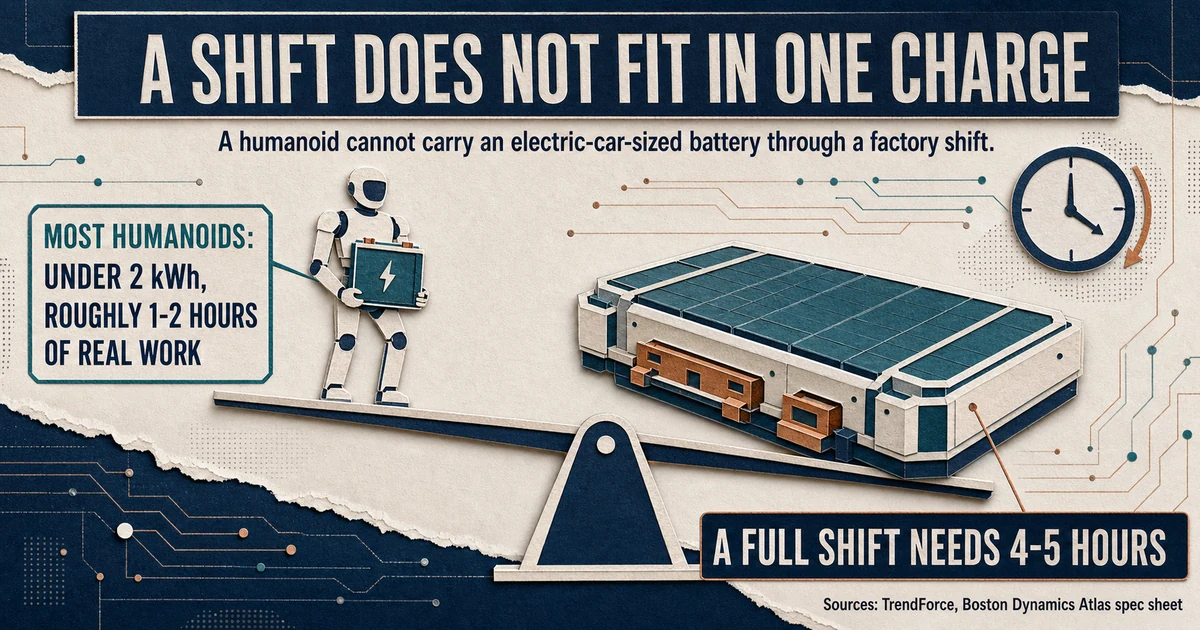
An electric car can carry a much larger battery pack because the pack sits low and the car does not have to balance on two feet. A humanoid does. A roughly 70-kilogram robot can allot only about 5 to 8 kilograms to its pack – a tenth or so of body weight – before the added mass raises its center of gravity, degrades walking stability, and makes the joint motors burn more current just to stay upright.
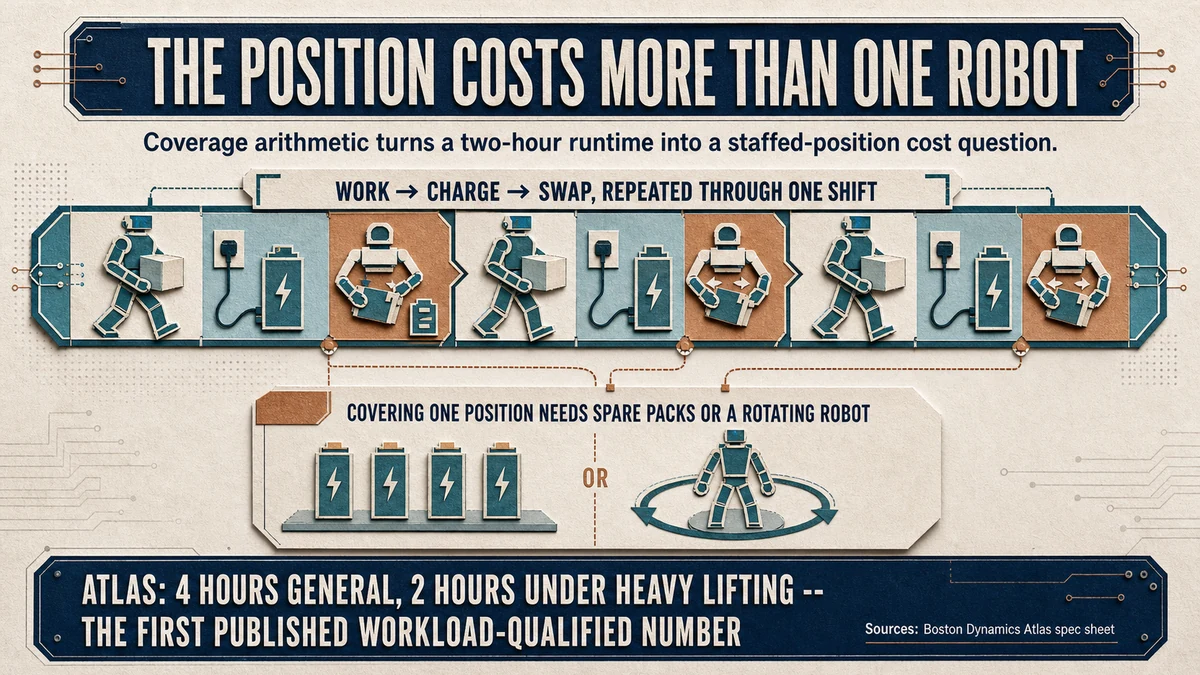
The result is a genuine paradox that engineers state plainly: past a point, adding battery makes the robot discharge faster, not last longer. So the pack stays small. Most humanoids ship with capacities under 2 kWh, which TrendForce puts at two to four hours of runtime with no workload stated, and for real manipulation work closer to one to two hours per charge — Tesla’s Optimus Gen2, on a 2.3-kWh system, manages around two hours of dynamic operation. Industrial deployment needs four to five hours of continuous work to stand in for a labor shift. The gap is not a rounding error — though three vendors now publish exactly that range on their own spec sheets: Boston Dynamics says 4 hours, Agility says 4, Figure says 5, and a reader who stops there would conclude the gap has already closed. None of the three names a workload. Boston Dynamics is the one maker that does, on the same sheet: Atlas is rated 4 hours in general and 2 hours specifically under heavy lifting, a runtime that halves the moment a real task is named. That is this article’s argument, published by a manufacturer.
It is also not a software problem, which is why a better model does not close it. The binding constraint is cell energy density: substituting for a shift needs cells around 350 Wh/kg, and today’s commercial lithium-ion sits near 250 to 300. That is a materials-science clock, and it ticks on its own schedule.
What a better control policy actually buys is now measured, not assumed. A physics-based model built from a real Unitree G1’s own battery-management system finds the robot draws 135 watts simply standing still — before a single joint does useful work. A separate hardware trial on a 30-kilogram open-source biped found that a passive-dynamics walking policy cut the electrical cost of moving one kilogram one meter by 31%, from a cost of transport of 1.13 down to 0.77, at a modest 0.3 metres per second. Both numbers describe motor-side mechanical draw, not the wall-plug total; add the 135-watt standing overhead back in and the gain shrinks further. Software can buy back real minutes. It has not been shown to buy back an hour.
Two answers to the same wall
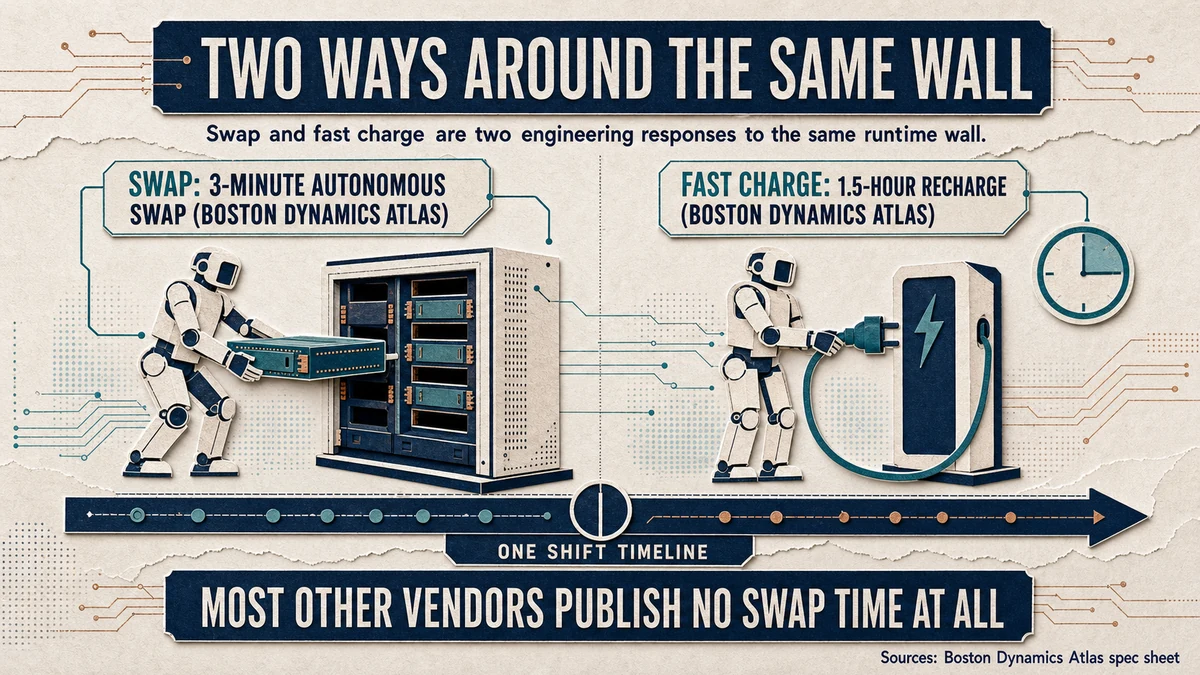
Here is the tell. Faced with the same wall, the serious makers have split into two camps – and both choices are admissions that one charge cannot hold a shift.
The first camp buys the hours back by exchanging the pack. UBTECH describes Walker S2 as the first humanoid capable of swapping its own batteries: it carries two battery bays, walks to a station, and uses tool attachments on the ends of its arms to pull a spent pack and seat a fresh one, a design intended to support near-continuous operation without manual battery replacement. It is not alone. Boston Dynamics’ own spec sheet rates Atlas for a three-minute autonomous swap and a 1.5-hour recharge; Unitree markets its G1 pack as quick-release but publishes no swap time for either the G1 or the H1, and the 30-second figure circulating for both comes only from resellers, not the company.
The second camp accepts a fixed pack and attacks charge time and heat instead: Tesla’s Optimus pairs its 2.3-kWh battery with a two-to-two-and-a-half-hour recharge from a standard 120V outlet, and Figure’s F03 adds 2-kilowatt fast charging and active cooling. Different engineering, same confession. When a product’s headline feature is how quickly it can stop working and start again, runtime is the constraint the whole design is bending around.
That reframes the unit economics under the “one robot replaces one worker” claim. At roughly two hours of work per charge, covering one continuous shift of the length Figure reports at BMW takes about five charge-cycles of coverage – meaning, per staffed position, either a swap station stocked with spare packs or a small rotation of units taking turns on the charger (estimated from the runtime and swap figures above). The robot may cost less per hour than a person; the staffed position quietly costs more than one robot.
What still stands
Take the strongest version of the optimistic case seriously, because it is strong. These are real hours in live plants, not staged demos: a greater-than-99% placement target, reported minimal failures, and a task cadence measured in seconds. The commercial pull is real too: Agility reports more than $300 million of multi-year orders and a pipeline past 30 customers, and Toyota’s Canadian plant added Digits to load and unload totes after a year-long pilot — though the unit count is trade reporting, not a company figure: Agility’s own announcement of the agreement states no robot number at all, and secondary coverage does not agree, some implying seven Digits in total and others seven added to an existing three.
A deployment that only reached full swing in its final months and still logged 1,250 hours is a fast-moving line, not a stalled one.
What survives the test is a more exact claim than either the hype or the backlash. Humanoids do real, repeatable production work, but they sit at limited deployment with partial-shift coverage, not at continuous-shift replacement. And the thing that promotes them one rung is not a smarter policy network; it is energy. That is why this constraint ripples outward.
It hands battery-cell makers a new premium demand class – TrendForce projects humanoid solid-state demand past 74 GWh by 2035, a more than 1,000-fold increase from 2026 – and it is why Samsung SDI is sampling a pouch solid-state cell aimed at physical-AI robots for mass production in the second half of 2027. It reshapes the factory floor plan, since swap stations and charger banks are new fixed infrastructure a line has to be designed around.
And it resets the near-term labor math: while a position needs either rotating units or spare packs and charging infrastructure, the humanoid augments a shift rather than automatically deleting a headcount from it.
This is the same pattern this desk has traced at the robot’s hands and actuators and its robot skin and tactile sensing: the humanoid’s limits keep turning out to be physical parts, not the intelligence running them. Energy is simply the biggest of those parts, because it gates how long everything else gets to work.
The cell makers have already chosen sides
If the wall is in the cell, the interesting question is who supplies it — and that has been quietly settled while the robot makers took the headlines. LG Energy Solution has secured battery supply agreements with the three largest US humanoid developers, Figure AI and Boston Dynamics among them, and is reported to be preparing cells for Tesla’s Optimus; it is also named as exclusive supplier of 2170 cylindrical cells for Bear Robotics’ service platforms. Samsung SDI took the other side of the same bet: a robot-specific development programme with Hyundai Motor and Kia announced in February 2025, aimed squarely at the packaging problem this article describes, and a pouch-type solid-state cell scheduled for mass production in 2027 and named for humanoid use. Panasonic, CATL, BYD and EVE are working the same lane, with Chinese suppliers pushing semi-solid and solid-state roadmaps for robots and drones.
That division of labour is worth reading carefully, because the two Korean makers are not competing for the same year. LG Energy Solution is winning the robots being built now, on cells that exist now, at the energy density this article calls insufficient for a shift. Samsung SDI is not trying to win that fight; it is selling the discontinuity, and its 2027 date is the earliest moment the arithmetic changes. A supplier list is not a runtime figure, and neither company has published a robot-pack energy density or cycle life. But it does answer a question the demo videos avoid: the value here accrues to whoever makes the cell, not to whoever assembles the robot around it — and on today’s cells, that is a decision already made.
The packaging constraint explains why this is not simply a matter of buying bigger cells. A humanoid has to fit its pack into less than a tenth of its body surface, in the back and chest, while staying light enough to carry itself. That is the physical reason a car-grade solution does not port across, and the reason a cell chemistry improvement matters more here than in any vehicle: the robot cannot solve the problem with volume.
Bottom Line
The humanoid race is being scored on cumulative hours, but it will be decided on the hours a machine can string together without stopping – and that number is set in a battery cell, not a neural network. Watch for the first vendor to publish single-charge availability at a named site, for a swap standard to consolidate into a shared dock, and for Samsung SDI’s 2027 solid-state target to turn into actual robot-cell shipments; whoever sells back the missing hours first, by the pack or by the swap, captures the layer the demo videos never show.
A cell chemistry keeps its own schedule, so the useful checkpoints are disclosures rather than launches. Four are due.
- A second vendor qualifies its runtime. Boston Dynamics is currently alone in publishing a workload-qualified figure — 4 hours in general, 2 under heavy lifting. If Figure, Agility or Tesla restates its runtime with a named workload attached rather than a bare hour count, the disclosure norm has moved. If the bare numbers persist, every published runtime should keep being read as a ceiling rather than a shift.
- Samsung SDI’s 2027 date acquires a number. A production target is not an energy density. The test is whether the solid-state programme reaches a stated Wh/kg and cycle life for a robot pack, not a vehicle one. Without those two figures the 2027 milestone cannot be checked against the roughly 350 Wh/kg a full shift is estimated to require.
- The swap converges or it does not. Atlas publishes a three-minute autonomous swap; most other makers publish no swap time at all. If two or more vendors adopt a shared dock geometry or a common pack form factor, swapping becomes infrastructure and a third-party market opens beneath it. If every maker keeps its own dock, the swap stays a per-vendor feature and coverage cost stays hidden inside each deployment.
- A robot-cell business appears in the numbers. Cell makers report by segment. If LG Energy Solution or Samsung SDI begins breaking out robotics revenue — or naming a robot customer in results rather than a press release — the category has crossed from design win to shipped volume. If it stays inside “other applications” through 2027, the supply agreements are still options rather than orders.
Sources
- KED Global — Trade reporting, not company disclosure: LG Energy Solution battery supply agreements with the three largest US humanoid robot makers, including Figure AI and Boston Dynamics, and preparation to supply Tesla’s Optimus; exclusive 2170 cylindrical supply for Bear Robotics platforms (2026-07-02)
- AJU Press — InterBattery 2026: Samsung SDI robot-optimized battery development with Hyundai Motor and Kia announced February 2025; pouch-type solid-state cell scheduled for mass production in 2027 and named for humanoid use; humanoid packs must fit within under 10% of body surface (2026-03-11)
- Figure AI — F.02 at BMW Spartanburg: 30,000+ X3s, 90,000+ parts, 1,250+ hours, >99% placement target, zero-intervention goal (never an achieved value) (2025-11-19)
- Agility Robotics — Digit: 65,000+ hours across nine facilities, $300M+ Digit v5 orders, 30+ customer pipeline (2026)
- Boston Dynamics — Atlas sales sheet: battery life 4 hours general, 2 hours under heavy lifting; 3-minute autonomous swap, 1.5-hour recharge (2025-12-23)
- Figure AI — F.03 battery: 2.3 kWh enabling 5 hours ‘at peak performance’ (no workload named), 2 kW fast charge with active cooling (2025-07-17)
- Deniz et al. (arXiv:2606.15915) — Measured 135W at-rest power draw on a physical Unitree G1 via its own battery-management system (2026-06-14)
View all sources
- Unitree — G1 spec: 9000mAh 13-string pack (~0.42-0.43 kWh), ‘About 2h’ endurance with no workload stated, no swap-time figure (2026)
- Unitree — H1 spec: 864 Wh pack; no battery-life or swap-time figure published (2026)
- Agility Robotics — Toyota Motor Manufacturing Canada agreement following a pilot; no robot count stated (2026-02-19)
- Samsung SDI — Pouch all-solid-state cell sampling for humanoid and robotic platforms, mass production targeted for the second half of 2027; no Wh/kg or capacity figure published (2026-03-09)
- Xia et al., The Duke Humanoid (arXiv:2409.19795) — Hardware cost-of-transport measurement: 1.13 to 0.77 (31% reduction) at 0.3 m/s on a 30kg open-source biped, mechanical power only (2024-09-29)
- Seoul Economic Daily — Pack-mass ceiling of roughly 5 to 8 kg on a ~70 kg humanoid; one to two hours per charge in real manipulation work against the four-to-five-hour shift requirement; cell energy density of about 350 Wh/kg needed against 250 to 300 Wh/kg commercially available today (2026-05-20)
- TrendForce — Two-to-four-hour runtime estimate for sub-2 kWh humanoid packs, with no workload condition stated; humanoid solid-state demand projected past 74 GWh by 2035 (market estimate) (2026-01-28)
- New Atlas — UBTECH Walker S2: two battery bays and arm-mounted tool attachments for autonomous pack exchange, described as supporting near-continuous operation (2025)
- Digital Today — Tesla Optimus Gen2: 2.3 kWh system, around two hours of dynamic operation, two-to-two-and-a-half-hour recharge from a standard 120V outlet (2026)
- Agility Robotics — Digit product page: 4-hour runtime listed with no workload condition stated (accessed 2026-08-04)
- The Robot Report — Secondary coverage of the Toyota Motor Manufacturing Canada deployment; unit counts in secondary reporting do not agree and the company announcement states none (2026-02)
This article is for informational and educational purposes only and does not constitute investment, financial, or legal advice.