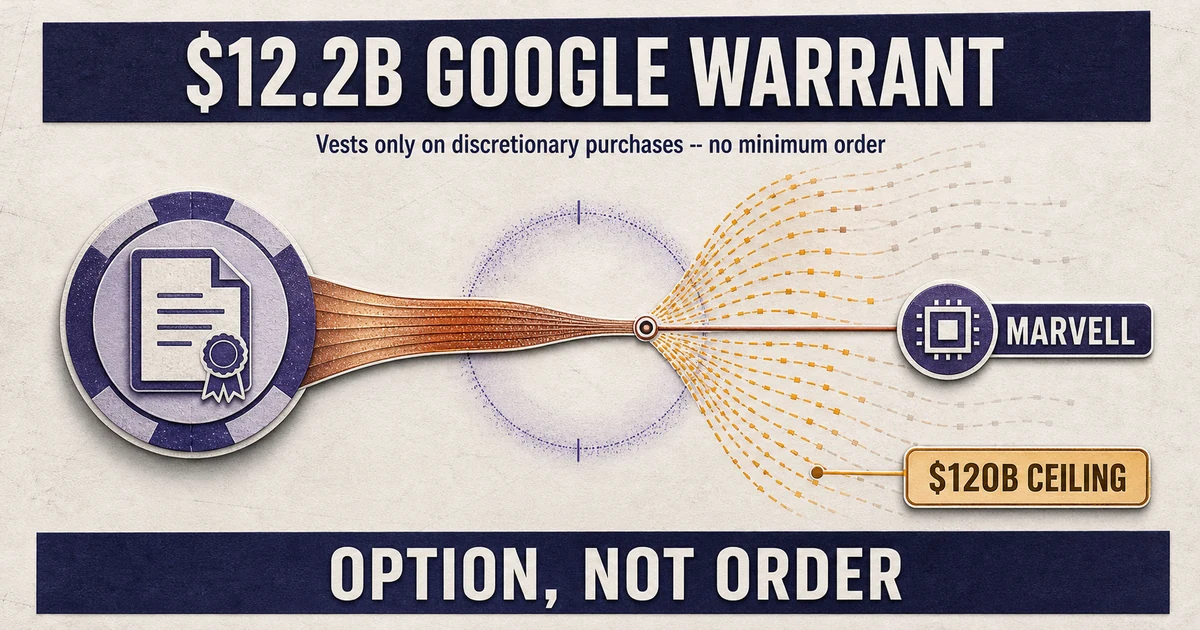
On August 18, Marvell's stock jumped as much as 13% on news that Google had received a warrant worth up to $12.2 billion tied to a custom-chip agreement. Broadcom's stock fell about 3% the same day. Nothing in the filing that moved Marvell's price touches Broadcom's own business with Google – it still designs and supplies the Tensor Processing Unit itself, under an arrangement reported to run through 2031. Broadcom investors priced in a loss the filing does not describe.
The Word Doing the Real Work Is "Discretionary"
Start with what Marvell actually filed. On July 29, 2026, Marvell and Google signed a commercial agreement covering silicon that "attaches to" Google's TPU ecosystem – AI inference accelerators, storage controllers, network interface controllers, memory interface controllers, and near-memory compute. Three weeks later, Marvell issued Google a warrant for up to 58,970,907 shares at $206.58 apiece, exercisable until August 18, 2033. Only a sliver of that – 1,360,867 shares, 2.3% of the total – vests on a fixed calendar.
The other 97.7% vests in 240 equal tranches, one for every $500 million of "Custom Products" revenue Marvell books from Google between Marvell's third fiscal quarter of 2027 and the end of fiscal 2033. Full vesting requires $120 billion in cumulative purchases.
Nowhere in that structure is a number Google has agreed to buy. The filing's own language calls the qualifying purchases "discretionary". Nothing Marvell has filed – not the 8-K, not the warrant itself – sets a minimum order, a volume floor, or an exclusivity clause. The warrant fixes the measuring window precisely: August 1, 2026 through January 29, 2033.
Spread the $120 billion ceiling across those 6.5 years and it implies an average pace near $18.5 billion a year in periphery-silicon purchases alone – a rate neither company has committed to hit, and one that cannot even begin registering until Marvell's Q3 FY2027 books its first qualifying dollar. The $12.2 billion in every headline prices a stake in Marvell, not an order for Marvell's silicon.
Two Different Products, Wearing One Number
The confusion compounds because three companies now sit inside the same sentence doing three different jobs. Broadcom designs and supplies the TPU compute die – the actual accelerator – under terms this news did not touch. Marvell supplies the silicon around it: the accelerators, controllers, and interconnects that move data in and out, a real and growing business, but not the chip Google's models run on. Google, for its part, gains a second supplier for the periphery without giving up anything binding in return.
A deal that reads as "Google just committed $120 billion to Marvell" is, on the filing's own terms, closer to "Google bought the option to keep giving Marvell more business if it wants to, at a discount Marvell is willing to pre-pay for in equity."
A Second Number, Flattened the Same Way
Eleven days earlier, on Microsoft's July 29 earnings call – the same day Marvell and Google signed their agreement – Satya Nadella made a claim that has been recirculated ever since as "Microsoft's AI chips deliver 40% efficiency gains." What he actually said was narrower and came packaged with at least three other numbers that most coverage dropped. "Maia 200 continues to scale," Nadella told investors.
"It delivers 30% better performance per dollar than the latest-generation hardware in our fleet and is now supporting both OpenAI and MAI models." Separately: "we are seeing 40% better performance per watt when running MAI models on Maia 200". The 40% figure is a per-watt ratio, specific to Microsoft's own MAI models, measured against Microsoft's own prior chip generation – not against Nvidia, and not a customer-facing price. Neither Nadella nor CFO Amy Hood disclosed what share of Azure's AI compute-hours actually run on Maia versus rented Nvidia GPUs.
The same call held a fourth number that is arguably the most useful one and got the least attention: Microsoft said swapping to its own smaller models cut "89% reduction of GPU costs in Dynamics 365 with MAI-Voice-2-Flash and up to 84% reduced GPU costs in PowerPoint with MAI-Image-2.5". That is a real, model-level cost cut visible in shipped products – a different axis entirely from the chip-hardware ratio, and closer to what a signature cost comparison for this category should look like.
It went almost unmentioned in the weeks of coverage that instead re-ran the "40% efficiency" line on August 5, 7, and 18 as if it were new news each time.
Line the actual claims up against what a reader would need to trust the headline version, and the gaps are specific, not vague:
| What moved the market | What it actually measures | What's missing | Information level |
|---|---|---|---|
| Marvell's "$12.2B / $120B" Google deal | A warrant's maximum value if Google buys $120B of periphery silicon by FY2033 | Any binding minimum purchase; a reported first quarter of qualifying revenue | Confirmed (terms), not disclosed (actual purchase pace) |
| Microsoft's "40% efficiency" Maia claim | Performance-per-watt for Microsoft's own MAI models on Maia 200 vs. its prior fleet | Azure fleet-share running on Maia vs. Nvidia; any customer-facing price change | Confirmed (internal ratio), not disclosed (fleet-share, pricing) |
| Microsoft's 89%/84% GPU-cost cuts | Cost of running Dynamics 365 / PowerPoint after switching to smaller in-house models | Whether this reflects model choice, chip choice, or both | Confirmed (product-level), not decomposed by cause |
The Discount Shows Up Again, Higher in the Stack
This desk has made a version of this argument three times already this summer, each time finding the same gap in a different part of the AI buildout. On July 29, the finding was that utilities plan for far less data-center load than the interconnection request books describe – announced gigawatts overstate real demand. On August 19, the finding was that the workaround for that energization gap, on-site power generation, is itself gated by a second, mostly invisible permitting queue, so even the workaround's own numbers need discounting.
This week's evidence shows the same gap appearing somewhere neither prior piece checked: not in physical capacity at all, but inside the paper terms of a chip-supply contract and inside a single earnings call's own choice of which ratio to lead with. Across power, capex, and now silicon contracts, the announced figure is consistently the ceiling, not the floor.
What Nobody Has Disclosed Yet
None of this means the underlying trend is fake. A warrant this large is not free for Marvell to grant, and Google would not accept the dilution exposure without a real expectation of future business – optionality has value even before it is exercised. And the pattern is broader than one deal: this desk noted on August 4 that Meta's Iris chip made it the fourth of five hyperscalers now running some form of custom AI silicon, all still bound to TSMC for fabrication and to Nvidia for the workloads too unpredictable to hand to a first-generation in-house chip.
Google widening beyond Broadcom and Microsoft going fully in-house with Maia are two more data points in that same multi-year shift, not evidence against it.
What would actually confirm this quarter's specific numbers, rather than just the general direction, is narrow and checkable: Marvell's first reportable quarter of Custom Products revenue from Google, once its Q3 FY2027 arrives, tracking anywhere near the $18.75-billion-a-year pace the warrant's own math implies – or Microsoft, at some future call, disclosing what fraction of Azure's AI workload actually runs on Maia instead of another performance-per-watt figure measured against itself.
Until one of those numbers shows up, the $12.2 billion and the 40% are both real quotes from real documents, describing something considerably narrower than what moved two stocks and one earnings narrative this month.
Sources
- futurumgroup.com — Marvell-Google commercial agreement scope (July 29, 2026); Broadcom's TPU contract reported to run through 2031, unaffected by this deal (2026-08-20)
- digitalapplied.com — Warrant mechanics: 58,970,907 shares, $206.58 exercise price, Aug 18 2033 expiration, 240-tranche/$500M vesting schedule, "discretionary" purchase language, no minimum (2026-08-19)
- 247wallst.com — Marvell +13% / Broadcom -3% stock moves on the warrant news (2026-08-19)
- microsoft.com — Nadella's Maia 200 quotes: 30% performance-per-dollar vs. fleet, 40% performance-per-watt on MAI models; no fleet-share disclosed (2026-07-29)
View all sources
- fool.com — Recirculation pattern: the same "40% efficiency" headline republished Aug 5, 7, and 18 across syndicated outlets (2026-08-18)
- Ai Phantom Gigawatts — This desk's prior analysis: announced AI data-center power demand overstates utility-committed capacity (2026-07-29)
- Data Center Fuel Cell Permitting Workaround — This desk's prior analysis: the on-site-power workaround is bottlenecked by a second permitting queue (2026-08-19)
- sec.gov — Marvell's own Form 8-K: the July 29 2026 agreement and its scope, 58,970,907 warrant shares at $206.58, 1,360,867 time-based shares vesting quarterly over the first year, 240 tranches of $500 million in Custom Products revenue, the "discretionary purchases" language, and the August 18 2033 expiration (2026-08-19)
- sec.gov — Exhibit 4.1, the warrant itself: Measuring Period defined as August 1 2026 through January 29 2033; 57,610,040 performance-based shares split 240,042 x 239 plus 240,002; Qualifying Revenue defined as GAAP revenue net of rebates, refunds, credits and returns, limited to the Qualifying Products listed in its Exhibit A (2026-08-18)
- Meta Iris Ai Chip — This desk's prior analysis: five hyperscalers now running custom AI silicon, all still bound to TSMC and Nvidia (2026-08-04)
This article is for informational and educational purposes only and does not constitute investment, financial, or legal advice.