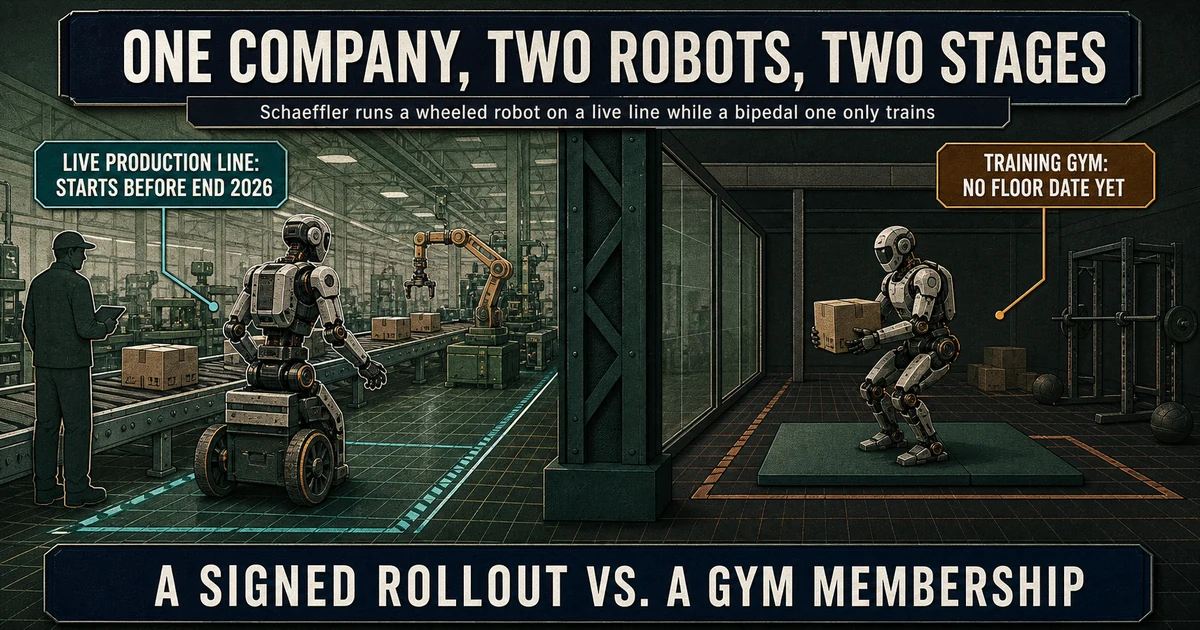
In a converted hall in Germany, a humanoid robot named AEON is learning to pick up a pallet box, over and over, under camera light that has nothing to do with a product launch. Hexagon calls the building a "Humanoid Gym." A short drive away, at a different Schaeffler site, a different robot – this one rolling on wheels, not walking on legs – already has a production line waiting for it, with a date on the calendar before this year is out.
Same company. Same industry. Two robots, at two visibly different stages of readiness, inside the same eight months of announcements. That gap is worth more than either press release on its own.
Three Deals, One Company, Three Different Kinds of Promise
Schaeffler makes bearings and, increasingly, the actuators and gearboxes that let a robot's joint move at all – a business it has quietly built into every major industrial market for a decade. This year it placed three separate bets on humanoid robots, and the three bets do not read the same way at all.
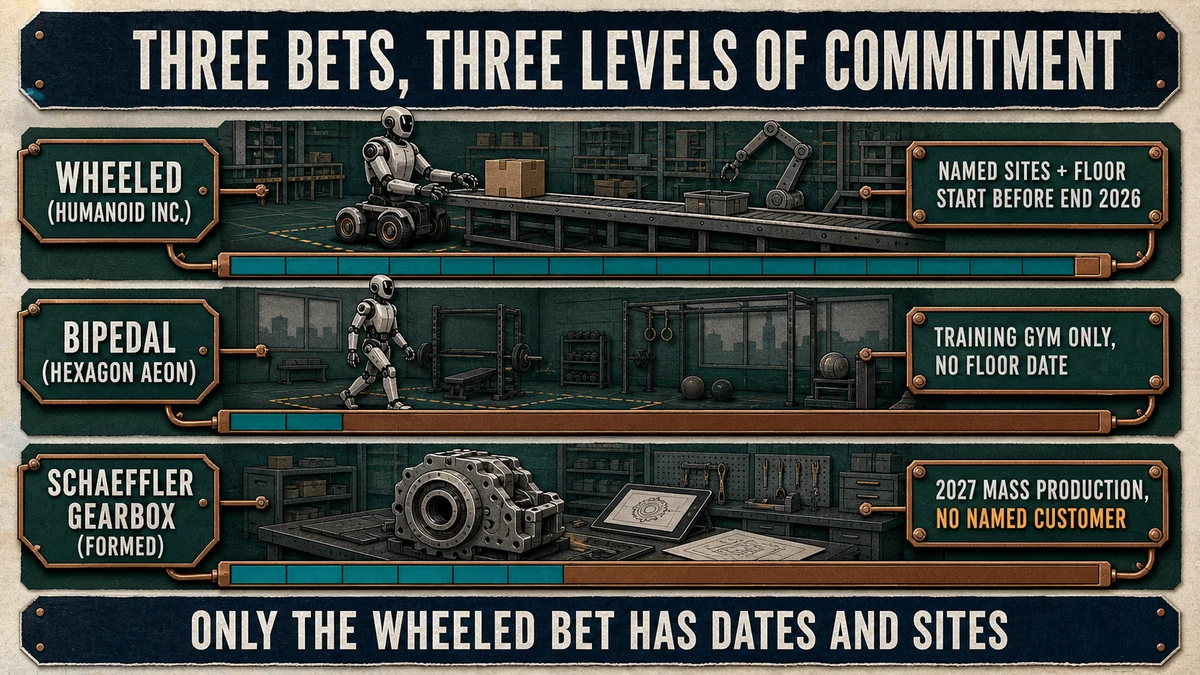
The most concrete one involves no legs. In January, Schaeffler agreed to deploy a four-digit number of wheeled humanoids – outside reporting narrows that to roughly 1,000 to 2,000 – built by the UK startup Humanoid Inc., across its global factories by 2032. This is not a pilot in the loose sense the industry usually means.
It names two German sites: Herzogenaurach, where the robots go straight into box-handling on a live production line, and Schweinfurt, running a six-month sequence – three months of capability testing, three months validating "stable, continuous operation approaching full production scale" – from December 2026 to June 2027. The first machines are due to be working before the end of this year. Schaeffler also becomes Humanoid Inc.'s preferred actuator supplier, covering more than half its demand through 2031.
The second bet walks on two legs, and it is much earlier. In April, Schaeffler committed to putting at least 1,000 of Hexagon's AEON humanoids – a 165-centimeter, 34-degree-of-freedom bipedal platform – into its factories by 2032. Through mid-August, what actually exists of that commitment is a training facility. AEON is being taught tasks there through imitation learning and repeated practice, with no production-floor start date, no unit count for a first wave, and no published success rate for the training itself.
The third bet is Schaeffler betting on itself. It has developed a way to press, rather than machine, the strain-wave gearboxes that sit inside a humanoid's joints – cutting manufacturing cost by more than 25 percent and material use by more than 75 percent, according to the company, with mass production starting in Germany in 2027. Schaeffler says the formed gearboxes reach "comparable torques and efficiencies" to the machined ones it has already shipped more than 2 million of over the past decade. It names no specific humanoid-maker customer for this new process beyond its own two pilots.
Lay the three side by side and a pattern falls out that none of Schaeffler's own announcements states: dates and named sites for the wheeled robot, a gym membership for the bipedal one, and a manufacturing claim with no customer attached for the part supposed to make both possible.
Why the Wheels Got There First
The gap is not a branding accident. Humanoid Inc.'s own case for wheels is a control-engineering argument: on a factory floor doing box handling, tote logistics and container transfer, a robot does not need legs, and a bipedal system spends a real share of its control budget simply staying upright rather than doing the work in front of it. A wheeled base is mechanically simpler, and reporting on the deal also ties it to an easier path toward CE safety certification, which Humanoid Inc. is targeting for 2027. None of that makes bipedal humanoids a mistake.
It says that for the narrow, structured task Schaeffler is paying for first, legs are the harder and slower way to get there – and Schaeffler, spending its own factory floor space on the answer, picked the easier one to move first.
Bipedal locomotion still matters for the tasks a wheeled base genuinely cannot reach – stairs, uneven ground, environments built for human bodies rather than factory aisles. Schaeffler is not choosing between the two forms; it is running both experiments on its own property at once, which is itself informative. A company confident the wheeled bet would win outright would not also be paying to train a second, bipedal robot inside its own walls.
The Number Neither Robot's Paperwork Contains
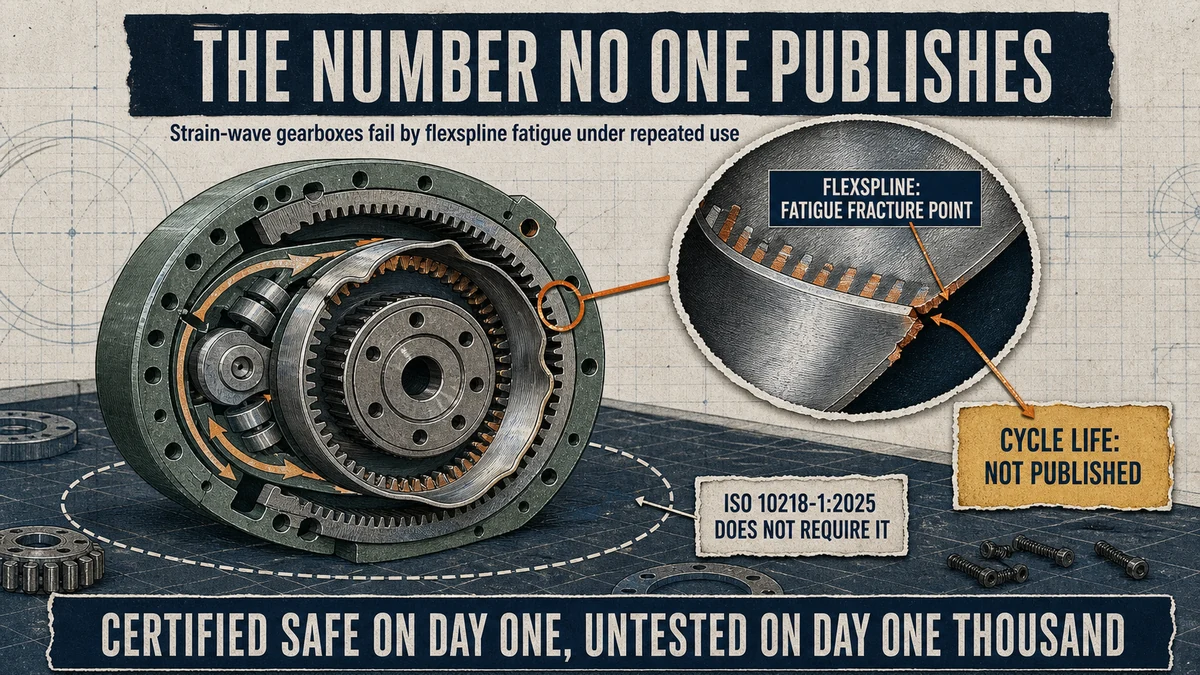
Here is what the wheeled deal's specificity does not cover: how long the actuator survives. Strain-wave gearboxes – the component family in both Schaeffler's own manufacturing claim and, in some form, most humanoid joints – fail primarily through fatigue fracture of the flexspline, the thin steel cup that flexes on every actuation. That failure mode is driven by cyclic stress, meaning it accumulates with repeated use rather than showing up on a single load test.
"Validation testing concluded" and "comparable torques and efficiencies" – Schaeffler's own language for the new gearbox – describe a part that performs, not one whose service life under a robot's real duty cycle has been published anywhere.
Nor does any safety standard currently require that disclosure. ISO 10218-1, the standard just updated in 2025 to cover this generation of industrial and collaborative robots, scopes itself entirely to eliminating or reducing hazard – inherent safe design, protective measures, information for use. It says nothing about how many cycles a joint should survive before it is retired. A robot can be certified safe on day one without anyone being required to say what happens on day one thousand.
This is not a Schaeffler-specific gap. Boston Dynamics – the humanoid maker that publishes more technical detail than almost anyone in the category – lists Atlas's battery life, payload, IP rating and degrees of freedom on its own product page, and states plainly that Atlas is in "field testing" at a Hyundai facility, not production deployment. There is no uptime figure, no duty-cycle number, no mean-time-between-failure statistic anywhere on that page either. If the most spec-transparent company in humanoid robotics does not publish the number, it is fair to assume nobody currently can.
What This Does to a Question This Desk Has Been Asking
This desk's running argument through 2026 has been that humanoid deployment is gated less by intelligence than by hardware: actuators and hands, not the control model, decide whether a robot lasts on a real task. Schaeffler's wheeled deal sharpens that claim rather than settling it. It shows a supplier willing to name dates and sites is choosing the mechanically simpler form first – evidence that the actuator problem is easier to solve for wheels than for legs, not that it is solved for either.
Boston Dynamics' own Atlas program, still at the field-testing stage after years of development and now owned by a company – Hyundai – that has put a real production timeline on it only for a US plant in 2028, tells the same story from the leg side: even a well-funded, technically advanced bipedal program has not converted "impressive demo" into "dated commercial rollout" the way Schaeffler's wheeled deal already has.
The honest counter is that none of this proves the wheeled bet is right, only that it is further along. A four-digit unit commitment with named sites can still fail on the factory floor in ways a training gym never reveals – box handling in a live line will surface failures a demo never would. If Herzogenaurach's line is not running on schedule by early 2027, or if Hexagon publishes a real deployment date for AEON before then, the ranking in the table above reverses.
Bottom Line
The most concrete evidence of humanoid robotics' maturity this year is not a robot that ran a marathon or lost a fight to a human boxer. It is a bearing company that has decided which of its own bets is safe enough to put on a live production line first, and which one still needs a gym. Watch two dates: whether Schaeffler's Herzogenaurach box-handling line actually goes live before the end of 2026 as promised, and whether Schaeffler's formed strain-wave gearbox reaches mass production in Germany in 2027 on schedule.
Either slipping would say the wheeled lead is softer than the paperwork suggests. Neither slipping, and the still-missing cycle-life number stays the same unanswered question it is today – just asked of a robot that is actually working, instead of one still on the mat.
Sources
- roboticsandautomationnews.com — Robotics & Automation News: Hexagon-Schaeffler April 2026 partnership terms and the August "Humanoid Gym" training launch, "Train-Validate-Deploy" model, no disclosed factory-floor start date. (2026-08-19)
- thehumanoid.ai — Humanoid Inc.: wheeled HMND 01 rollout terms, named sites (Herzogenaurach, Schweinfurt), December 2026-June 2027 timeline, actuator supply terms (company announcement). (2026-01)
- therobotreport.com — The Robot Report: Schaeffler's decade of strain-wave gearbox supply, the new formed-gearbox process, cost/material reduction figures and 2027 mass-production timeline. (2026-08-14)
- interestingengineering.com — Interesting Engineering: independent corroboration narrowing the deployment figure to roughly 1,000-2,000 wheeled units. (2026)
View all sources
- electronics360.globalspec.com — Electronics360: AEON specifications (height, weight, degrees of freedom, payload, onboard compute). (2026)
- interestingengineering.com — Interesting Engineering: Humanoid Inc.'s stated rationale for a wheeled base over bipedal (control budget, CE certification path). (2026)
- ieeexplore.ieee.org — IEEE: flexspline fatigue fracture as the dominant failure mode in harmonic/strain-wave gear drives under cyclic loading. (2021)
- iso.org — ISO: ISO 10218-1:2025 scope, limited to hazard elimination and safety, not durability or fatigue life. (2025)
- bostondynamics.com — Boston Dynamics: Atlas specifications and "field testing" status at a Hyundai facility; absence of uptime/duty-cycle/MTBF figures. (2026)
- Humanoid Robot Brains Are Nearly Solved The Hands And — This desk's prior reporting: actuators and hands, not control models, gate humanoid deployment. (2026-08-04)
This article is for informational and educational purposes only and does not constitute investment, financial, or legal advice.