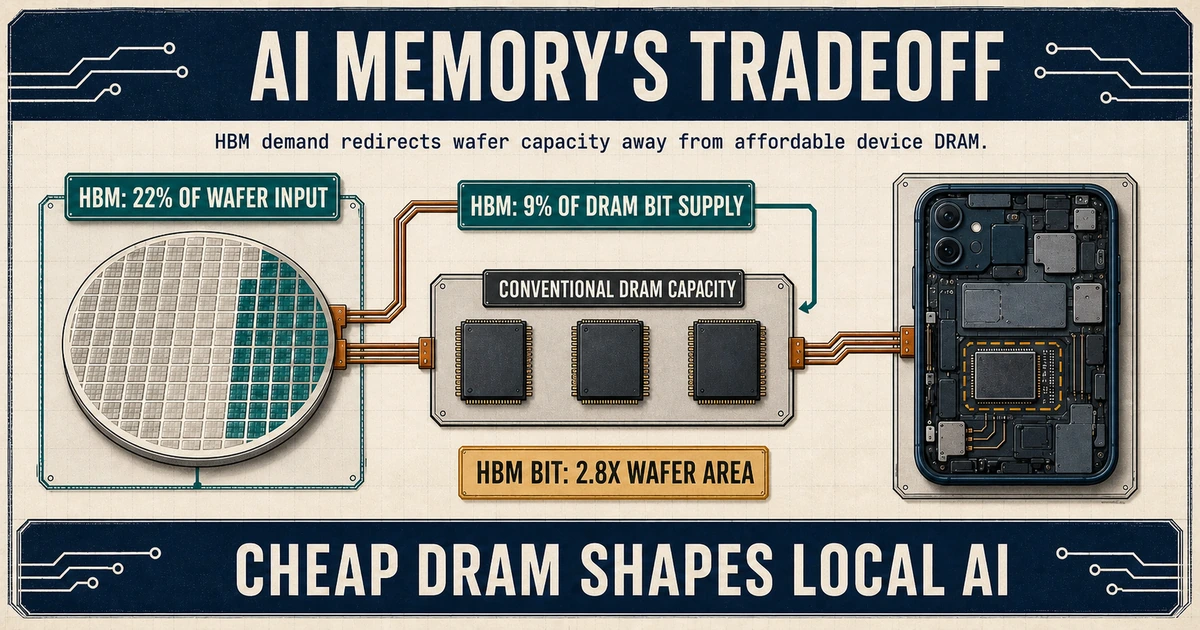
The DRAM shortage of 2026 is being read as a story about expensive laptops. But the same AI boom is quietly rationing the cheap DRAM that on-device AI needs.
The Wafer Reallocation Behind the Shortage
For most of the last decade, DRAM was the commodity you could count on getting cheaper, the input that let each new phone and server generation carry more memory for the same money. In 2026 that assumption broke. TrendForce recorded conventional DRAM contract prices rising roughly 93-98% quarter-on-quarter in Q1 2026 and a further roughly 58-63% in Q2. It then reported that Samsung was seeking as much as another 20% for Q3, with LPDDR mobile parts possibly rising more.
On TrendForce’s cumulative measure, the move since late 2025 was on the order of 340%, meaning contract prices were roughly 4.4 times late-2025 levels. Those are reported contract-market figures, not a claim that every customer or DRAM product paid an identical price.
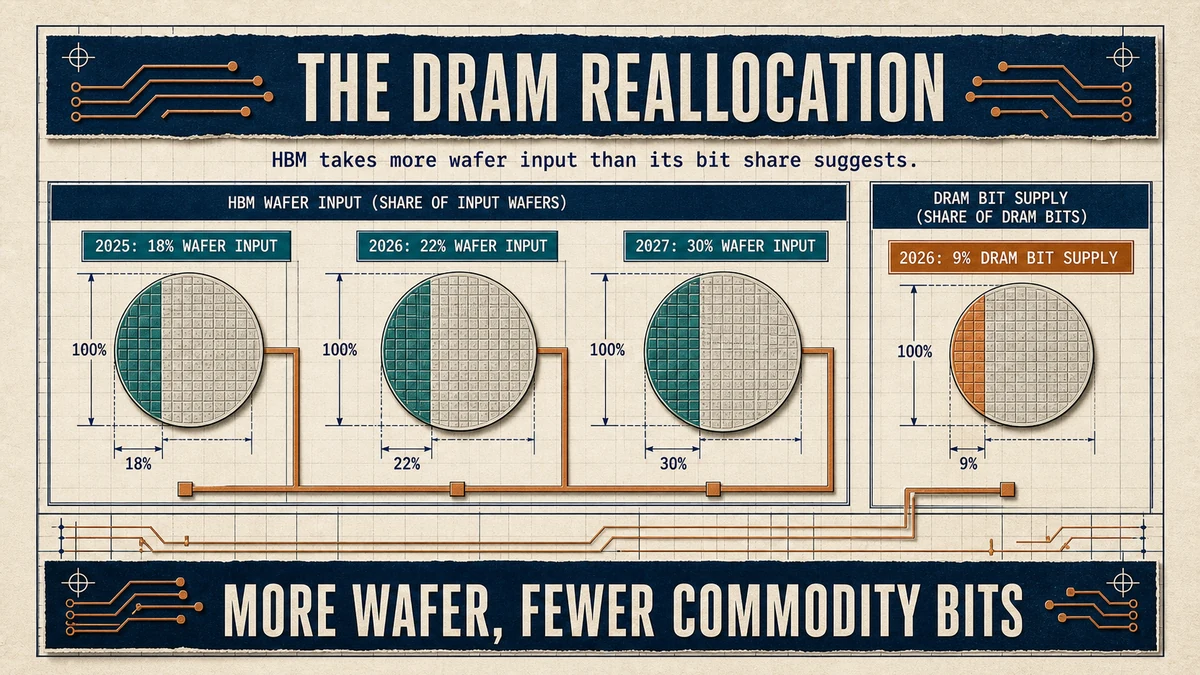
The cause was not presented as a fab fire or a conventional PC demand spike. The moving bottleneck began with a deliberate reallocation of wafer input toward high-bandwidth memory for AI accelerators. TrendForce projected HBM rising from roughly 18% of the top three suppliers’ total DRAM wafer input at the end of 2025 to roughly 22% at the end of 2026 and roughly 30% at the end of 2027. S&P Global characterized the resulting squeeze on legacy DRAM as structural and expected supply to stay tight through 2027 as AI demand outran wafer expansion.
The simplified allocation ladder puts HBM first, server DDR5 second, and mobile DRAM roughly third. That ordering is an interpretation based on pricing power and contract visibility, not a supplier-disclosed allocation policy. Hyperscalers such as Meta, Google, Microsoft, and Amazon can support large, long-duration commitments. Micron was reported to have signed around 16 take-or-pay agreements with price floors and non-cancelable terms extending beyond 2027. Consumer-device makers compete for the capacity left after those higher-value commitments.
Why HBM Consumes More Than Its Bit Share Suggests
HBM looks small in bit-volume terms and large in wafer terms. TrendForce put it at about 9% of DRAM bit supply in 2026 but roughly 22% of wafer input by the end of the year. The reason is physical. A conventional DDR5 package uses a single DRAM die, while an HBM product stacks eight, twelve, or sixteen DRAM dies over a logic base die and connects them with thousands of through-silicon vias.
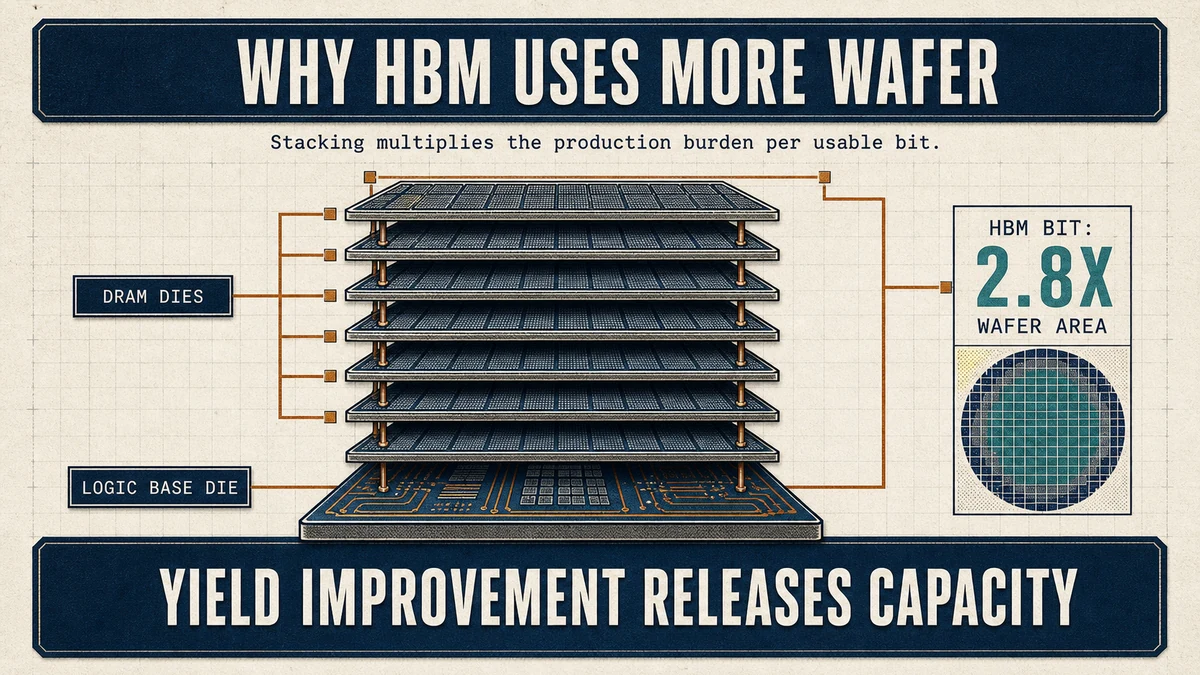
The stack removes one problem for AI accelerators: it places far more memory bandwidth close to the processor. But it creates tighter yield and assembly requirements. Multiple suitable dies must be fabricated, tested, handled, bonded, and assembled into a working stack. A defective layer can compromise the entire known-good stacked die. Effective yield and wafer input per usable gigabyte therefore matter far more than HBM’s final bit share suggests. Industry estimates cited in the baseline put wafer cost for a given HBM capacity at three to four times that of standard DDR5.
Using TrendForce’s roughly 22% wafer share and 9% bit share, an HBM bit absorbs about 2.8 times the wafer area of an average DRAM bit. That is an editorial calculation, not a supplier number. It lands in the same direction as the cited industry range: each point of HBM bit-share growth removes a disproportionate amount of commodity capacity. This is the opportunity-cost side of the stacking and base-die complexity discussed in HBM’s move to custom base dies.
The equipment and material effect follows the same chain. More wafer input is committed to producing stackable dies, while additional testing, through-silicon-via processing, bonding, and packaging must deliver a qualified HBM product. The baseline does not quantify each process step’s cost, so the defensible conclusion is narrower: HBM’s physical structure raises the production burden per usable bit and makes yield improvement a direct lever on how much conventional DRAM capacity remains.
The New Bottleneck Moves Into the Device
HBM helps remove the accelerator’s memory-bandwidth problem, but the allocation creates a new constraint in phones and PCs: affordable memory capacity. Running a language model on a phone is memory-bound during decoding because the processor repeatedly streams model weights from DRAM. More compute does not solve that problem if the device lacks enough usable memory or bandwidth.
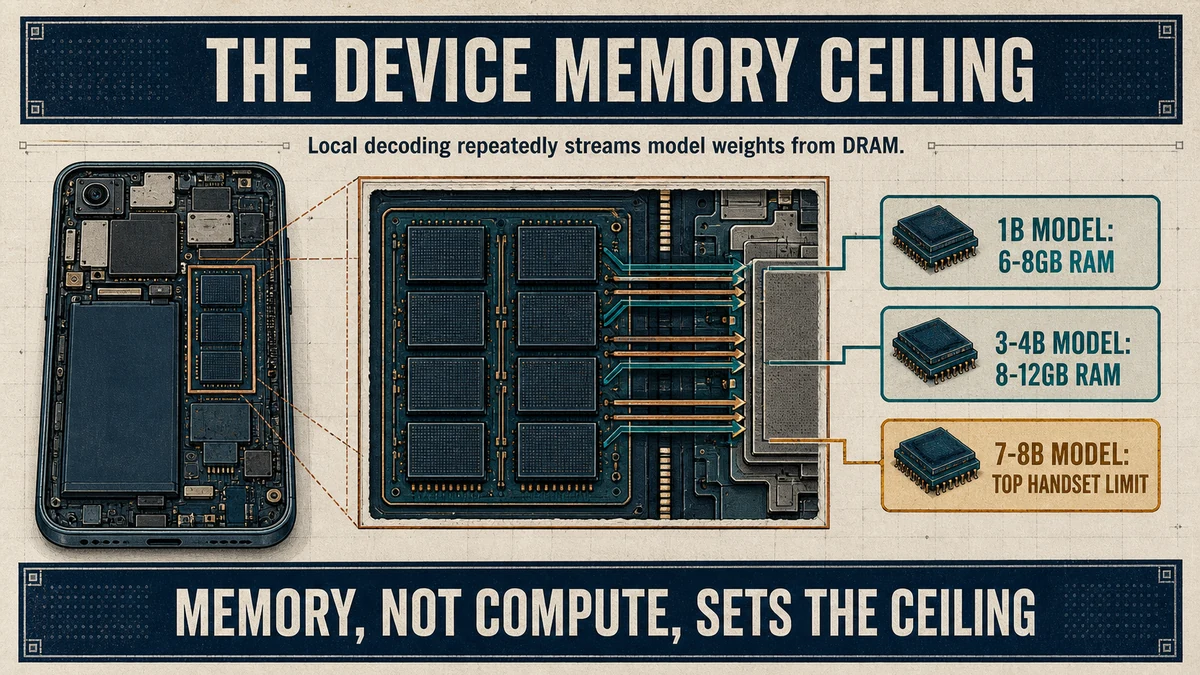
The practical tiers in the supplied baseline make the constraint visible. A 1-billion-parameter model fits on a phone with 6-8GB of RAM. A 3-4B model is better suited to an 8-12GB flagship. A 7-8B model pushes the best handsets toward their limit. The operating system and background applications can consume 2-4GB, leaving less than 4GB usable on some devices. Exact requirements vary with model format, quantization, software, and hardware, but the upgrade path remains unambiguous: capable local AI wants both more DRAM and cheaper DRAM.
The shortage therefore squeezes on-device AI without killing it. Small quantized 1-3B models can still run on current phones. The risk is that the memory budget stops growing. If mid-tier configurations stall while cloud models continue expanding, developers must reduce model size, narrow features, support fewer devices, or send more work to the cloud. A data-center allocation decision then shapes how much AI can run privately, offline, and with low latency in the user’s hand.
This is the new bottleneck created by solving the old one. HBM relieves bandwidth pressure inside an AI accelerator, but its wafer appetite raises the cost of LPDDR capacity elsewhere. The edge does not lose because its workload disappears. It loses because the memory needed to expand that workload has a more profitable destination.
Who Captures the Value and Who Carries the Risk
Follow the money and it points at the consumer. Analyst estimates cited by MLQ.ai put memory at more than 40% of a smartphone’s component cost. Android Authority reported that the Galaxy S26 and S26+ arrived about $100 more expensive year-on-year, with the RAM shortage cited as a significant contributor. It also reported mobile DRAM moving toward short quarterly contracts near $70 per 12GB instead of inexpensive long-term pricing. These are reporting and analyst estimates, not audited bills of materials for every handset.
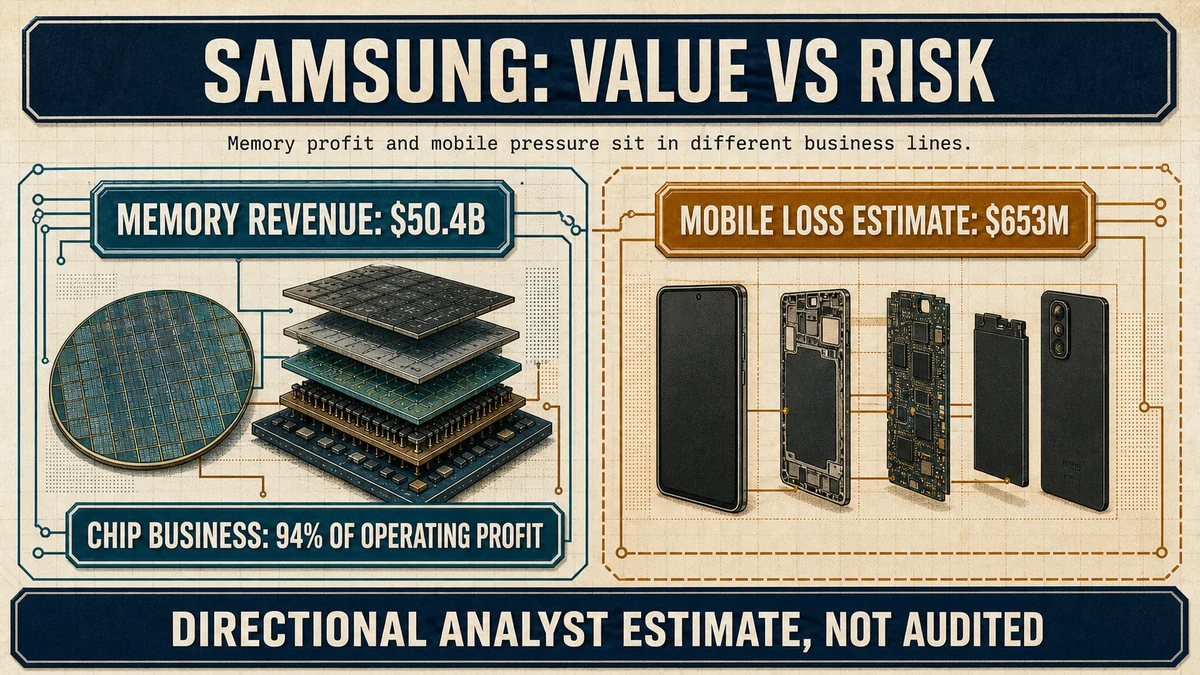
Samsung supplies the cleanest named example because it operates both sides of the squeeze. Counterpoint reported about $50.4 billion in memory revenue for Q1 2026 and described the chip business as contributing roughly 94% of operating profit. Separate media reporting summarized memory profit as rising around 48-50 times year-on-year.
Over the same quarter, figures compiled by MLQ.ai suggested that Samsung’s mobile and appliance profit fell about 40%, that the mobile division may have lost around $653 million because it was buying expensive memory, including memory effectively supplied by another Samsung business, and that an internal warning contemplated the mobile division’s first annual loss. Those figures are directional analyst estimates rather than audited segment disclosures. Even with that limitation, the contrast shows where value was accumulating: the memory supplier captured scarcity economics while the device business carried the bill-of-materials and pricing risk.
The exposure extends beyond phones. Automakers and industrial-electronics producers rely on legacy DDR4 and LPDDR4 products that suppliers have incentives to retire as they prioritize HBM and DDR5. Long product lives and slow redesign cycles make rapid substitution difficult. Qualification becomes part of the bottleneck because changing a memory component can require engineering work, validation, and customer approval even when an alternative part is technically available. These buyers carry both price risk and the schedule risk of redesign.
PC and server OEMs face DDR5 inflation and must absorb it in margin or pass it to buyers. On-device-AI software teams face a different cost: a smaller addressable base for memory-hungry local models. Consumers finally carry higher prices, slower base-RAM growth, or greater dependence on cloud inference. Memory suppliers own much of the near-term value. Device vendors and software teams own the risk that higher costs weaken demand, delay local-AI features, or shift inference toward someone else’s data center.
What Could Break the Constraint
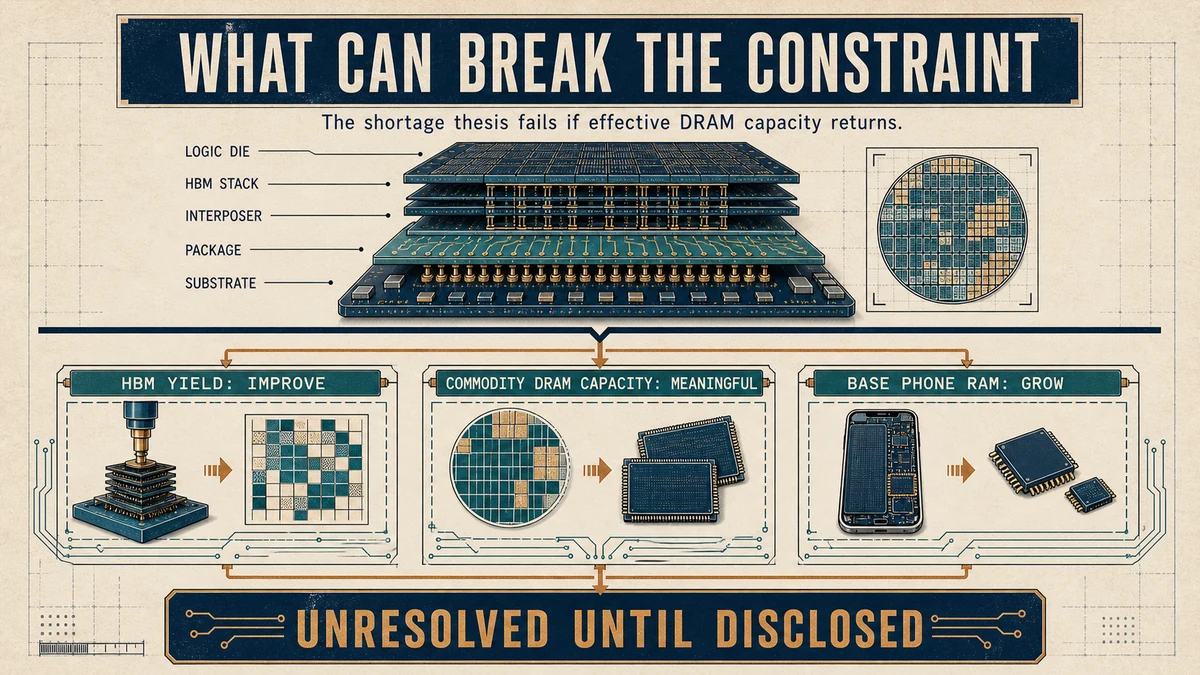
The shortage is not confirmed permanent. A substantial 2028 capacity response from Samsung, SK hynix, and Micron could loosen conventional DRAM supply. Better HBM yields could also reduce wafer input per usable bit and return effective capacity without a new fab. The strongest counterargument is that the market may be treating a 2026 constraint as permanent before the 2028 supply response is known.
On-device AI also retains advantages that memory price alone cannot erase. Latency, privacy, and offline operation continue to favor local execution. Cloud inference is winning on the memory-cost axis in this argument, not settling the entire deployment question.
Four signals can test the thesis. First is HBM’s wafer-input share against TrendForce’s roughly 22% path for late 2026 and 30% for late 2027. A faster rise would keep commodity products starved. A plateau paired with improving yield would ease the squeeze. Second is base RAM in the 2027 flagship and mid-range phone cycles. Holding at 12GB instead of moving toward 16GB would make the local-AI ceiling visible.
Third is Samsung’s mobile operating result. An annual mobile loss alongside record memory profit would strengthen the internal-cannibalization interpretation. Fourth is whether suppliers announce meaningful commodity-DRAM capacity rather than more AI-memory investment. Greenfield DDR5 capacity, rather than another Micron-style investment aimed at AI memory, would be the first hard evidence against the structural-shortage reading.
Memory has quietly become AI’s second hard constraint after power. Unlike a data-center power queue, it cannot be solved through permitting when supply is concentrated among three manufacturers and HBM stacking imposes a physical wafer penalty. The number to watch is not the RAM price on a spec sheet but the base memory in next year’s mid-range phone. As long as cheap DRAM bends toward the data center, the AI in the user’s hand will keep losing ground to the AI in someone else’s building, and the reallocation of a commodity wafer will quietly decide where the next wave of AI lives.
This article is for informational and educational purposes only and does not constitute investment, financial, or legal advice.
Sources
- trendforce.com — HBM share of DRAM wafer input (~18/~22/~30% for 2025/26/27) and ~9% bit share; tight supply (2026-06-02)
- trendforce.com — Samsung seeking up to 20% Q3 2026 DRAM hike, LPDDR possibly higher; Q1/Q2 QoQ moves; ~340% cumulative (2026-07-03)
- spglobal.com — AI memory boom squeezes legacy DRAM; structural through 2027; hyperscaler priority; capex-response caveat (2026-01)
- androidauthority.com — Mobile DRAM third in priority; Galaxy S26 ~$100 increase; ~$70/12GB; short quarterly contracts (2026)
View all sources
- finance.yahoo.com — Micron ~16 take-or-pay long-term agreements reaching beyond 2027 (2026)
- tech-insider.org — HBM consumes ~3-4x the wafer capacity of standard DDR5 per unit (2026)
- v-chandra.github.io — On-device LLM memory constraints; decode is memory-bound; usable RAM under ~4GB after OS (2026)
- localaimaster.com — Model-size-to-RAM tiers (1B on 6-8GB, 3-4B on 8-12GB, 7-8B at flagship limit) (2026)
- mlq.ai — Memory >40% of device cost; ~$653M mobile-division loss estimate; first annual loss warning (2026)
- counterpointresearch.com — Samsung Q1 2026 memory revenue $50.4B record; chip division ~94% of operating profit (2026)
- techpowerup.com — Samsung Q1 2026 memory profit up ~48-50x YoY; 2027 shortage warning (2026)