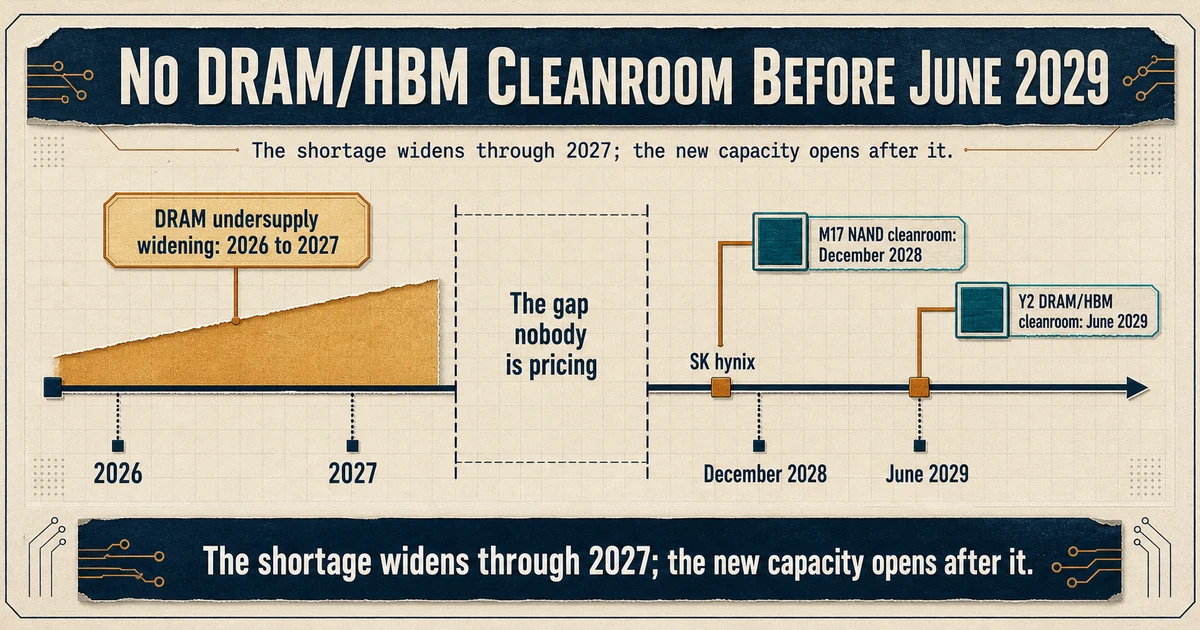
The DRAM capacity timeline SK hynix wrote into its own investor materials this month has two dates in it, and neither is this year. December 2028 is when the first of its two newly approved fabs opens a cleanroom. June 2029 is when the second one does – and that second fab, not the first, is the one that actually makes DRAM and HBM. A market reading SK hynix's $38.1 billion approval as the start of relief from the AI memory shortage skipped the part where the company said, in its own release, when the doors actually open.
Two Dates Before the Dollar Figure
On August 7, 2026, SK hynix's board approved roughly 54 trillion won – about $38.1 billion – split between two new fabs. Yongin's "Y2" gets 35.2 trillion won and is designated for HBM and other next-generation DRAM; Cheongju's "M17" gets 19.1 trillion won and is designated for NAND, according to SK hynix's own newsroom release. Both sit inside a longer buildout the company announced in June: 600 trillion won earmarked for the Yongin cluster over time, plus another 100 trillion won for Cheongju.
Construction on the two fabs does not start at the same time, and neither opens on the same schedule. M17 breaks ground in February 2027 and targets its first cleanroom in December 2028. Y2 breaks ground five months later, in July 2027, and targets its first cleanroom in June 2029. SK hynix's release is explicit that equipment installation follows cleanroom completion, sequenced to demand rather than pre-loaded – meaning even these two dates describe when the buildings are ready, not when a customer receives a qualified wafer.
Markets read the headline number as relief arriving. SK hynix's own construction calendar says otherwise: the fab built to make the product AI accelerators actually need does not open its doors until three calendar years from the vote that funded it.
The Fab That Opens First Isn't the One AI Needs
| SK hynix Yongin Y2 (DRAM/HBM) | SK hynix Cheongju M17 (NAND) | Micron Clay, NY | |
|---|---|---|---|
| Board approval | 2026-08, $38.1bn total (KRW 54tn) | same approval | – |
| Groundbreaking | 2027-07 | 2027-02, five months earlier | 2026-01, complete |
| First cleanroom | 2029-06 | 2028-12 | not stated |
| Approval to cleanroom | 34 months | 29 months | – |
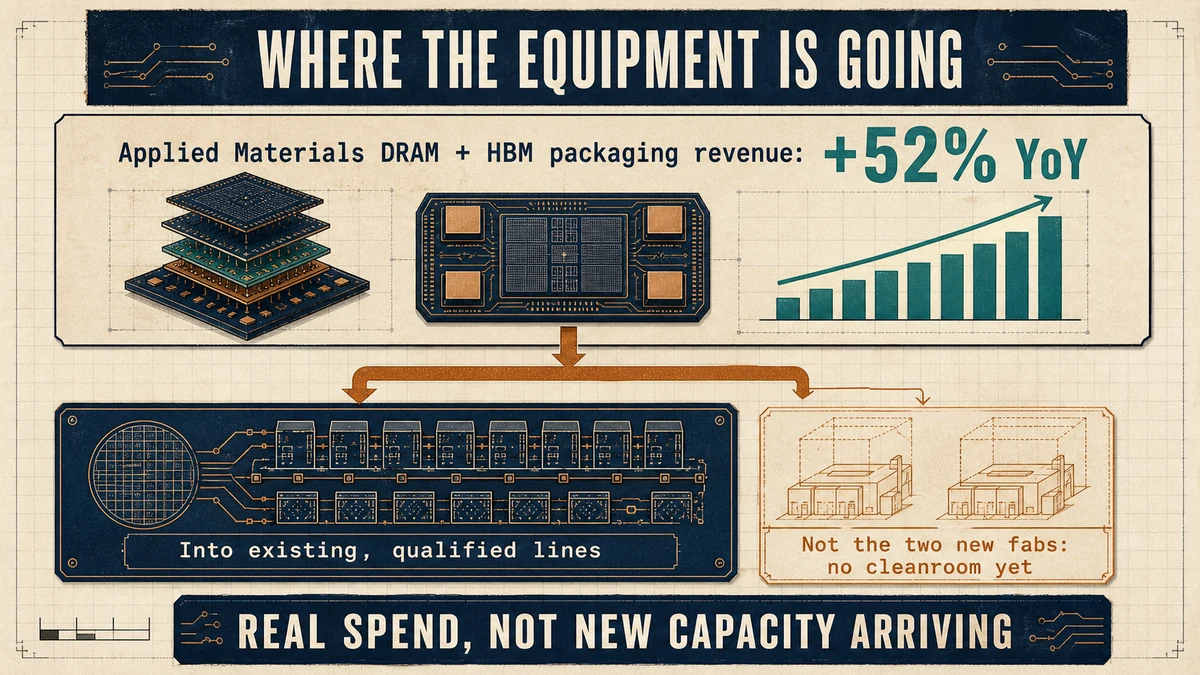
Applied Materials' DRAM revenue, which includes HBM packaging, grew 52% year over year in its fiscal Q3 2026. Equipment is moving now, against a cleanroom that does not open until the middle of 2029.
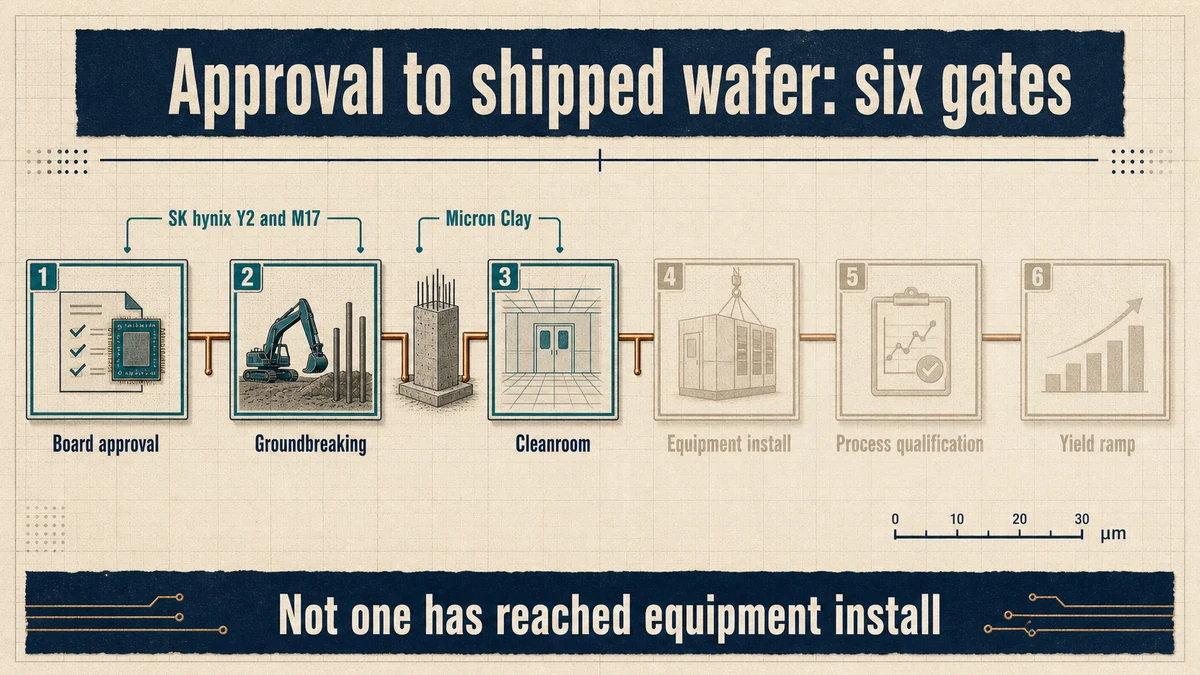
A memory fab does not move from capital approval to shipping wafers in one motion. It passes through a sequence: board approval, groundbreaking, cleanroom construction, equipment installation, process qualification, yield ramp, and only then does a customer see the volume a headline dollar figure implied. Each step is measured in quarters, and SK hynix's own release confirms equipment goes in only after the cleanroom is ready, timed "in line with demand trends" rather than pre-staged – so a cleanroom-opening date is the floor of the wait, not the ceiling.
SK hynix's own calendar puts the NAND fab through that sequence roughly five months ahead of the DRAM/HBM fab at every stage: groundbreaking in February 2027 versus July 2027, cleanroom in December 2028 versus June 2029. The company's release does not explain why NAND was sequenced first – that reasoning isn't public, and this piece does not guess at it. What is confirmed is the effect: the faster of the two projects makes the product category least connected to the AI shortage driving the investment in the first place.
A reader tracking the $38.1 billion approval as "AI memory relief" is, for the first year and a half of visible progress, watching a NAND fab rise.
Micron Is Already a Step Ahead of Its Own Money – And Still Years Out
Micron is running a similar calendar on a different continent, and it started earlier. On July 9, 2026, the company raised its total planned US investment to more than $250 billion through 2035 – up from $200 billion a year earlier – and marked "first concrete" at its Clay, New York site, more than a quarter ahead of the original schedule, according to Micron's investor relations release. That is genuine progress: the site broke ground in January 2026, and by July it had moved from site preparation into what Micron itself calls "transitioning to vertical construction".
It is also, on the same multi-gate scale SK hynix's release implies, still years from a qualified wafer.
The same day, Micron routed a separate $3 billion toward a different link in the chain entirely: $500 million in financing to GlobalWafers' 300mm raw-silicon-wafer plant in Sherman, Texas, plus a 10-year supply agreement giving Micron locked-in access to the wafers its fabs will eventually need. That deal doesn't add a single unit of fab capacity – it secures an input two steps upstream of the fab, the way an automaker might lock in steel years before a new plant opens.
The ripple from moves like this reaches equipment makers building tools for cleanrooms that don't exist yet, construction and engineering firms staffing multi-year builds in upstate New York and central Texas, and – further downstream – the PC, phone and AI-server makers who are the ones actually paying today's DRAM price while all of this gets poured, wired and qualified.
The Gap Nobody Is Pricing
Set these dated milestones against the industry's own demand model and the gap sharpens. DRAM undersupply is forecast to widen from a high-single-digit percentage in 2026 to a low-to-mid-teens percentage in 2027 – the shortage gets worse, not better, through the entire year in which neither SK hynix's nor Micron's new large-node projects reach a cleanroom, let alone ship a qualified wafer. No single source states the two curves together, but laid side by side they don't overlap: the demand-shortfall window closes before the supply-timeline window even opens.
The strongest case against that reading is sitting in Applied Materials' own numbers. In its fiscal third quarter, DRAM revenue – including HBM packaging tools – grew 52% year-over-year to a record level, and the company now expects overall packaging revenue to grow more than 70% in calendar 2026, up from a prior guide above 50%, per Applied Materials' Q3 FY2026 results. That looks like capacity arriving faster than a multi-year fab calendar suggests. It mostly isn't.
Equipment orders at that scale flow overwhelmingly into qualifying and expanding lines that already exist and are already running – cleanrooms SK hynix or Micron built years ago, not the two greenfield projects named this week. Applied Materials' guidance is a real, measurable signal that the industry is investing harder than it was six months ago. It is not evidence that the specific new capacity announced this month arrives on any schedule faster than the two companies themselves have stated.
What the Money Actually Buys, Compared to What CXMT Sold
This is the same distinction this desk drew at the end of July about China's newest DRAM entrant: CXMT's record IPO bought wafer-start capacity approaching Micron's own, but capacity is not competitive bit supply, and the cash landed where the shortage wasn't. SK hynix and Micron's capital this month makes the same category error look different only because it's coming from the incumbents instead of the challenger. A board vote and a construction schedule are not the same asset as a qualified, shipping wafer, no matter which company writes the check.
It also sharpens a thesis this desk has tracked on the demand side: that AI inference, pushed out of HBM by cost and packaging constraints, is rationing LPDDR5X too. That piece established the squeeze was spreading down through price tiers. This one adds the missing other half – a dated floor on how long the squeeze lasts even in the best case. SK hynix's own calendar says June 2029 for the fab that matters; nothing published this month moves that date earlier.
It's the same pattern this desk has tracked in the AI capex cash-conversion test, where announced capital and delivered capacity turn out to be different quantities measured on different clocks – here, the clock runs on concrete and cleanrooms instead of gigawatts and grid interconnects, but the lesson transfers directly: a dollar figure in a press release is the start of a multi-year calendar, not a substitute for it.
Who Owns the Wait
There is a live dispute over why supply stayed this tight in the first place. On June 25, 2026, seventeen plaintiffs sued Samsung, SK hynix and Micron – who together hold roughly 90% of the global DRAM market – in the US District Court for the Northern District of California, alleging the companies coordinated to restrict DRAM supply and used the shift toward HBM as cover to curtail DDR3 and DDR4 production, pushing consumer DRAM prices up by as much as 700% over four years.
Micron has denied the allegations, saying it competes "vigorously, fairly and in compliance with all applicable laws". The claims are unresolved, and this piece takes no position on whether they hold up.
What doesn't depend on that lawsuit's outcome is the calendar. Whether today's tight supply is deliberate restriction or simple physical limits, the fabs that would prove the difference either way don't have cleanrooms yet. Pouring concrete, wiring a cleanroom and qualifying a process are not legal questions, and they set a floor under how long this shortage runs regardless of what a court eventually decides.
For the AI accelerator makers, PC and phone OEMs, and everyone pricing memory into a 2027 or 2028 product roadmap, the figure worth tracking isn't the next investment headline – it's whether SK hynix's Y2 fab breaks ground on schedule in July 2027. If that date slips, June 2029 slips with it, and the gap this article describes gets wider, not narrower.
Sources
- news.skhynix.com — SK hynix board approval amount, Y2/M17 breakdown, groundbreaking and first-cleanroom dates, equipment-sequencing statement (2026-08-07)
- investors.micron.com — Micron's $250B total US investment target, Clay NY first-concrete milestone and construction stage (2026-07-09)
- globenewswire.com — Micron's $3B supply-chain investment, GlobalWafers Sherman TX financing and 10-year wafer supply agreement (2026-07-09)
- globenewswire.com — Applied Materials Q3 FY2026 DRAM revenue growth and advanced-packaging revenue guidance (2026-08-13)
View all sources
- newsletter.semianalysis.com — Industry DRAM undersupply forecast (2026 to 2027), via house evidence ledger (2026-06-23)
- tomshardware.com — DRAM price-fixing class action filing details, allegations, and Micron's response (2026-06-29)
This article is for informational and educational purposes only and does not constitute investment, financial, or legal advice.